Over 100 new sharks and rays classified
September 18, 2008 The Maugean Skate Zearaja maugeana

Enlarge

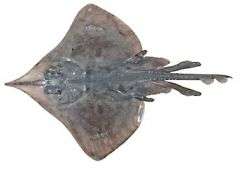
The Maugean Skate Zearaja maugeana, a new species from Bathurst and Macquarie Harbours in Tasmania. Currently listed as Endangered by the IUCN Red List of Threatened Animals. Image: CSIRO

(PhysOrg.com) -- Australian scientists have completed an ambitious 18-month project to name and describe more than 100 new species of sharks and rays.

Conducted by scientists working under the auspices of CSIRO’s Wealth From Oceans National Research Flagship, the project named a third of Australia’s – and about a tenth of the world’s – shark and ray species.

Team leader, CSIRO’s Dr Peter Last, says analysis of DNA sequences was used to clarify the identity of closely related species.

“Additional taxonomic information like this is critical to managing sharks and rays, which reproduce relatively slowly and are extremely vulnerable to over-fishing and other human impacts,” he says. “Their populations are also sensitive to small-scale events and can be an indicator of environmental change.”

CSIRO’s Dr William White says sharks and rays also play a vital ecosystem role as apex predators. “Take them away and what does it mean for the rest of the ecosystem?” Dr White says. “We can’t understand possible implications unless we know what species we’re dealing with.”

The new species include:

-- The endemic, Northern Freshwater Whipray and the Northern River Shark, which grow to over two metres in length, and are among the largest freshwater animals in Australia. Until recently these were confused with similar marine species.
-- The Endangered Maugean Skate which has an extremely narrow distribution. It is closely related Gondwanan ancestor which lived off southern Australia some 80 million years ago, and the present day species clings to life at the south-western tip of Tasmania.
-- A Critically Endangered gulper shark, the Southern Dogfish, which is endemic to the continental slope off southern Australia. It has suffered severe population declines in the past few decades.

More than 90 of the new species were identified but undescribed in the 1994 book; Sharks and Rays of Australia, by Dr Last and CSIRO’s Dr John Stevens. The new names and descriptions will feature in a revised edition of the book in 2009. Specimens of many of the new species are in the Australian National Fish Collection at CSIRO Hobart – the largest collection of preserved sharks and rays in the Southern Hemisphere.

A workshop focusing on the project’s findings will be held at Sydney’s Australian Museum on 22 September during the 2nd Annual Meeting of the Oceania Chondrichthyan Society. Involving some of the world’s leading experts in the field, the WWF-Australia-sponsored workshop also will assess priority areas of future research and management of sharks in Australian waters.

Provided by CSIRO


print this article email this article download pdf blog this article bookmark this article     Stumble it Digg this share on Facebook retweet share on Reddit add to delicious
Rate this story - 3.8 /5 (5 votes)


September 18, 2008 all stories

Comments: 0

3.8 /5 (5 votes)
  • Stumble this up

  • Digg this

  • share this

  • hide
  • Related Stories

  • World interest in Australian fishery impact test
    created Oct 27, 2009 | popularity not rated yet | comments 0
  • Palau creates world's first shark sanctuary
    created Sep 25, 2009 | popularity not rated yet | comments 0
  • Third of open ocean sharks face extinction: study
    created Jun 25, 2009 | popularity not rated yet | comments 0
  • Oldest fossil brain found in Kansas (Videos)
    created Mar 02, 2009 | popularity not rated yet | comments 0
  • Fossil fish shows oldest live birth
    created Feb 25, 2009 | popularity not rated yet | comments 0


Other News

Jellyfish swarm northward in warming world (AP)

Jellyfish swarm northward in warming world

Biology / Ecology

created 10 hours ago | popularity 3.9 / 5 (8) | comments 2

(AP) -- A blood-orange blob the size of a small refrigerator emerged from the dark waters, its venomous tentacles trapped in a fishing net. Within minutes, hundreds more were being hauled up, a pulsating ...


Federal agencies not taking chances to keep carp from invading Great Lakes

Biology / Ecology

created 13 hours ago | popularity not rated yet | comments 0

A group of federal agencies criticized in the past for failing to move quickly to stop Asian carp from entering the Great Lakes announced Friday that they're taking every precaution to keep them out, even poisoning thousands ...


Salmon migration mystery explored on Idaho's Clearwater River

Salmon migration mystery explored on Idaho's Clearwater River

Biology / Ecology

created 16 hours ago | popularity not rated yet | comments 0

(PhysOrg.com) -- Temperature differences and slow-moving water at the confluence of the Clearwater and Snake rivers in Idaho might delay the migration of threatened juvenile salmon and allow them to grow larger ...


Ancient penguin DNA raises doubts about accuracy of genetic dating techniques

Ancient penguin DNA raises doubts about accuracy of genetic dating techniques

Biology / Evolution

created Nov 10, 2009 | popularity 4.7 / 5 (23) | comments 13

Penguins that died 44,000 years ago in Antarctica have provided extraordinary frozen DNA samples that challenge the accuracy of traditional genetic aging measurements, and suggest those approaches have been ...


Rasberry crazy ant

Rapacious Rasberry ants march north

Biology / Plants & Animals

created Nov 13, 2009 | popularity 4.3 / 5 (7) | comments 10

Poor Texas. First it was killer bees, then fire ants. Now, it's the Rasberry ants.