Scientists find 'redesigned hammer' that forged evolution of pregnancy in mammals
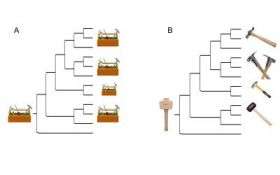
Yale researchers have shown that the origin and evolution of the placenta and uterus in mammals is associated with evolutionary changes in a single regulatory protein, according to a report in Proceedings of the National Academy of Sciences.
"Many past studies have shown that genes are regulated and altered by changes within their own structures. This is the first work suggesting that the evolution of transcription factors — separate regulatory proteins — may play an active role in the origin and evolution of structural innovations like the placenta and uterus," said senior author Gunter Wagner, the Alison Richard Professor of Ecology & Evolutionary Biology at Yale.
Pregnancy is a biologically unusual situation where one organism lives and develops inside another that is genetically different. Ordinarily, the immune system identifies and destroys the dissimilar tissue as if it were a parasite. But in some early mammals, changes 'turned down' the immune system, allowing the developing embryo to grow and thrive unchallenged by the maternal immune response.
With the evolution of the uterus and placenta, it became possible for mammals to protect their growing young and to ensure they were not exposed to an unpredictable environment, like their egg-laying relatives. This study identified one of the genetic switches that tempered the immune system and allowed formation of the placenta and internal development of young.
By analyzing DNA from many species of mammals, including resurrecting genes from the extinct ancestors of mammals, the researchers found that a crucial regulatory link in the evolution of pregnancy involved the altered function of a transcription factor protein, HoxA-11.
The specific change they found in HoxA-11 is present in all known placental mammals — from elephants, the most primitive lineage with a placenta, to humans — but does not exist in marsupials, like opossums or wallabies, where there is a brief and rudimentary pregnancy followed by development of the offspring outside the mother, or in egg-laying mammals like the platypus.
The textbook story is that regulatory proteins, like HoxA-11, are ancient, universal and unchanging tools, and that new functions arise by using an existing tool from the gene regulatory 'toolbox' in a new or different place.
According to Yale graduate student Vincent Lynch, lead author of the study, "We are writing a different chapter. In this case the function of a major regulatory tool was altered — it is like we found a redesigned hammer."
Citation: Proc. Natl. Acad. Sci. (early online September 17, 2008)
Source: Yale University


