Phoenix Images Discarded Heat Shield
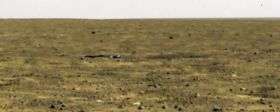
September 18, 2008 Crumpled Heat Shield

Enlarge

Image: NASA/JPL-Caltech/University of Arizona/ Texas A&M Univeristy

(PhysOrg.com) -- A new color high-resolution image from the Phoenix Mars Lander shows its crumpled heat shield about 150 meters away from the spacecraft.

The Phoenix Mars Lander's Surface Stereo Imager took this image of the spacecraft's crumpled heat shield on Sept. 16, 2008, the 111th Martian day of the mission.

The 2-1/2 meter (about 8-1/2 feet) heat shield landed southeast of Phoenix, about halfway between the spacecraft and its backshell/parachute. The backshell/parachute touched ground 300 meters (1,000 ft) to the south of the lander.

The dark area to the right of the heat shield is the "bounce mark" it made on impact with the Red Planet. This image is the highest-resolution image that will likely be taken by the lander, and is part of the 1,500-image "Happily Ever After" panorama.

The Phoenix mission is led by the University of Arizona, Tucson, on behalf of NASA. Project management of the mission is led by NASA's Jet Propulsion Laboratory, Pasadena, Calif. Spacecraft development is by Lockheed Martin Space Systems, Denver.

Provided by NASA


print this article email this article download pdf blog this article bookmark this article     Stumble it Digg this share on Facebook retweet share on Reddit add to delicious
Rate this story - 3.9 /5 (14 votes)


September 18, 2008 all stories

Comments: 0

3.9 /5 (14 votes)
  • Stumble this up

  • Digg this

  • share this

  • hide
  • Related Stories

  • Orbiter's HiRISE Camera Saw Phoenix Heat Shield in Freefall on Landing Day
    created Jul 09, 2008 | popularity not rated yet | comments 0
  • NASA Mars Lander Prepares to Move Arm
    created May 27, 2008 | popularity not rated yet | comments 0
  • Intense Testing Paved Phoenix Road to Mars
    created May 12, 2008 | popularity not rated yet | comments 0
  • Spacecraft at Mars Prepare to Welcome New Kid on the Block
    created Feb 28, 2008 | popularity not rated yet | comments 0
  • NASA Readies Mars Lander for August Launch to Icy Site
    created Jul 09, 2007 | popularity not rated yet | comments 0


  • hide
  • Relevant PhysicsForums posts

Other News

Greenland ice cap melting faster than ever

Greenland ice cap melting faster than ever

Space & Earth / Earth Sciences

created 26 minutes ago | popularity 3 / 5 (2) | comments 0

Satellite observations and a state-of-the art regional atmospheric model have independently confirmed that the Greenland ice sheet is loosing mass at an accelerating rate, reports a new study in Science.


2 Earth-sized bodies with oxygen rich atmospheres found -- but they're stars not planets

Two Earth-sized bodies with oxygen rich atmospheres found -- but they're stars not planets

Space & Earth / Astronomy

created 21 minutes ago | popularity 5 / 5 (2) | comments 0

Astrophysicists at the University of Warwick and Kiel University have discovered two earth sized bodies with oxygen rich atmospheres - however there is a bit of a disappointing snag for anyone looking for ...


Record high temperatures far outpace record lows across US

Record high temperatures far outpace record lows across US (w/ Video)

Space & Earth / Earth Sciences

created 1hour ago | popularity 1.8 / 5 (5) | comments 1

Spurred by a warming climate, daily record high temperatures occurred twice as often as record lows over the last decade across the continental United States, new research shows. The ratio of record highs ...


A faraway planet intrigues: Exoplanet with extremely tilted orbit raises new interest in stellar astronomy

A faraway planet intrigues: Exoplanet with extremely tilted orbit raises new interest in stellar astronomy

Space & Earth / Astronomy

created 7 hours ago | popularity 4.9 / 5 (7) | comments 5

(PhysOrg.com) -- Two teams of astronomers have found a planet outside the solar system that might be orbiting backwards compared to its star's rotation, a discovery that could shed light on how unique the ...


A glimpse at the Earth's crust deep below the Atlantic

A glimpse at the Earth's crust deep below the Atlantic

Space & Earth / Earth Sciences

created 4 hours ago | popularity 5 / 5 (1) | comments 0

Long-term variations in volcanism help explain the birth, evolution and death of striking geological features called oceanic core complexes on the ocean floor, says geologist Dr Bram Murton of the National ...