Girders Get the Green Light
September 18, 2008 Girders Get the Green Light

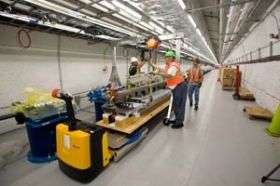
Workers position the undulator girder next to the support pedestals using an electric pallet jack. Photo by Brad Plummer.

(PhysOrg.com) -- The temperature is now stabilized at a mild 68 °F (20 °C), support pedestals are in place and aligned, the paint is dry and physicists are moving in. That's the scene in the Linac Coherent Light Source Undulator Hall, where the last items on the civil construction punch list are being checked off. Last week, after extensive monitoring and testing of the air handling system, workers began moving in crates containing the heavy, precision-aligned steel girders that will support the LCLS undulators.

"It's a pretty big milestone, getting these things in here," said Mike Zurawel, SLAC area manager for the Undulator Hall.

Girder installation marks the latest step toward completion of the LCLS construction project, which began in 2006. Situated inside a tunnel leading from SLAC's Research Yard, the 300-foot long, climate-controlled Undulator Hall will house arrays of magnets used to produce X-rays from a beam of accelerated electrons. The undulator magnets will rest atop the 33 specially designed girders now being installed.

The girder assemblies are more than sturdy mounting stands for the undulators. Designed and built by collaborators at Argonne National Laboratory, the girders also support the vacuum chamber that carries the electron and X-ray beams, as well as the adjacent quadrupole steering magnets, diagnostic equipment and a sophisticated leveling system to monitor the position of the girder assemblies.

Crates housing the six-foot, 2,600-pound girders are unwieldy to maneuver, but SLAC's Mechanical Fabrication department simplified the problem with a custom-built swivel plate and wheeled dolly system. The swivel plate couples with an electric pallet jack positioned under one end of the eight-foot crate, with the aluminum dolly placed beneath the other end. The system enables workers to move the crates through a tight maze of shielding corridors leading into the Undulator Hall. Once the crate is in position, workers use a hand-operated gantry crane to hoist the girder into place atop the support pedestals.

As next steps, another team will install and adjust the girders in preparation for undulator magnet installation, which should begin early next year.

Provided by SLAC, by Brad Plummer


print this article email this article download pdf blog this article bookmark this article     Stumble it Digg this share on Facebook retweet share on Reddit add to delicious
Rate this story - 3.8 /5 (6 votes)


September 18, 2008 all stories

Comments: 0

3.8 /5 (6 votes)
  • Stumble this up

  • Digg this

  • share this

  • hide
  • Related Stories

  • Atomic-level Snapshot Catches Protein Motor in Action (w/ Video)
    created Nov 20, 2009 | popularity not rated yet | comments 0
  • Tapering a Free-Electron Laser to Extract More Juice
    created Nov 20, 2009 | popularity not rated yet | comments 0
  • World's First Hard X-ray Laser Achieves 'First Light'
    created Apr 21, 2009 | popularity not rated yet | comments 0
  • Free Electron Lasers and You: An LCLS Primer
    created Dec 05, 2008 | popularity not rated yet | comments 0
  • Mother of Pearl Secret Revealed
    created Nov 27, 2008 | popularity not rated yet | comments 0


  • hide
  • Relevant PhysicsForums posts

  • Nikola Tesla's Dynamic Theory of Gravity
    created 2 hours ago
  • Electron carrier
    created 3 hours ago
  • eight short questions, but very important to me
    created 3 hours ago
  • Laws of Physics vs. Laws of Nature
    created 4 hours ago
  • More from Physics Forums - General Physics

Other News

Marohn describes breakthrough imaging technology

Researchers are on the path to creating nano-MRI images

Physics / General Physics

created 2 hours ago | popularity 4.5 / 5 (2) | comments 1

(PhysOrg.com) -- Cornell researchers are devising methods to detect the magnetic fields of individual electrons and atomic nuclei, which they hope to use to make a nanoscale version of magnetic resonance imaging.


More precise measurements of the W boson

Physics / General Physics

created 23 hours ago | popularity 4.3 / 5 (13) | comments 2

(PhysOrg.com) -- "The W boson is one of the very few major building blocks of matter," Dmitri Denisov tells PhysOrg.com. "It is a member of a family of particles that is the most fundamental in nature. The W boson is res ...


Physicists propose quantum entanglement for motion of microscopic objects

Physics / Quantum Physics

created 15 hours ago | popularity 4.1 / 5 (9) | comments 8

Researchers at the California Institute of Technology (Caltech) have proposed a new paradigm that should allow scientists to observe quantum behavior in small mechanical systems.


Swimming Bacteria Could Become Model for Micromachines

Swimming Bacteria Could Become Model for Micromachines

Physics / General Physics

created 13 hours ago | popularity not rated yet | comments 0

(PhysOrg.com) -- UConn researchers say Spiroplasma's propulsion style is optimal for converting energy into motion.


Proposed Spacetime Structure Could Provide Hints for Quantum Gravity Theory

Proposed Spacetime Structure Could Provide Hints for Quantum Gravity Theory

Physics / Quantum Physics

created Dec 16, 2009 | popularity 4.6 / 5 (53) | comments 15

(PhysOrg.com) -- Spacetime, which consists of three dimensions of space and one time dimension, is such a large, abstract concept that scientists have a very difficult time understanding and defining it. Moreover, ...