Future looks bright for interferometry
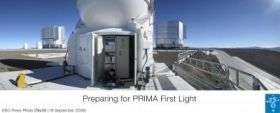
September 19, 2008 Preparing for PRIMA First Light

Enlarge

ESO Staff member Nicola Di Lieto braves the stiff winds of the Paranal summit to perform some system upgrades on the Auxiliary Telescope number 4 in support of the PRIMA installation. Credit: ESO

The PRIMA instrument of the ESO Very Large Telescope Interferometer (VLTI) recently saw "first light" at its new home atop Cerro Paranal in Chile. When fully operational, PRIMA will boost the capabilities of the VLTI to see sources much fainter than any previous interferometers, and enable astrometric precision unmatched by any other existing astronomical facility. PRIMA will be a unique tool for the detection of exoplanets.

"PRIMA is specifically designed to see if one star 'wobbles' to and fro because it is has unseen planetary companions", says instrument scientist Gerard van Belle. "This allows us to not only detect exoplanets, but to measure their mass." PRIMA's expected astrometric precision of tens of micro-arcseconds is unmatched by any other existing astronomical facility, whether on the ground or in orbit. In addition to taking astrometric measurements PRIMA will be the key to the imaging of faint sources with the VLTI using the science instruments AMBER and MIDI.

Interferometry combines the light received by two or more telescopes, concentrating on tiny differences between the signals to measure angles with exquisite precision. Using this technique PRIMA can pick out details as sharply as a single telescope with a diameter equivalent to the largest distance between the telescopes. For the VLTI, the distance between the two telescope elements is about 200 metres.

The PRIMA instrument is unique amongst the VLTI instruments, in that it is effectively two interferometers in one. PRIMA will take data from two sources on the sky simultaneously: the brighter source can be used for tracking, allowing the interferometer to "stare" at the fainter source for longer than is now possible with conventional interferometers. Although there have been earlier pathfinder experiments to test this technique, PRIMA represents the first facility-class instrument of its kind that is open to all astronomers.

PRIMA parts arrived at the summit at Paranal at the end of July and were integrated and tested during the following month. On 2 September 2008, as a first milestone, starlight from two VLTI 1.8-m Auxiliary Telescopes was fed into the PRIMA system, and interference fringes were detected on PRIMA's Fringe Sensor Unit. Three days later the system was routinely using active tracking on the fringes, compensating for atmospheric turbulence.

First light - or, in the case of interferometric instruments, first fringes - actually occurred ahead of the ambitious schedule set out by lead engineer Francoise Delplancke: "There were many activities that all had to be successful simultaneously for this to happen, but the assembly, integration, and verification went smoothly - I was pleased by how easy and reliable the fringe tracking was, for our first try."

All PRIMA sub-systems have been installed successfully for use with two Auxiliary Telescopes and will now be submitted to intensive commissioning tests before being offered to the community of users for routine observations.

Source: ESO


print this article email this article download pdf blog this article bookmark this article     Stumble it Digg this share on Facebook retweet share on Reddit add to delicious
Rate this story - 4.6 /5 (5 votes)


September 19, 2008 all stories

Comments: 0

4.6 /5 (5 votes)
  • Stumble this up

  • Digg this

  • share this

  • hide
  • Related Stories

  • Inside the First Bird, Surprising Signs of a Dinosaur
    created Oct 08, 2009 | popularity not rated yet | comments 0
  • SAfricans begin removing bodies of beached whales
    created May 31, 2009 | popularity not rated yet | comments 0
  • New research on the 'guardian of the genome'
    created May 12, 2009 | popularity not rated yet | comments 0
  • Breast cancer drug shows promise for treating, preventing progestin-dependent tumors
    created Jan 28, 2009 | popularity not rated yet | comments 0
  • Astronomers discover upper mass limit for black holes
    created Sep 11, 2008 | popularity not rated yet | comments 0


  • hide
  • Relevant PhysicsForums posts

  • Some help with a X-Ray astronomy question please!
    created 19 hours ago
  • Help with Images and Optical Instrument Question..
    created Nov 26, 2009
  • Redshift as a distance indicator
    created Nov 26, 2009
  • Question about 2-body gravity
    created Nov 24, 2009
  • More from Physics Forums - General Astronomy

Other News

Fermi Telescope Peers Deep into Microquasar

Fermi Telescope Peers Deep into Microquasar (w/ Video)

Space & Earth / Astronomy

created 12 hours ago | popularity 4.5 / 5 (6) | comments 0

(PhysOrg.com) -- NASA's Fermi Gamma-ray Space Telescope has made the first unambiguous detection of high-energy gamma-rays from an enigmatic binary system known as Cygnus X-3. The system pairs a hot, massive ...


The Energy Sources of Ultraluminous Galaxies

The Energy Sources of Ultraluminous Galaxies

Space & Earth / Astronomy

created 13 hours ago | popularity 4.4 / 5 (10) | comments 1

(PhysOrg.com) -- Ultraluminous infrared galaxies ((ULIRGs) are galaxies whose luminosity exceeds that of a trillion suns; for comparison, the Milky Way galaxy has a typical (and much more modest) luminosity ...


Space shuttle Atlantis, 7 astronauts back on Earth (AP)

Space shuttle Atlantis, 7 astronauts back on Earth

Space & Earth / Space Exploration

created 14 hours ago | popularity not rated yet | comments 0

(AP) -- Space shuttle Atlantis and its seven astronauts returned to Earth with a smooth touchdown Friday to end an 11-day flight that resupplied the International Space Station.


New climate targets may not change daily life much (AP)

New climate targets may not change daily life much

Space & Earth / Environment

created 17 hours ago | popularity 3.8 / 5 (10) | comments 3

(AP) -- Americans' day-to-day lives won't change noticeably if President Barack Obama achieves his newly announced goal of slashing carbon dioxide pollution by one-sixth in the next decade, experts say.


China is set to launch its second moon orbiter next October, state media have reported

China to launch second lunar probe: state media

Space & Earth / Space Exploration

created 18 hours ago | popularity 5 / 5 (4) | comments 0

China will launch its second moon orbiter next October, state media reported Friday, as it powers ahead with a space programme that has sparked concerns abroad.