September 19, 2008 feature
A broadband single-photon source
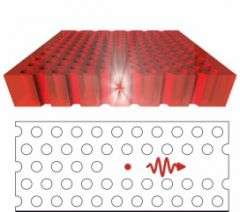
As science makes progress toward practical quantum computing, improved quantum cryptography and scalable quantum communications systems, single photon sources will become more important. Until now, though, efficient solid-state single photon sources are hard to come by. “The standard procedure,” Peter Lodahl tells PhysOrg.com, “has been to put a quantum dot in a photonic crystal cavity.”
Lodahl, a physicist at DTU Fotonik, Technical University of Denmark in Lyngby, explains that the conventional cavity setup does produce single photons. However, the drawback is the narrow bandwidth that accompanies such cavities. “The cavity linewidth is very narrow, and this significantly limits the applicability of the device since very precise positioning and tuning of the quantum dot relative to the cavity is required,” he says. “Furthermore, the photon subsequently needs to be coupled out of the cavity to be useful for quantum communication purposes.”
Lodahl and his team at the Technical University of Denmark have taken a step toward a broad bandwidth, high-efficiency, single photon source for quantum communications purposes. The group also includes scientists from Würzburg University in Germany. The team has coupled a quantum dot to a photonic crystal waveguide, rather than relying on cavities. The results of their experiment can be found in Physical Review Letters: “Experimental Realization of Highly Efficient Broadband Coupling of Single Quantum Dots to a Photonic Crystal Waveguide,” by Toke Lund-Hansen et al.
“The quantum dots are embedded in a photonic crystal waveguide,” Lodahl explains. “A quantum dot is excited and emits a single photon, which is coupled into the waveguide with high efficiency. Then we get one single photon from the quantum dot propagating in the single mode of the waveguide.” Re-exciting the quantum dot, he says, allows for the single photon source to produce one photon after the other.
Lodahl says that the broadband effect is a unique property of photonic crystal waveguides. “We can engineer it, for example, by controlling the distance between the holes that the photonic crystal is made of.” He also points out that the resulting scattering of the light on the holes means that light propagating in the waveguide is slowed down. “Slow light propagation is a key to getting the strong coupling between the quantum dots and the photonic crystal waveguide.”
A single photon source is thought to have a variety of applications in terms of practical quantum applications. Lodahl’s team is particularly interested in creating on-chip single photon sources. This would make them more usable in the realm of solid-state quantum information processing or quantum computing.
While advancing solid-state quantum information is interesting to Lodahl, he cautions that this is a just a first step. There is still a way to go before the process can be put into practice. “This is just the first experiment,” he says, “the first demonstration that this setup is possible, and that single photons can be extracted efficiently this way.” He points out that there is still much to learn and explore. “We want to study the properties of the photons emitted from the waveguide, especially their coherence.” Lodahl also believes that through further experiments it should be possible to improve upon the design. “This new, efficient single photon source could be improved further, making it very promising for quantum information and quantum computing applications.”
For more on this project, visit www.fotonik.dtu.dk/quantumphotonics .
Copyright 2007 PhysOrg.com.
All rights reserved. This material may not be published, broadcast, rewritten or redistributed in whole or part without the express written permission of PhysOrg.com.


