Taming Europe’s robots (Robot Special part 1)
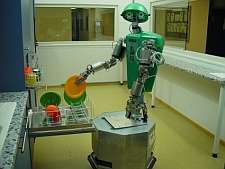
(PhysOrg.com) -- Europe is the world leader for industrial robotics, but its leading corporations and research institute’s need to co-operate more closely to ensure that the continent also leads the world in future robotic applications in the home. One European network paved the way forward.
Europe’s robotics manufacturers lead the world for industrial applications. Meanwhile, the continent’s research institutes and universities are producing some of the most innovative, forward-looking and pioneering research in the world.
But the true potential of European robotics remains unrealised because technology transfer from the academic researchers to the industrial producers is not sufficiently robust.
It is a vital issue, because many analysts believe that robotics could become perhaps even more ubiquitous than PCs by 2025, with some predicting a robot in every house.
“When you see people like Bill Gates investing in robotics you realise that the market potential is huge,” emphasises Bruno Siciliano, chair for dissemination of the EURON network of excellence.
Europe’s robot manufacturers and researchers need to get to know each other better. And Europe needs to develop its potential in domestic robot markets if it is to maintain and extend its global leadership in the sector.
Adopting robots
EURON, the European Robotics Network, aims to strengthen links both between individual labs and between labs and industry, and thus broaden the industrial base in the continent’s robotics sector.
EU-funded EURON sought to strengthen Europe’s academic community, foster technology transfer and identify obstacles and propose possible solutions.
The NoE has been operating for eight years, since early 2001, in two phases. It fulfilled its primary objectives by offering networking opportunities through meetings, a website, online fora and a regular column in the highly regarded Robotics and Automation Magazine of the IEEE.
The meeting has now evolved into EUROS, the European Robotics Symposium. “It is special because it is focused on a single track and it allows for a lot of brainstorming and networking,” explains Siciliano.
Enter the iDroid
The network also established a special technology prize, to highlight particularly strong technology transfer demonstrations. One of the most notable award winners, the iDroid, became something of a publishing phenomenon.
The iDroid was a fully functioning, humanoid robot that consumers could build for themselves, simply by subscribing to a 72-issue ‘part work’ by Italian publisher DiAgostini. A part work is a magazine series that develops into a complete book, or series of books. Each issue offered a new part for the iDroid.
The magazine was a huge seller, particularly in Japan. “In Japan, which currently leads the world in domestic robots, people are very comfortable with robots that look and act like people, or dogs or whatever,” notes Siciliano. “But in Europe, people like robots to look like machines,” he suggests.
This was just one of EURON’s many successes. The network also established a fund to enable labs and teams to carry out a feasibility study for specific pieces of research. One very successful example, called PHRIDOM, looked at the potential for research in physical human robot interactions (PHRI).
Making PHRIENDS
Most robots used in European industry are behind a fence for safety, but people have been injured, and even killed, when working on robots during maintenance. PHRIDOM looked at the potential for a solution. Its work was so successful it became a standalone IST project, called PHRIENDS (see feature ‘Real-life robots obey Asimov’s laws’).
EURON also identified two obstacles to closer co-operation between labs and companies wishing to undertake a research project, namely investment and trust.
“It can take three person months to prepare a project proposal that has just a 15% chance of success,” reveals Siciliano. “SMEs and systems integrators in the industry cannot afford to dedicate personnel to that.”
“Similarly, many of Europe’s leading companies are wary of investing money and personnel in unusual, sometimes even seemingly crazy research. Anything that looks beyond or outside their five-year roadmap has little chance of backing.”
The issue of trust is, perhaps, even more of an obstacle. Technical solutions to some robotics problems are a focus of intense competition between manufacturers. As such, the technical breakthroughs represent an enormous commercial advantage, and some manufacturers simply will not give research partners access to special technology.
EURON has gone a long way towards tackling these issues, and the work and discussions are ongoing.
EURON’s influence will continue beyond the life of the project, which ended in May 2008. Its meeting, EUROS, will continue, as too the links between labs, and between labs and industry. It all means Europe should be better prepared to domesticate its robotics industry in time for the markets of the future.
The EURON NoE received funding from the Fifth and Sixth Framework Programme for research.
This is the first of a four-part special series of features exploring European robotics research, from humanoids friends, to functional home help, to just plain odd-bots.
Provided by ICT Results


