Important Twist in Supercapacitor Research
September 19, 2008
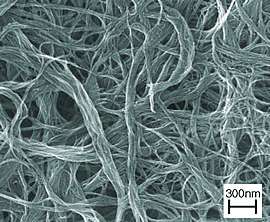
The cover photo from Synthetic Metals shows a scanning electron microscope image of a single-walled carbon nanotube sheet consisting of randomly entangled bundles of carbon nanotubes. Image: University of Texas at Dallas
(PhysOrg.com) -- Car batteries as we know them today may soon be relics. Storing energy in clunky containers with limited shelf lives has plagued car makers and military engineers who need lightweight, powerful and reliable means to crank engines into life, enliven radios and operate other electronic appliances.
But research by post-doctoral Researcher Jiyoung Oh and Research Scientist Mikhail “Mike” Kozlov at UT Dallas’ NanoTech Institute offers tantalizing insights into a new, lightweight, reliable means of delivering power via the mighty supercapacitor. A photograph of a material obtained in their research made the cover of the journal Synthetic Metals along with the published paper, (Synthetic Metals, 158 (2008) 638).
“We were extremely proud to see the scanning electron micrograph of our carbon nanotube sheet on the cover of this research journal,” Kozlov said. “The focus of this journal is on important accomplishments in the field of conductive polymers and molecular electronics.”
Supercapacitors are beefed-up electronic components that can be charged and counted on to store energy reliably for long periods. They deliver power in a smooth, steady stream safe for operating sensitive electronics. Unlike car lead batteries, which are typically heavier and bulker, capacitors and super-capacitors accumulate electric charge instead of delivering it via a chemical reaction.
Being lightweight, reliable, safe and efficient while also offering a steady stream of power is a prized set of attributes that technology designers readily seek out. But how do they bridge the gap between current designs that call for batteries and the virtually limitless design possibilities offered when supercapacitors offer up power and the battery box disappears? That’s where Drs. Oh and Kozlov step in.
The team, along with legendary nanotechnology pioneer Dr. Ray Baughman, developed a means to create supercapacitors using “paper” sheets of single-walled carbon nanotubes embedded with a special polymer called polypyrrole.
Imagine if the boxy, heavy car battery morphed into something light, strong, perhaps paper-thin and flexible that could be molded to fit elsewhere in the vehicle—even hidden in plain sight. Getting rid of the weight and bulk of batteries could prove especially helpful in hybrid car designs, which today rely on a suitcase-sized array of hefty, metal batteries. And that’s just one application.
“Our electrode preparation procedure is an extension of conventional bucky-paper [a film made of 100 percent carbon nanotubes] fabrication technique for the multi-component system,” Oh said. “This procedure is easily scalable for device fabrication on an industrial scale.”
This team’s research was supported in part by the International Research Internship Program of the Korea Research Foundation, a Korea Research Foundation Grant, a Robert A. Welch Foundation grant and funds from the LINTEC Corporation—a firm that collaborates with UT Dallas’ NanoTech Institute on supercapacitor research.
Provided by University of Texas at Dallas
-
The right recipe: Engineering research improves laser detectors, batteries
Feb 06, 2012 |
5 / 5 (7) |
0
-
Driving the green: New study suggests that electric-powered trucks will save money for businesses
Feb 01, 2012 |
4.3 / 5 (6) |
9
-
Qualcomm's HaloIPT tech brings wireless charging for EVs
Jan 16, 2012 |
4.4 / 5 (7) |
5
-
Ford sets the stage for Fusion 2013 in Detroit
Jan 10, 2012 |
2.6 / 5 (7) |
0
-
Mystery of car battery's current solved
Dec 19, 2011 |
4.7 / 5 (28) |
15
-
Engineers build first sub-10-nm carbon nanotube transistor
Feb 01, 2012 |
4.9 / 5 (30) |
30
-
Something old, something new: Evolution and the structural divergence of duplicate genes
Jan 31, 2012 |
4.6 / 5 (7) |
1
-
The hidden nanoworld of ice crystals: Revealing the dynamic behavior of quasi-liquid layers
Jan 30, 2012 |
5 / 5 (3) |
1
-
Stock market network reveals investor clustering
Jan 27, 2012 |
3.9 / 5 (23) |
8
-
Of microchemistry and molecules: Electronic microfluidic device synthesizes biocompatible probes
Jan 26, 2012 |
5 / 5 (1) |
0
-
Corrosion Tests on Magnesium
4 hours ago
-
polyethylene copper nanocomposite
9 hours ago
-
Output of xrd analysis
Feb 08, 2012
-
Transport phenomena problem based on problems 18.B11 and 19B.6 from Bird, stewart, lw
Feb 06, 2012
-
Help with material selection - Car Piston
Feb 05, 2012
-
Name of the steel alloy?!!?
Feb 02, 2012
- More from Physics Forums - Materials & Chemical Engineering
More news stories
Inspired by steel, nanomanufacturing gets wear-resistant carbide tip
(PhysOrg.com) -- Scientists at the University of Pennsylvania, the University of Wisconsin-Madison and IBM Research - Zurich have fabricated an ultrasharp silicon carbide tip possessing such high strength ...
9 hours ago |
5 / 5 (2) |
1
|
Nanotube therapy takes aim at breast cancer stem cells
Wake Forest Baptist Medical Center researchers have again proven that injecting multiwalled carbon nanotubes (MWCNTs) into tumors and heating them with a quick, 30-second laser treatment can kill them.
Nanotechnology / Bio & Medicine
4 hours ago |
5 / 5 (1) |
0
|
New technology platform for molecule-based electronics
Researchers at the Nano-Science Center at the University of Copenhagen have developed a new nano-technology platform for the development of molecule-based electronic components using the wonder material graphene. At the same ...
Nanotechnology / Nanomaterials
6 hours ago |
5 / 5 (2) |
0
Australians risking skin cancer to avoid nanoparticles
More than three in five Australians are concerned enough about the health implications of nanoparticles in sunscreens to want to know more about their impact. And while the initial scientific information released suggests ...
Nanotechnology / Bio & Medicine
8 hours ago |
5 / 5 (1) |
0
New kind of solar cell could capture significantly more energy than current cells
New solar cells could increase the maximum efficiency of solar panels by over 25%, according to scientists from the University of Cambridge.
Feb 08, 2012 |
4.3 / 5 (9) |
14
|
Decoding the molecular machine behind E. coli and cholera
Scientists from Queen Mary, University of London have discovered the workings behind some of the bacteria that kill hundreds of thousands every year, possibly paving the way for new antibiotics that could treat infections ...
Deadly bird parasite evolves at exceptionally fast rate
A new study of a devastating bird disease that spread from poultry to house finches in the mid-1990s reveals that the bacteria responsible for the disease evolves at an exceptionally fast rate. What's more, ...
Flexible paper robots
(PhysOrg.com) -- These inexpensive robots can stretch, bend and twist under control, and lift objects up to 120 times their own weight. Being soft, they can apply gentle and even pressure, and adapt to varied ...
Tell me how you are -- and I know how long you will live
The way people rate their health determines their probability of survival in the following decades. Researchers from the Institute of Social and Preventive Medicine at the University of Zurich demonstrate that for ratings ...
New research reveals why fishermen keep fishing despite dwindling catches
Half of fishermen would not give up their livelihood in the face of drastically declining catches according to research led by the University of East Anglia (UEA).
Ultrasound study provides first direct evidence of effect of malaria on fetal growth
A study of almost 3,800 pregnancies has provided the most accurate and direct evidence to date that malaria infection reduces early foetal growth. Low birth weight is the most important risk factor for neonatal mortality ...
Sep 19, 2008
Rank: 4.2 / 5 (15)
Sep 19, 2008
Rank: 4.7 / 5 (3)
The article doesn't explain much but my guess is that their buckypaper is extremely thin and strong compared to Al foil or whatever is used in other capacitors allowing for a capacitor with plates of substantially greater surface area / unit volume. Now they need a superdielectric.
Sep 19, 2008
Rank: 1.6 / 5 (9)
Sep 20, 2008
Rank: 3.5 / 5 (6)
I'll ditto that. It sounds like they haven't actually made a battery, just the this buckypaper.
but they could have at least made estimates.
For one thing, the regular ultracap has a very low voltage tolerance and so needs to have a lot of them in series or a massive voltage converter which reduces efficiency and reliability. Another issue would be how many times can it take a recharge? If its only a few thousand, it wouldn't last 6 months in a car especially if it recycles brake energy, so a lot of recycles per mile.
Sep 20, 2008
Rank: 4 / 5 (9)
Sep 20, 2008
Rank: 4 / 5 (4)
Sep 20, 2008
Rank: 5 / 5 (7)
Sep 20, 2008
Rank: 4.5 / 5 (2)
Sep 21, 2008
Rank: 1 / 5 (1)
Sep 21, 2008
Rank: 5 / 5 (1)
Sep 22, 2008
Rank: 2 / 5 (1)
Sep 22, 2008
Rank: 1 / 5 (1)
It is certainly true that supercaps have low voltage ratings and it's easy to show why.
Capacitance = (epsilon * Area)/separation
Capacitance can be increased by massively increasing area (bucky-paper), increasing dielectric constant, and/or reducing separation distance. The dielectric and separation are what determines working voltage. Dry air breaks down around 3MV/m and typical dielectrics have a dielectric constant around 2-3. (Yes I know there are much higher ones with their own drawbacks as well) Let us then assume that the breakdown for a dielectric is roughly 10 Million Volts per meter (1E7). The scale bar on this SEM shows 300nm. If the separation is higher at 1um, then the voltage possible is (1E7 V/m)*(1E-6m) or 1 Volt. Not that high obviously. Capacitance could be increased further at the expense of working voltage until the plate separation is less than 6nm at which time the electrons will just tunnel through.
It is really tough to beat the energy in an electrochemical cell with a capacitor though I encourage every option to eliminate batteries and improve energy density. Step back, take a deep breath, and think about the articles logically instead of emotionally. We all want cheap, lightweight energy storage but wishing and cheering wont help. We've got to understand the problems and the drawbacks with solutions. Besides, we could really use some real references and data in these articles. I don't want to have to chase down every journal article by hand.
Sep 22, 2008
Rank: 1 / 5 (1)
Sep 28, 2008
Rank: not rated yet
the formula for the capacitance than you specified is an approximation for the parallel-plate capacitor of surface A and separation d, where the length of the plates >> d
The formula then would be: C = eo * er * A / d (eq.1)
We also know that: C = Q / V (eq.2)
Can you please explain how the voltage between the capacitors "plates" equals to:
er * d
(you multiplied 1E7 * 1E-6, ie the dielectric (er) with the separation (d))
P.S. 1E7 * 1E-6 equals 10, not 1.
Oct 17, 2008
Rank: not rated yet
Your formula for capacitance simply expands epsilon into the vacuum permittivity and the relative permittivity of the dielectric. Clear to anyone reasonably skilled in the art, as they say. The charge storage equation doesn't help solve for maximum voltage in the capacitor. You are confusing dielectric constant or permittivity with dielectric strength. The dielectric constant of air is 1.0006*epsilon_0 F/m but its dielectric strength is 3x10^6 V/m. They are entirely different properties.
The maximum voltage in a parallel plate capacitor is limited by the dielectric breakdown field in volts/meter. When the dielectric breakdown strength is exceeded (10V/um in my example, as you corrected me), the dielectric will arc and ruin the capacitor. I was simply trying to explain maximum capacitor voltage in terms of known material parameters. The same equations are valuable even when it's not parallel 'plates' but an electrolyte solution. Whenever the field exceeds the dielectric's ability to 'stop' it, the charge will not be confined and ruin the cap.