Scientists create world's thinnest balloon, just 1 atom thick
September 19th, 2008 By Lauren Gold World's thinnest balloon

Enlarge

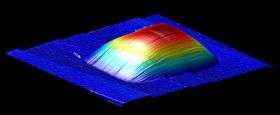
Scientists have developed the world's thinnest balloon that is impermeable to even the smallest gas molecules. Above is a multi-layer graphene membrane that could be used in various applications, including filters and sensors. Image: Jonathan Alden

(PhysOrg.com) -- Using a lump of graphite, a piece of Scotch tape and a silicon wafer, Cornell researchers have created a balloonlike membrane that is just one atom thick -- but strong enough to contain gases under several atmospheres of pressure without popping.

And unlike your average party balloon -- or even a thick, sturdy glass container -- the membrane is ultra-strong, leak-proof and impermeable to even nimble helium atoms.

The research, by former Cornell graduate student Scott Bunch (now an assistant professor at the University of Colorado), Cornell professor of physics Paul McEuen and Cornell colleagues, could lead to a variety of new technologies -- from novel ways to image biological materials in solution to techniques for studying the movement of atoms or ions through microscopic holes.

The work was conducted at the National Science Foundation-supported Cornell Center for Materials Research and published in a recent issue of the journal Nano Letters.

Graphene, a form of carbon atoms in a plane one atom thick, is the strongest material in the world, with tight covalent bonds in two dimensions that hold it together even as the thinnest possible membrane. It's also a semimetal, meaning it conducts electricity but changes conductivity with changes in its electrostatic environment.

Scientists discovered several years ago that isolating graphene sheets is as simple as sticking Scotch tape to pure graphite, then peeling it back and re-sticking it to a silicone dioxide wafer. Peeled back from the wafer, the tape leaves a residue of graphite anywhere from one to a dozen layers thick -- and from there researchers can easily identify areas of single-layer-thick graphene.

To test the material's elasticity, the Cornell team deposited graphene on a wafer etched with holes, trapping gas inside graphene-sealed microchambers. They then created a pressure differential between the gas inside and outside the microchamber. With a tapping atomic force microscope, which measures the amount of deflecting force a tiny cantilever experiences as it scans nanometers over the membrane's surface, the researchers watched the graphene as it bulged in or out in response to pressure changes up to several atmospheres without breaking.

They also turned the membrane into a tiny drum, measuring its oscillation frequency at different pressures. They found that helium, the second-smallest element (and the smallest testable gas, since hydrogen atoms pair up as a gas), stays trapped behind a wall of graphene -- again, even under several atmospheres of pressure.

"When you work the numbers, you would expect that nothing would go through, so it's not a scientific surprise," said McEuen. "But it does tell you that the membrane is perfect" -- since even an atom-sized hole would allow the helium to escape easily.

Such a membrane could have all kinds of uses, he added. It could form a barrier in an aquarium-like setup, for example, allowing scientists to image biological materials in solution through a nearly invisible wall without subjecting the microscope to the wet environment. Or, researchers could poke atomic-sized holes in the membrane and use the system to study how single atoms or ions pass through the opening.

"This could serve as sort of an artificial analog of an ion channel in biology," McEuen said -- or as a way to measure the properties of an atom by observing its effect on the membrane.

"You're tying a macroscopic system to the properties of a single atom," he said, "and that gives opportunities for all kinds of single atom sensors."

The paper's co-authors are Cornell physics graduate students Arend van der Zande and Jonathan Alden; postdoctoral researcher Scott Verbridge; and professors Jeevak Parpia and Harold Craighead.

Provided by Cornell University


print this article email this article download pdf blog this article bookmark this article     Digg this Stumble it share on Facebook share on Reddit add to delicious save to Yahoo! bookmarks
4.6/5 after 42 votes

Rank Filter

Move the slider to adjust rank threshold, so that you can hide some of the comments.


Display comments: newest first

  • jscroft - Sep 19, 2008
    • Rank: 4.3 / 5 (4)
    Well, this is one kind of Holy Grail... if a graphene membrane can contain helium gas, then it can also contain tritium gas. That'll make it a whole lot easier to maintain our strategic arsenal, since thermonuclear warheads currently have to be recharged with tritium gas every few months to replace what leaks out.
  • Bob_B - Sep 19, 2008
    • Rank: 5 / 5 (1)
    Why are they releasing this information (same image even) again? Is somebody trying to naked short the balloons now?
  • gmurphy - Sep 19, 2008
    • Rank: not rated yet
    wow, i didn't know that, thanks jscroft
  • bobwinners - Sep 19, 2008
    • Rank: not rated yet
    I'm not clear on the properties of graphine. Can it be constructed in greater thicknesses which maintain the same properties? I have in mind the problem of containing hydrogen as a fuel for transportation. Could simple steel containers be lined with this to maintian a prefect seal?
  • NeilFarbstein - Sep 19, 2008
    • Rank: 1.7 / 5 (3)
    great idea jscroft
    and this articvle is a valuable resource to scientists
  • cybrbeast - Sep 20, 2008
    • Rank: 4 / 5 (2)
    jscroft, actually an important reason why tritium degrades in nuclear weapons is its short half life, 12 years or so. So it would still need to be replaced.
  • tkjtkj - Sep 20, 2008
    • Rank: 5 / 5 (2)
    cybrbeast:
    jscroft's comment is not made
    irrelevent by the fact of tritium's
    half-life! There is a big diff
    between 'recharging every few
    months' and the 12 years'
    half-life!

  • trippingsock - Sep 20, 2008
    • Rank: not rated yet
    Thanks to such material we soon will be buying condoms which never burst.
    Ultra thin for maximum experience.
  • jscroft - Sep 21, 2008
    • Rank: 5 / 5 (1)
    Haha, I like trippingsock's idea best! :)

    Cybrbeast: good point. It really would make a difference, though... I believe the recharge rate on current warheads is a matter of weeks. A graphene envelope would extend this considerably, although to nothing like 12 years, since the decay products of tritium actually POISON the thermonuclear reaction.

    It's interesting to note that the tritium recharge issue is one of two essential reasons why "missing" Soviet suitcase nukes are not really to be feared (at least, not for their explosive qualities).

    Tritium is devilishly difficult and expensive to manufacture, far beyond the capabilities of any terrorist group or even a fairly advanced sovereign nation like Iran. Also, because of the storage issues I cited above, any group hoping to maintain a thermonuclear arsenal must manufacture or purchase a continuous supply. And fortunately, while a few suitcase nukes DID go missing after the fall of the USSR, literally every MICROGRAM of tritium on the planet is accounted for, several times a year.

    I'd like to see Al Qaida try to mail order some of the stuff! :)

    Incidentally, the other reason not to fear those suitcase nukes is that an implosion-style thermonuclear device is, among other things, a super-high-precision machine. The elements of its plutonium shell are machined to tolerances well below a micrometer... and such precision machinery doesn't ride well behind a camel's hump.

    So, in the unlikely event that a terrorist actually manages to detonate one of the things with evil intent, by far the most likely outcome is a small, VERY dirty, conventional explosion.

September 19th, 2008 all stories
Physics / General Physics

Comments: 9
Rank: 4.6/5 after 42 votes

  • Stumble this up

  • Digg this

  • Share it:
  • share on Facebook
  • share on MySpace
  • share on Slashdot
  • rss-newsfeed
  • share on Google
  • share on Reddit
  • add to delicious
  • save to Yahoo! bookmarks
  • share on Windows Live
  • Add to Mixx!
Rating: 4.6/5 after 42 votes

  • Related Stories

  • Physics graduate creates graphene resonator
    created Feb 18, 2007 | popularity not rated yet | comments 0
  • You still can't drink the water, but now you can touch it
    created Jan 10, 2007 | popularity not rated yet | comments 0
  • Vise Squad: Putting the Squeeze on a Crystal Leads to Novel Electronics
    created May 06, 2009 | popularity not rated yet | comments 0
  • Frozen helium-4 may be an unusual 'superglass'
    created May 01, 2009 | popularity not rated yet | comments 0
  • Researcher discover two highly complex organic molecules detected in space
    created Apr 21, 2009 | popularity not rated yet | comments 0


  • Physicists Demonstrate Quantum Memory with Matter Qubits
    Physicists Demonstrate Quantum Memory with Matter Qubits
    Physics / General Physics
    created Jul 03, 2009 | popularity 4.4 / 5 (17) | comments 1
  • 'Holey' Nanosheets for Wastewater Dye Removal
    Nanotechnology / Nanomaterials
    created Jul 01, 2009 | popularity 5 / 5 (5) | comments 1
  • Jellyfish Robot Swims Like its Biological Counterpart
    Jellyfish Robot Swims Like its Biological Counterpart
    Electronics / Robotics
    created Jun 26, 2009 | popularity 4.4 / 5 (8) | comments 1
  • Could Maxwell's Demon Exist in Nanoscale Systems?
    Could Maxwell's Demon Exist in Nanoscale Systems?
    Physics / General Physics
    created Jun 24, 2009 | popularity 4.4 / 5 (18) | comments 29
  • Living Safely with Robots, Beyond Asimov's Laws
    Living Safely with Robots, Beyond Asimov's Laws
    Electronics / Robotics
    created Jun 22, 2009 | popularity 4.6 / 5 (52) | comments 40
  • Other News

    Scientists create first electronic quantum processor

    Scientists create first electronic quantum processor

    Physics / General Physics

    created Jun 28, 2009 | popularity 4.8 / 5 (53) | comments 40

    A team led by Yale University researchers has created the first rudimentary solid-state quantum processor, taking another step toward the ultimate dream of building a quantum computer.


    Science journals

    How to Spot an Influential Paper Based on its Citations

    Physics / General Physics

    created Jul 04, 2009 | popularity 4 / 5 (9) | comments 6

    (PhysOrg.com) -- At first it may seem that the number of citations received by a published scientific paper is directly related to that paper's quality of content. The higher the quality, the more people read ...


    Fermilab's CDF observes Omega-sub-b baryon

    Fermilab's CDF observes Omega-sub-b baryon

    Physics / General Physics

    created Jun 29, 2009 | popularity 4.7 / 5 (17) | comments 7

    (PhysOrg.com) -- At a recent physics seminar at the Department of Energy’s Fermi National Accelerator Laboratory, Fermilab physicist Pat Lukens of the CDF experiment announced the observation of a new particle, ...


    New insights, and a new angle, on high-temperature superconductivity

    New insights, and a new angle, on high-temperature superconductivity

    Physics / Superconductivity

    created Jun 29, 2009 | popularity 4.8 / 5 (13) | comments 6

    (PhysOrg.com) -- A Princeton-led research team has revealed surprising information about how electron behavior influences the conduction of electricity in a class of high-temperature superconductors. An increased ...


    The art of invisibility and the perfect cat's eye

    The art of invisibility and the perfect cat's eye

    Physics / Optics & Photonics

    created Jun 30, 2009 | popularity 4 / 5 (8) | comments 6

    (PhysOrg.com) -- In recent years scientists have explored the impossible by developing invisibility or 'cloaking' devices, but can the same technology also help make things more visible?