Researcher micro-sizes genetics testing
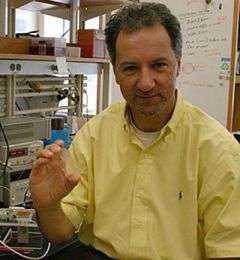
Using new "lab on a chip" technology, James Landers hopes to create a hand-held device that may eventually allow physicians, crime scene investigators, pharmacists, even the general public to quickly and inexpensively conduct DNA tests from almost anywhere, without need for a complex and expensive central laboratory.
"We are simplifying and miniaturizing the analytical processes so we can do this work in the field, away from traditional laboratories, with very fast analysis times, and at a greatly reduced cost," said Landers, a University of Virginia professor of chemistry and mechanical engineering and associate professor of pathology.
Landers published a review this month of his research and the emerging field of lab-on-a-chip technology in the journal Analytical Chemistry.
"This area of research has matured enough during the last five years to allow us to seriously consider future possibilities for devices that would allow sample-in, answer-out capabilities from almost anywhere," he said.
Landers and a team of researchers at U.Va., including mechanical and electrical engineers, with input from pathologists and physicians, are designing a hand-held device — based on a unit the size of a microscope slide — that houses many of the analytical tools of an entire laboratory, in extreme miniature. The unit can test, for example, a pin-prick-size droplet of blood, and within an hour provide a DNA analysis.
"In creating these automated micro-fluidic devices, we can now begin to do macro-chemistry at the microscale," Landers said.
Such a device could be used in a doctor's office, for example, to quickly test for an array of infectious diseases, such as anthrax, avian flu or HIV, as well as for cancer or genetic defects. Because of the quick turn-around time, a patient would be able to wait only a short time on-site for a diagnosis. Appropriate treatment, if needed, could begin immediately.
Currently, test tube-size fluid samples are sent to external labs for analysis, usually requiring a 24- to 48-hour wait for a result.
"Time is of the essence when dealing with an infectious disease such as meningitis," Landers said. "We can greatly reduce that test time, and reduce the anxiety a patient experiences while waiting."
Landers said the research also dovetails with the trend toward "personalized medicine," in which medical care increasingly is tailored to the specific genetic profile of a patient. Such highly specialized personalized care can allow physicians to develop specific therapies for patients who might be susceptible to, for example, particular types of cancers.
Simplifying genetic testing, and reducing the costs of such tests, could help pave the way toward routine delivery of such personalized care based on an individual's genetic profile.
Hand-held micro labs also would be useful to crime scene investigators who could collect and analyze even a tiny sample of blood or semen on-site, enter the finding into a genetic database, and possibly identify the perpetrator very shortly after a crime has occurred.
Likewise, agricultural biotechnologists could do very rapid genetic analysis on
thousands of hybrid plants that have desirable properties such as drought and disease resistance, Landers said.
"We can now do lab work in volumes that are thousands of times smaller than would normally be used in a regular lab setup, and can do it up to 100 times faster," he said. "As we improve our techniques and capabilities, the costs of fabricating these micro-analysis devices will drop enough to employ them routinely in a wide variety of settings."
Landers even envisions home DNA test kits, possibly available for purchase from pharmacies, that would allow individuals to self-test for flu or other diseases.
Source: University of Virginia


