After Trio of Explosions, Scientists Say Supernova is Imminent
Three powerful recent blasts from three wholly different regions in space have left scientists scrambling. The blasts, which lasted only a few seconds, might be early alert systems for star explosions called supernovae, which could start appearing any day.
The first two blasts, called X-ray flashes, occurred on September 12 and 16. These were followed by a more powerful burst on September 24. The burst seems to be on the cusp between an X-ray flash and a full-fledged gamma ray burst, a discovery interesting in its own right. If these signals lead to supernovae, as expected, scientists would have a tool to predict star explosions, and researchers could watch explosions from start to finish.
A team led by Dr. George Ricker of the Massachusetts Institute of Technology (MIT), Cambridge, detected the explosions with NASA's High-Energy Transient Explorer (HETE-2). Science teams around the world, using space- and ground-based observatories, have joined in, torn and conflicted over which burst region to track most closely.
"Each burst has been beautiful," Ricker said. "Depending on how these evolve, they could support important theories about supernovae and gamma-ray bursts. These past two weeks have been like 'cock, fire, reload.' Nature keeps on delivering, and our HETE-2 satellite keeps on responding flawlessly," he said."
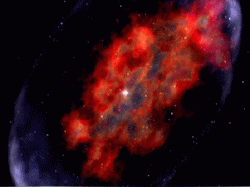
Gamma ray bursts are the most powerful explosions known other than the Big Bang. Many appear to be caused by the death of a massive star collapsing into a black hole. Others might be from merging black holes or neutron stars. In either case, the event likely produces twin, narrow jets in opposite directions, which carry off tremendous amounts of energy. If one of jets points to Earth, we see this energy as a gamma ray burst.
The lower-energy X-ray flashes might be gamma ray bursts viewed slightly off angle from the jet direction, somewhat similar to how a flashlight is less blinding when viewed at an angle. The majority of light particles from X-ray flashes, called photons, are X-rays, energetic, but not quite as powerful as gamma rays. Both types of bursts last only a few milliseconds to about a minute. HETE-2 detects the bursts, studies their properties, and provides a location, so other observatories can study the burst afterglow in detail.
The trio of bursts from the past few weeks has the potential of settling two long-standing debates. Some scientists say X-ray flashes are different beasts all together, not related to gamma-ray bursts and massive star explosions. Detecting a supernova in the region where the X-ray flash appeared would refute that belief, instead confirming the connection between the two. Follow-up observations of the September 24 burst, named GRB040924 for the date it was observed, are already solidifying the theory of a cosmic explosion continuum from X-ray flashes up through gamma ray bursts.
More interesting for supernova hunters is the fact X-ray flashes are closer to Earth than gamma ray bursts. While the connection between gamma ray bursts and supernovae has been made, these supernovae are too distant to study in detail. X-ray flashes might be signals for supernovae; scientists can actually sink their teeth into and observe in detail.
"Last year HETE-2 sealed the connection between gamma ray bursts and massive supernovae," said Prof. Stanford Woosley of the University of California at Santa Cruz, who has championed several theories concerning the physics of star explosions. "These two September bursts may be the first time we see an X-ray flash lead to a supernova."
"We all expect much more of this type of exciting science to come after the launch of Swift," said Dr. Anne Kinney, director of NASA's Universe Division. The Swift spacecraft, scheduled to launch no earlier than late October, contains three telescopes (gamma ray, X-ray and UV/optical) for quick burst detection and immediate follow-up observations of the afterglow.
HETE was built by MIT as a mission of opportunity under the NASA Explorer Program. It was built in collaboration among U.S. universities, Los Alamos National Laboratory, N.M., scientists and organizations in Brazil, France, India, Italy and Japan.
Source: NASA


