New Ways to Use Biomass
September 22, 2008 New Ways to Use Biomass

Enlarge

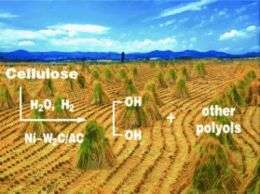
The expense of using precious-metal catalysts is avoided in the high-yielding conversion of cellulose to ethylene glycol (see picture; AC=activated carbon). This process occurs in up to 29 percent yield over a tungsten carbide catalyst, and in up to 61 percent yield when the catalyst is promoted with a small amount of nickel. An attractive feature of this reaction is the low yields of other polyols with respect to ethylene glycol. (C) Wiley-VCH 2008

(PhysOrg.com) -- Alternatives to fossil fuels and natural gas as carbon sources and fuel are in demand. Biomass could play a more significant part in the future. Researchers in the USA and China have now developed a new catalyst that directly converts cellulose, the most common form of biomass, into ethylene glycol, an important intermediate product for chemical industry. As reported in the journal Angewandte Chemie, the catalyst is made of tungsten carbide and nickel on a carbon support.

Currently, biomass is mainly used in the form of starch, which is degraded to make sugars and then fermented to make ethanol. It would be cheaper to use cellulose, which is the main component of plant cell walls and thus the most plentiful organic compound on Earth. In contrast to starch from corn and grain, cellulose is not a food, so there would be no competition between its use as food or as raw material and fuel.

At the moment, cellulose is mainly processed by fermentation. However, splitting cellulose into its individual sugar components, which can then be fermented, is a slow and cost-intensive process. The direct conversion of cellulose into useful organic compounds is thus an attractive alternative.

Initial reactions using various noble-metal catalysts have been developed. Their disadvantage is that large amounts of expensive metal are needed to break down the cellulose. On an industrial scale, these processes are thus not economical. A less costly and more effective catalyst is needed.

A team led by Tao Zhang at the Dalian Institute of Chemical Physics (China) and Jingguang G. Chen at the University of Delaware (Newark, USA) has now developed just such a system. The catalyst is made of tungsten carbide deposited on a carbon support. Small amounts of nickel improve the efficiency and selectivity of the catalyst system: a synergetic effect between the nickel and tungsten carbide not only allows 100 % conversion of cellulose, but also increases the proportion of ethylene glycol in the resulting mixture of polyalcohols to an amazing 61%. Ethylene glycol is an important intermediate in the chemical industry. For example, in the plastics industry it is needed for the production of polyester fibers and resins, and in the automobile industry it is used as antifreeze.

Citation: Direct Catalytic Conversion of Cellulose into Ethylene Glycol Using Nickel-Promoted Tungsten Carbide Catalysts, Angewandte Chemie International Edition, doi: 10.1002/anie.200803233

Provided by Wiley


print this article email this article download pdf blog this article bookmark this article     Stumble it Digg this share on Facebook retweet share on Reddit add to delicious
Rate this story - 4.7 /5 (13 votes)


September 22, 2008 all stories

Comments: 0

4.7 /5 (13 votes)
  • Stumble this up

  • Digg this

  • share this

  • hide
  • Related Stories


Other News

New imagining technique could lead to better antibiotics and cancer drugs

Chemistry / Biochemistry

created 33 minutes ago | popularity not rated yet | comments 0

A recently devised method of imaging the chemical communication and warfare between microorganisms could lead to new antibiotics, antifungal, antiviral and anti-cancer drugs, said a Texas AgriLife Research scientist.


Ice cream researchers making sweet strides with 'functional foods'

Ice cream researchers making sweet strides with 'functional foods' (w/ Video)

Chemistry / Other

created 38 minutes ago | popularity not rated yet | comments 0

A comfort food, a tasty treat, an indulgence - ice cream conjures feelings of happiness and satisfaction for millions. Ice cream researchers at the University of Missouri have discovered ways to make ice cream ...


H1N1 Virus Can Be Killed by Acidic Ozone Water

H1N1 Virus Can Be Killed by Acidic Ozone Water

Chemistry / Biochemistry

created 7 hours ago | popularity 5 / 5 (9) | comments 5

(PhysOrg.com) -- Scientists have found that acidic ozone water can deactivate H1N1 viruses very effectively, offering a promising disinfectant for the millions of people trying to avoid the disease. Acidic ...


Wet ethanol production process yields more ethanol and more co-products

Chemistry / Biochemistry

created 6 hours ago | popularity not rated yet | comments 1

Using a wet ethanol production method that begins by soaking corn kernels rather than grinding them, results in more gallons of ethanol and more usable co-products, giving ethanol producers a bigger bang for their buck - ...


Antimicrobials: Silver (and copper) bullets to kill bacteria

Chemistry / Materials Science

created 1hour ago | popularity not rated yet | comments 0

Dana Filoti of the University of New Hampshire will present thin films of silver and copper she has developed that can kill bacteria and may one day help to cut down on hospital infections. The antimicrobial properties of ...