Insight into the evolution of parasitism
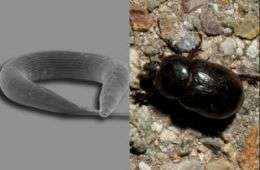
Scientists at the Max Planck Institute for Developmental Biology, together with American colleagues, have decoded the genome of the Pristionchus pacificus nematode, thereby gaining insight into the evolution of parasitism. In their work, which has been published in the latest edition of Nature Genetics, the scientists from Professor Ralf J. Sommer's department in Tübingen have shown that the genome of the nematode consists of a surprisingly large number of genes, some of which have unexpected functions.
These include a number of genes that are helpful in breaking down harmful substances and for survival in a strange habitat: the Pristionchus uses beetles as a hideout and means of transport, feeding on the fungi and bacteria that spread out on their carcasses once they have died. It thus provides the clue to understanding the complex interactions between host and parasite.
With well over a million different species, nematodes are the largest group in the animal kingdom. The worms, usually only just one millimetre in length, are found on all continents and in all ecosystems on Earth. Some, as parasites, are major pathogens to humans, animals and plants. Within the group of nematodes, at least seven forms of parasitism have developed independently from one another. One member of the nematode group has acquired a certain degree of fame: due to its humble lifestyle, small size and quick breeding pattern, the Caenorhabditis elegans is one of the most popular animals being used as a model in biologists' laboratories. It was the first multicellular animal whose genome was completely decoded in 1998.
Ten years later, a group of scientists from the Max Planck Institute for Developmental Biology in Tübingen, together with researchers from the National Human Genome Research Institute in St. Louis (USA), have now presented the genome of another species of nematode, the model organism Pristionchus pacificus. Pristionchus species have carved out a very particular habitat for themselves: they live together with May beetles, dung beetles and potato beetles in order to feast on the bacteria and fungi that develop on the carcasses of these beetles after they die. The nematodes therefore use the beetles as a mobile habitat that offers them shelter and food.
When they move from the land to the beetle, the nematodes' habitat changes dramatically. The nematodes have to protect themselves against toxic substances in their host, for example. The methods they employ to cope with the conditions in the beetle are worthy of closer attention, as this life form can possibly be regarded as the precursor to real parasites. At least, this is what researchers have suspected for a long time.
The sequencing of the genome of the P. pacificus has now confirmed this suspicion: the genome, consisting of around 170 megabases, contains more than 23,500 protein-coding genes. By comparison, the model organism of C. elegans and the human parasite Brugia malayi (the genome of this was sequenced in 2007) only have about 20,000 or 12,000 protein-coding genes respectively. "The increase in P. pacificus is partly attributable to gene duplications," explained Ralf Sommer. "These include a number of genes that could be helpful for breaking down harmful substances and survival in the complex beetle ecosystem."
Surprisingly, the Pristionchus genome also has a number of genes that are not known in C. elegans, although they have been seen in plant parasites. Genes for cellulases - enzymes that are required to break down the cell wall of plants and microorganisms - have aroused particular interest among scientists. "The really exciting questions are still to come", said Sommer. "Using the sequence data, we can test how the Pristionchus has adapted to its specific habitat. And this will undoubtedly give us new insight in to the evolution of parasitism."
Citation: Dieterich, C., Clifton, S. W., Schuster, L., Chinwalla, A., Delehaunty, K., Dinkelacker, I., Fulton, L., Fulton, R., Godfrey, J., Minx, P., Mitreva, M., Roeseler, W., Tian, H., Witte, H., Yang, s.-P., Wilson, R. K. & Sommer R. J.; The genome sequence of the nematode Pristionchus pacificus and the evolution of nematode parasitism. Nature Genetics, September 22, 2008
(doi: 10.1038/ng.227)
Source: Max-Planck-Gesellschaft


