Mars Rover Opportunity To Head Toward Bigger Crater
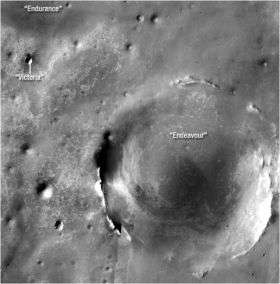
September 22, 2008 Bigger Crater Farther South of 'Victoria' on Mars

Enlarge

The team operating NASA's Mars Exploration Rover Opportunity has chosen southeast as the direction for the rover's next extended journey, toward a crater more than 20 times wider than "Victoria Crater." Image credit: NASA/JPL/ASU

(PhysOrg.com) -- NASA's Mars Rover Opportunity is setting its sights on a crater more than 20 times larger than its home for the past two years.

To reach the crater the rover team calls Endeavour, Opportunity would need to drive approximately 7 miles to the southeast, matching the total distance it has traveled since landing on Mars in early 2004. The rover climbed out of Victoria Crater earlier this month.

"We may not get there, but it is scientifically the right direction to go anyway," said Steve Squyres of Cornell University, principal investigator for the science instruments on Opportunity and its twin rover, Spirit. "This crater is staggeringly large compared to anything we've seen before."

Getting there would yield a look inside a bowl 13.7 miles across. Scientists expect to see a much deeper stack of rock layers than those examined by Opportunity in Victoria Crater.

"I would love to see that view from the rim," Squyres said. "But even if we never get there, as we move southward we expect to be getting to younger and younger layers of rock on the surface. Also, there are large craters to the south that we think are sources of cobbles that we want to examine out on the plain. Some of the cobbles are samples of layers deeper than Opportunity will ever see, and we expect to find more cobbles as we head toward the south."

Opportunity will have to pick up the pace to get there. The rover team estimates Opportunity may be able to travel about 110 yards each day it is driven toward the Endeavour crater. Even at that pace, the journey could take two years.

"This is a bolder, more aggressive objective than we have had before," said John Callas, the project manager for both Mars rovers at NASA's Jet Propulsion Laboratory in Pasadena, Calif. "It's tremendously exciting. It's new science. It's the next great challenge for these robotic explorers."

Opportunity, like Spirit, is well past its expected lifetime on Mars, and might not keep working long enough to reach the crater. However, two new resources not available during the 4-mile drive toward Victoria Crater in 2005 and 2006 are expected to aid in this new trek.

One is imaging from orbit of details smaller than the rover itself, using the High Resolution Imaging Science Experiment (HiRISE) camera on NASA's Mars Reconnaissance Orbiter, which arrived at the Red Planet in 2006.

"HiRISE allows us to identify drive paths and potential hazards on the scale of the rover along the route," Callas said. "This is a great example of how different parts of NASA's Mars Exploration Program reinforce each other."

Other advantages come from a new version of flight software uplinked to Opportunity and Spirit in 2006, boosting their ability to autonomously choose routes and avoid hazards such as sand dunes.

During its first year on Mars, Opportunity found geological evidence that the area where it landed had surface and underground water in the distant past. The rover's explorations since have added information about how that environment changed over time. Finding rock layers above or below the layers already examined adds windows into later or earlier periods of time.

Provided by NASA


print this article email this article download pdf blog this article bookmark this article     Stumble it Digg this share on Facebook retweet share on Reddit add to delicious
Rate this story - 5 /5 (5 votes)


September 22, 2008 all stories

Comments: 0

5 /5 (5 votes)
  • Stumble this up

  • Digg this

  • share this

  • hide
  • Related Stories

  • NASA to Begin Attempts to Free Sand-Trapped Mars Rover
    created Nov 12, 2009 | popularity not rated yet | comments 0
  • Scientists work to free Mars rover Spirit
    created Oct 13, 2009 | popularity not rated yet | comments 0
  • Dust Storm Passing Over Spirit
    created Aug 26, 2009 | popularity not rated yet | comments 0
  • Mars Reconnaissance Orbiter Gets New View of Victoria Crater
    created Aug 12, 2009 | popularity not rated yet | comments 0
  • Meteorite Found on Mars Yields Clues About Planet's Past
    created Aug 10, 2009 | popularity not rated yet | comments 0


  • hide
  • Relevant PhysicsForums posts

  • Question about 2-body gravity
    created Nov 24, 2009
  • life on Mars
    created Nov 24, 2009
  • Semi-major axis from cartesian co-ordinates
    created Nov 23, 2009
  • Primary Mirror grinding
    created Nov 23, 2009
  • More from Physics Forums - General Astronomy

Other News

Monster Waves on the Sun are Real

Monster Waves on the Sun are Real (w/ Video)

Space & Earth / Astronomy

created 9 hours ago | popularity 4.8 / 5 (10) | comments 1

Sometimes you really can believe your eyes. That's what NASA's STEREO (Solar Terrestrial Relations Observatory) spacecraft are telling researchers about a controversial phenomenon on the sun known as the "solar ...


Cosmic 'dig' reveals vestiges of the Milky Way's building blocks

Cosmic 'Dig' Reveals Vestiges of the Milky Way's Building Blocks

Space & Earth / Astronomy

created 13 hours ago | popularity 4.9 / 5 (14) | comments 1

(PhysOrg.com) -- Peering through the thick dust clouds of our galaxy's "bulge" (the myriads of stars surrounding its center), a team of astronomers has unveiled an unusual mix of stars in the stellar grouping ...


No Wheel Stall in Diagnostic Drive

Spirit Mars Rover: No Wheel Stall in Diagnostic Drive

Space & Earth / Space Exploration

created 9 hours ago | popularity 4.5 / 5 (2) | comments 0

(PhysOrg.com) -- On Sol 2095 (Tuesday, Nov. 24), Spirit performed a set of diagnostic actions related to a stall of the right-rear wheel on the previous drive, three days earlier.


Climate experts debate strategies for reducing atmospheric carbon and future warming

Climate experts debate strategies for reducing atmospheric carbon and future warming

Space & Earth / Environment

created 9 hours ago | popularity 2.8 / 5 (6) | comments 8

(PhysOrg.com) -- Reducing carbon dioxide to safe levels may require extracting carbon from the air, says Cornell climate researcher.


Oceanic crust formation is dynamic after all

Oceanic crust formation is dynamic after all

Space & Earth / Earth Sciences

created 12 hours ago | popularity 4.6 / 5 (5) | comments 0

Imagine the Earth's crust as the planet's skin: Some areas are old and wrinkled while others have a fresher, more youthful sheen, as if they had been regularly lathered with lotion.