High-temperature superconductor 'pseudogap' imaged
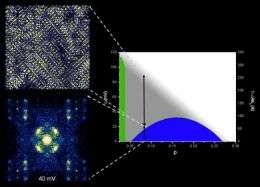
(PhysOrg.com) -- Cornell researchers and colleagues have produced the first atomic-scale description of what electrons are doing in the mysterious "pseudogap" in high-temperature superconductors.
Materials known as cuprates, made of copper oxide doped with other atoms, can become superconducting with just the right amount of doping, which allows electrons to bind into pairs that can conduct electricity without interference. "Pseudogap" refers to the fact that at some levels of doping an energy signal for these "Cooper pairs" is found, yet the material does not superconduct. Now Cornell experimenters find that in this state electrons may pair up, but most of the pairs are locked into fixed locations in the crystal lattice.
"These are the experimental observations," said J.C. Séamus Davis, the J.G. White Distinguished Professor of Physical Sciences at Cornell and a senior scientist at Brookhaven. "Now it's up to the theorists to explain why it's this way." Davis and colleagues at the Brookhaven National Laboratory and in Japan report the work in the Aug. 28 issue of the journal Nature.
Cuprates can superconduct at up to 150 kelvins (-253 F). If scientists can figure out how they work, it may be possible to design new materials that superconduct at room temperature. Many believe that understanding the pseudogap is a key step.
Davis and colleagues studied a cuprate consisting of bismuth, strontium, calcium, copper and oxygen at several doping percentages. Up to about 5 percent doping it remains an insulator; from about 10 percent to 25 percent it becomes a superconductor. Between 5 percent and 15 percent the pseudogap appears.
Using a scanning tunneling microscope so precise that it can resolve distances less than the diameter of an atom, the researchers scanned 50-by-50 nanometer squares of the cuprate, mapping the spatial arrangements and energy levels of the electrons.
In the pseudogap doping range they found electron pairs locked into fixed positions in the crystal lattice, and other pairs moving freely. As the doping percentage went down they found more and more locked-in pairs. Doping creates "holes" -- where an electron should be but isn't -- allowing more freedom of movement, Davis explained.
Breaking the locked-in pairs required more energy than to break moving pairs. In theory, the more tightly bound the electron pairs are, the more they resist being pulled apart as the temperature rises. But it's a catch-22, Davis said. "When there are few holes, allowing the pairs to be tightly bound, the pairs are not free to move around, and when there are plenty of holes, allowing them to move around, they are too weakly bound to survive higher temperatures."
So to make higher-temperature superconductors, he proposes, requires creating a material where strong pairing occurs, but without the "traffic jam" created by a shortage of holes.
Provided by Cornell University


