In radiation 'ventriloquism,' electromagnetic waves travel backwards
September 23, 2008 By Lisa Zyga In radiation 'ventriloquism,' electromagnetic waves travel backwards

Enlarge

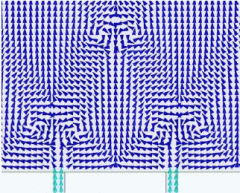
This figure shows back power flow lines at 21 GHz. Credit: Cesar Monzon.

(PhysOrg.com) -- Typically, electromagnetic waves travel away from their sources. For instance, a radar system emits radio waves that travel all the way to a target, such as a car or plane, before being reflected back to the source. Police officers and the military rely on the forward movement of the waves to determine the speed or location of an object.

So if electromagnetic radiation started flowing in reverse, back toward its source, it could cause serious confusion. But this is just what Cesar Monzon, a Senior Scientist at Enig Associates, Inc., in Silver Spring, Maryland, has discovered. In a recent study, he theoretically demonstrates that, under special conditions of geometry, location, and frequency, power may flow backwards in the direction of its source. The study is published in a recent issue of Physical Review Letters.

“I have been working in diverse aspects of electromagnetics for a number of years, and I just happened to stumble on some solutions of Maxwell’s equations that exhibited a very unusual behavior,” Monzon told PhysOrg.com. “It is counterintuitive because we observe that, in some portions of space, the power is actually flowing back in the direction of the sources. On the other hand, based on experience, and with very rare exceptions (that involve wave guidance in exotic circumstances), the radiated power always spreads out as it travels away from the sources. For example, thermal radiation travels in straight lines away from a heat source.”

In Monzon’s theoretical set-up, a number of identical electromagnetic wave sources are aligned in a row. When they radiate power at a certain frequency, an unusual power flow pattern develops at a distance of about half a wavelength away from the sources. At this location, the power turns and flows back toward the source array, accompanied by a vortex formation.

As Monzon explains, the backwards power flow is caused by interference from the multiple sources. The waves superpose in such a way that the phase gradient of the waves points backwards in certain regions. Mathematically speaking, the electrical terms must overcome a geometric term. Monzon likens this condition to that of a mechanical object whose kinetic energy must overcome the potential energy of a barrier in order to overcome the barrier – like a ball with momentum rolling up a hill.

As Monzon notes, the backward power flow is being carried by an ordinary wave, in which the phase velocity, group velocity, and power all point in the same direction. Until now, power flowing toward its source has only been demonstrated for “backward” waves, where some of these characteristics are reversed.

But the fact that ordinary waves are flowing backwards here results in some unusual effects. If an observer were to detect the backward-moving waves, it would seem as if the waves were originating from a “ghost” source in the opposite direction from the true source. Monzon shows that it’s possible to control the placement of the backwards power flow, and harness the effect for various applications, including deception.

“On the case of deception, it appears possible that with current technology we can build a radiator (such as a radar) that can convince an observer, through measurements, that radiation is coming from a given direction, when in reality we are somewhere else, and perhaps even observing them,” he said. “The effect is real, not an illusion. The resulting effect on the observer is, however, akin to the illusion offered by a ventriloquist who manipulates his or her voice so that it appears that the voice is coming from elsewhere.”

Monzon added that the phenomenon could also be applied to other areas, such as optics, acoustics, and water wave problems.

“On the case of satellite antenna feeds, the theory indicates it may be possible to build these behind the main reflector dish, which will offer a clear field of view without blocking or the disadvantages derived from feed offsetting,” he explained. “The same principle applies to both transmit and receive antennas.”

More information: Monzon, Cesar. “Anomalous Power Flow and ‘Ghost’ Sources.” Physical Review Letters 101, 083901 (2008).

Copyright 2008 PhysOrg.com.
All rights reserved. This material may not be published, broadcast, rewritten or redistributed in whole or part without the express written permission of PhysOrg.com.


Rate this story - 4.5 /5 (81 votes)

Rank Filter

Move the slider to adjust rank threshold, so that you can hide some of the comments.


Display comments: newest first

  • earls - Sep 23, 2008
    • Rank: 1.8 / 5 (8)
    Forget particles, long live waves.
  • superhuman - Sep 23, 2008
    • Rank: 4 / 5 (3)
    In reality any metal object in the path of the wave will interfere with this making it very challenging to model where exactly vortexes form and how they look. That makes it rather impractical in any macro-environment.

    Still interesting though, but I am not so sure its a new discovery as the setup is very basic.
  • tpb - Sep 23, 2008
    • Rank: 4 / 5 (5)
    Half-wavelength at radar frequencies is inches, doesn't seem too likely for spoofing someone as to your location when it's only inches away from your actual location.
  • vivcollins - Sep 23, 2008
    • Rank: 1 / 5 (1)
    Half-wavelength at radar frequencies is inches, doesn't seem too likely for spoofing someone as to your location when it's only inches away from your actual location.


    So how many half waves are there in RADAR just one?
  • tpb - Sep 23, 2008
    • Rank: 4 / 5 (3)
    Of course not, but if you look at the picture, the sources are also spaced about a half wavelength from each other. If this worked at other distances away from the source, the pseudo source would appear every half wavelength, getting weaker as it gets farther from the sources.
  • earls - Sep 23, 2008
    • Rank: 1 / 5 (1)
  • E_L_Earnhardt - Sep 23, 2008
    • Rank: 4.3 / 5 (3)
    These "ghosts" were confusing in early radar. I'm glad to hear some explanation. We used to think they never got out of the wave guide. Some operators used to call them up to the bridge.
  • SMMAssociates - Sep 24, 2008
    • Rank: 4 / 5 (2)
    Seems like plain old "Standing Waves" to me....

    Power is reflected back to the source by way of improperly matched lines, and I suppose some cavity effects at higher frequencies.

    Nothing new there....

    Just IMHO....
  • thales - Sep 24, 2008
    • Rank: not rated yet
    Mmmmm... did someone say u2013Field?? Ahhh yeah.
  • Bob_B - Sep 27, 2008
    • Rank: 1 / 5 (1)
    The small photo in the main page looks sort of like tits with those pasties some women use to hide the part that feeds young children...be nice now!

September 23, 2008 all stories

Comments: 10

4.5 /5 (81 votes)

  • hide
  • Related Stories


  • hide
  • Relevant PhysicsForums posts

  • Interception angle
    created 1hour ago
  • Pressure created by clamping base and cover
    created 1hour ago
  • How to find static friction
    created 7 hours ago
  • Calculating decible increases
    created 14 hours ago
  • Coefficients of friction
    created 14 hours ago
  • Deduction of centripetal force
    created 15 hours ago
  • More from Physics Forums - General Physics

Other News

Extra large carbon

Extra large carbon

Physics / General Physics

created 14 hours ago | popularity 4.7 / 5 (12) | comments 7 | with audio podcast

An exotic form of carbon has been found to have an extra large nucleus, dwarfing even the nuclei of much heavier elements like copper and zinc, in experiments performed in a particle accelerator in Japan. ...


Scientist explore future of high-energy physics

Scientist explore future of high-energy physics

Physics / General Physics

created 20 hours ago | popularity 4.9 / 5 (12) | comments 8 | with audio podcast

In a 1954 speech to the American Physical Society, the University of Chicago's Enrico Fermi fancifully envisioned a particle accelerator that encircled the globe. Such would be the ultimate theoretical outcome, ...


Leaf veins inspire a new model for distribution networks (w/ Video)

Physics / General Physics

created 17 hours ago | popularity 5 / 5 (3) | comments 0 | with audio podcast

(PhysOrg.com) -- Following the straight and narrow may be good moral advice, but it’s not a great design principle for a distribution network. In new research, a team of biophysicists describe a complex netting of interconnected ...


New magnetic tuning method enhances data storage

New magnetic tuning method enhances data storage

Physics / General Physics

created 21 hours ago | popularity 4.2 / 5 (5) | comments 0 | with audio podcast

Researchers in Chicago and London have developed a method for controlling the properties of magnets that could be used to improve the storage capacity of next-generation computer hard drives.


High-performance microring resonator developed by INRS researchers

Physics / Optics & Photonics

created 13 hours ago | popularity 1.5 / 5 (2) | comments 0

A new, more efficient low-cost microring resonator for high speed telecommunications systems has been developed and tested by Professor Roberto Morandotti's INRS team in collaboration with Canadian, American, and Australian ...