Ulysses spacecraft data indicate Solar System shield lowering
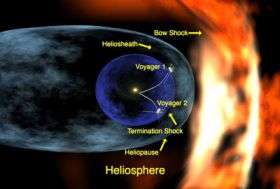
September 23, 2008 The heliosphere

Enlarge

The heliosphere is the big magnetic bubble in space carved out by the solar wind. The solar defines the border between our Solar System and interstellar space. This border, called the heliopause, is where the solar wind's strength is no longer great enough to push back the wind originating from other stars. The region around the heliopause also acts as a shield for our Solar System, warding off a significant portion of the cosmic rays outside the galaxy. Latest data from Ulysses show that the Sun has reduced its output of solar wind to the lowest levels since accurate readings have become available. This current state of the Sun could reduce the natural shielding that envelops our Solar System. Image: NASA/Feimer

(PhysOrg.com) -- Data from the joint ESA/NASA Ulysses mission show that the Sun has reduced its output of solar wind to the lowest levels since accurate readings have become available. This current state of the Sun could reduce the natural shielding that envelops our Solar System.

"The Sun’s 1.5 million km-per-hour solar wind inflates a protective bubble around the Solar System and can influence how things work here on Earth and even out at the boundary of our Solar System, where it meets the galaxy," said Dave McComas, Principal Investigator for the Ulysses solar wind instrument and senior Executive Director at the Southwest Research Institute in San Antonio, Texas. "Ulysses data indicate the solar wind’s global pressure is the lowest we have seen since the beginning of the space age."

The Sun's solar wind plasma is a stream of charged particles that are ejected from the upper atmosphere of the Sun. The solar wind interacts with every planetary body in our Solar System. It even defines the border between our Solar System and interstellar space.

This border, called the heliopause, is a bubble-shaped boundary surrounding our Solar System where the solar wind's strength is no longer great enough to push back the wind originating from other stars. The region around the heliopause also acts as a shield for our Solar System, warding off a significant portion of the cosmic rays outside the galaxy.

"Galactic cosmic rays carry with them radiation from other parts of our galaxy," said Ed Smith, NASA's Ulysses Project Scientist from the Jet Propulsion Laboratory in California, USA. "With the solar wind at an all-time low, there is an excellent chance that the heliosphere will diminish in size and strength. If that occurs, more galactic cosmic rays will make it into the inner part of our Solar System."

Galactic cosmic rays are of great interest; cosmic rays are linked to engineering decisions for unmanned interplanetary spacecraft and exposure limits for astronauts traveling beyond low-Earth orbit.

In 2007, Ulysses executed its third scan of the solar wind and magnetic field from the Sun’s south to the north pole. When the results were compared with Ulysses observations from the previous cycle, the strength of the solar wind pressure and the radial component of the magnetic field embedded in the solar wind were found to have decreased by 20%. The field strength near the spacecraft has decreased by 36%.

"The sun cycles between periods of great activity and lesser activity," Smith said. "Right now, we are in a period of minimal activity that has stretched on longer than anyone anticipated."

"These exciting results could only have been obtained by a spacecraft orbiting the poles of the Sun and are a perfect example of what makes Ulysses a unique mission," said Richard Marsden, ESA's Ulysses Project Scientist and Mission Manager.

The venerable spacecraft has lasted almost 18 years, or almost four times its expected mission lifetime. It was expected to end its operations in July this year, but is still working and collecting data. "Even though the end is now in sight, every day's worth of new data is adding to our knowledge of the Sun and its environment," added Marsden.

The Ulysses spacecraft was carried into Earth orbit in the cargo bay of the Space Shuttle Discovery on 6 October 1990. From Earth orbit, it was propelled toward Jupiter by a combination of solid-fuel motors. Ulysses passed Jupiter on 8 February 1992; the giant planet's gravity bent the spacecraft's flight path downward and away from the plane of the planets. This put it into a final orbit around the Sun that would take it over the Sun's north and south poles.

The Ulysses solar wind findings were published in a recent edition of Geophysical Research Letters.

Provided by ESA


Rate this story - 4.6 /5 (45 votes)

Rank Filter

Move the slider to adjust rank threshold, so that you can hide some of the comments.


Display comments: newest first

  • superhuman - Sep 23, 2008
    • Rank: 2.2 / 5 (12)
    "The Sun's 1.5 million km-per-hour solar wind inflates a protective bubble around the Solar System and can influence how things work here on Earth ... Ulysses data indicate the solar wind's global pressure is the lowest we have seen since the beginning of the space age.


    Fear mongering everywhere!
    No, it wont make ANY difference on Earth, and the term "protective" is plainly wrong as this "protective" solar wind is in fact deadly to all life and has to be protected against.
  • seanpu - Sep 23, 2008
    • Rank: 3.5 / 5 (6)
    Fear mongering everywhere!
    No, it wont make ANY difference on Earth, and the term "protective" is plainly wrong as this "protective" solar wind is in fact deadly to all life and has to be protected against.


    i wonder what taxes can be thought up that can help stop the depletion of the heliosphere???
  • Arikin - Sep 23, 2008
    • Rank: 5 / 5 (4)
    Could the solar flare cycle be related to the strength of the heliopause? Solar flare activity is also currently in a longer than usual low point of activity. But to be sure we would need to measure near sun and heliopause at the same time?

    IF they are related then this is just another cycle of of the heliopause.
  • menkaur - Sep 24, 2008
    • Rank: 4.8 / 5 (5)
    could this be related to current climate change phase?
  • superhuman - Sep 24, 2008
    • Rank: 2 / 5 (2)
    but this *isn't* fear mongering. It is a series of stated _facts_


    Its a false interpretation of facts which attempts to convince readers that some cosmic disaster can happen cause ""protective" sheath around Solar System is depleting and is more weak then ever" to get attention and lure more $$.

    Just like implying planets like Earth and Venus can collide in a mature system like Sol cause astronomers found lots of hot gas in some binary system, found in another recent article.

    Could the solar flare cycle be related to the strength of the heliopause?


    It can be related to solar wind which is the source of heliopause so yes.

    could this be related to current climate change phase?


    As for galactic wind - no, as for solar wind - very unlikely.
  • russellharper - Sep 24, 2008
    • Rank: 4.8 / 5 (4)
    @menkaur - I remember reading some years ago an article in Sky & Telescope where they were showing the relationship between the number of sunspots vs. the average global temperature. They matched very closely - i.e. more sunspots -> higher temperature. Currently, the number of sunspots has been very low, even for a solar minimum. It will be interesting to see what the average global temperature is this year. For me, it's been noticeable colder than usual for a couple of years.
  • bmerc - Sep 24, 2008
    • Rank: 4.5 / 5 (4)
    For me, it's been noticeable colder than usual for a couple of years.


    Yeah the same here, I have been living in the Philippines for the last ten years and am very intolerant of heat and it has still been what I would consider a very mild year with my electric bill at times only 1/3 of normal and that is just due to the fact that I haven't needed to use the air conditioner as much.

    Fortunately we have all already been warned by the UN that this is because of global warming, ah sorry I forgot that it has now been changed to climate change, otherwise I would have just assumed that all the alarming news stories of how we are all doomed unless we all change our lifestyles (except of course for Al Gore and all the liberal elites who preach the most about global.... or I mean climate change) were no longer a concern. But why should we bother anyway, because I read plenty of news articles that say it is already to late anyway so why not just live our short doomed existence as if we were parting like it was 1999 and try to put out of our minds the horrible fate that awaits us?
  • yyz - Sep 24, 2008
    • Rank: not rated yet
    With the diminished size and strength of the heliosphere, I would think ground-based UHECR observatories like H.E.S.S., VERITAS, MAGIC, etc. may be able to see an increase in these cosmic ray fluxes during this time. Sounds like good news for them.
  • thinking - Sep 24, 2008
    • Rank: 1 / 5 (1)
    So if global temperatures drops this year, does this then prove that sunspots influence global temperatures? Please answer yes or no, and if you a believer in man made global warming.

    I myself do not believe in man made global warming, so I believe global temperatures should go down. If not, then I will not believe sunspots have a temperature effect...
  • Doug_Huffman - Sep 24, 2008
    • Rank: 5 / 5 (1)
    Correlation is not cause - or even influence. Post hoc propter hoc is a weak syllogism.


September 23, 2008 all stories

Comments: 10

4.6 /5 (45 votes)

  • hide
  • Related Stories


  • hide
  • Relevant PhysicsForums posts

  • Spreading Life in the Universe
    created 9 hours ago
  • Force of Gravity in terms of Density
    created Feb 08, 2010
  • what is the relation between gravity and light?
    created Feb 08, 2010
  • Does the Thermoelectric effect apply in sun?
    created Feb 07, 2010
  • More from Physics Forums - General Astronomy

Other News

Rho Ophiuchus cloud

Professor: We have a 'moral obligation' to seed universe with life

Space & Earth / Astronomy

created 20 hours ago | popularity 3 / 5 (26) | comments 52 | with audio podcast report

(PhysOrg.com) -- Eventually, the day will come when life on Earth ends. Whether that’s tomorrow or five billion years from now, whether by nuclear war, climate change, or the Sun burning up its fuel, the last ...


Climate 'Tipping Points' May Arrive Without Warning, Says Top Forecaster

Space & Earth / Environment

created 8 hours ago | popularity 3.7 / 5 (6) | comments 5 | with audio podcast

(PhysOrg.com) -- A new University of California, Davis, study by a top ecological forecaster says it is harder than experts thought to predict when sudden shifts in Earth's natural systems will occur -- a worrisome finding ...


A new 3-D map of the interstellar gas within 300 parsecs from the sun

A new 3D map of the interstellar gas within 300 parsecs from the Sun

Space & Earth / Astronomy

created 11 hours ago | popularity 5 / 5 (4) | comments 0 | with audio podcast

(PhysOrg.com) -- Astronomy & Astrophysics is publishing new 3D maps of the interstellar gas in the local area around our Sun. A French-American team of astronomers presents new absorption measurements toward ...


38 percent of world's surface in danger of desertification

38 percent of world's surface in danger of desertification

Space & Earth / Environment

created 5 hours ago | popularity 2.3 / 5 (3) | comments 4

A team of Spanish researchers has measured the degradation of the planet's soil using the Life Cycle Assessment (LCA), a scientific methodology that analyses the environmental impact of human activities, and ...


Russian Soyuz TMA-17 rocket blasts off to the International Space Station

Russia wants to charge more for rides to space: report

Space & Earth / Space Exploration

created 22 hours ago | popularity 5 / 5 (3) | comments 5

Russia, which is set to hold a monopoly on flights to the international space station (ISS), wants to charge more for rides on its Soyuz rocket, the space agency head said Tuesday.