Worlds in collision
September 23, 2008
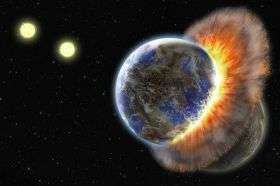
An artist's rendering depicts planets colliding in a sun-like binary system about 300 light-years from Earth, in the constellation Aries. Artwork by Lynette R. Cook.
Two terrestrial planets orbiting a mature sun-like star some 300 light-years from Earth recently suffered a violent collision, astronomers at UCLA, Tennessee State University and the California Institute of Technology will report in a December issue of the Astrophysical Journal, the premier journal of astronomy and astrophysics.
"It's as if Earth and Venus collided with each other," said Benjamin Zuckerman, UCLA professor of physics and astronomy and a co-author on the paper. "Astronomers have never seen anything like this before. Apparently, major catastrophic collisions can take place in a fully mature planetary system."
"If any life was present on either planet, the massive collision would have wiped out everything in a matter of minutes — the ultimate extinction event," said co-author Gregory Henry, an astronomer at Tennessee State University (TSU). "A massive disk of infrared-emitting dust circling the star provides silent testimony to this sad fate."
Zuckerman, Henry and Michael Muno, an astronomer at Caltech at the time of the research, were studying a star known as BD+20 307, which is surrounded by a shocking 1 million times more dust than is orbiting our sun. The star is located in the constellation Aries. The astronomers gathered X-ray data using the orbiting Chandra X-ray Observatory and brightness data from one of TSU's automated telescopes in southern Arizona, hoping to measure the age of the star.
"We expected to find that BD+20 307 was relatively young, a few hundred million years old at most, with the massive dust ring signaling the final stages in the formation of the star's planetary system," Muno said.
Those expectations were shown to be premature, however, when Carnegie Institution of Washington astronomer Alycia Weinberger announced in the May 20, 2008, issue of the Astrophysical Journal that BD+20 307 is actually a close binary star — two stars orbiting around their common center of mass.
"That discovery radically revised the interpretation of the data and transformed the star into a unique and intriguing system," said TSU astronomer Francis Fekel who, along with TSU's Michael Williamson, was asked to provide additional spectroscopic data from another TSU automated telescope in Arizona to assist in comprehending this exceptional binary system.
The new spectroscopic data confirmed that BD+20 307 is composed of two stars, both very similar in mass, temperature and size to our own sun. They orbit about their common center of mass every 3.42 days.
"The patterns of element abundances in the stars show that they are much older than a few hundred million years, as originally thought," Fekel said. "Instead, the binary system appears to have an age of several billion years, comparable to our solar system."
"The planetary collision in BD+20 307 was not observed directly but rather was inferred from the extraordinary quantity of dust particles that orbit the binary pair at about the same distance as Earth and Venus are from our sun," Henry said. "If this dust does indeed point to the presence of terrestrial planets, then this represents the first known example of planets of any mass in orbit around a close binary star."
Zuckerman and colleagues first reported in the journal Nature in July 2005 that BD+20 307, then still thought to be a single star, was surrounded by more warm orbiting dust than any other sun-like star known to astronomers. The dust is orbiting the binary system very closely, where Earth-like planets are most likely to be and where dust typically cannot survive long. Small dust particles get pushed away by stellar radiation, while larger pieces get reduced to dust in collisions within the disk and are then whisked away. Thus, the dust-forming collision near BD+20 307 must have taken place rather recently, probably within the past few hundred thousand years and perhaps much more recently, the astronomers said.
"This poses two very interesting questions," Fekel said. "How do planetary orbits become destabilized in such an old, mature system, and could such a collision happen in our own solar system?"
"The stability of planetary orbits in our own solar system has been considered for nearly two decades by astronomer Jacques Laskar in France and, more recently, by Konstantin Batygin and Greg Laughlin in the U.S.A.," Henry noted. "Their computer models predict planetary motions into the distant future and they find a small probability for collisions of Mercury with Earth or Venus sometime in the next billion years or more. The small probability of this happening may be related to the rarity of very dusty planetary systems like BD+20 307."
"There is no question, however," Zuckerman said, "that major collisions have occurred in our solar system's past. Many astronomers believe our moon was formed from the grazing collision of two planetary embryos — the young Earth and a body about the size of Mars — a crash that created tremendous debris, some of which condensed to form the moon and some of which went into orbit around the young sun. By contrast with the massive crash in the BD+20 307 system, the collision of an asteroid with Earth 65 million years ago, the most favored explanation for the final demise of the dinosaurs, was a mere pipsqueak."
In their 1932 novel "When Worlds Collide," science fiction writers Philip Wylie and Edwin Balmer envisioned the destruction of Earth by a collision with a planet of a passing star. The 1951 classic movie based on the novel began a long line of adventure stories of space rocks apocalyptically plowing into Earth.
"But," Zuckerman noted, "there is no evidence near BD+20 307 of any such passing star."
Source: University of California - Los Angeles
-
Six new planets discovered
Jun 14, 2010 |
4.8 / 5 (30) |
3
-
Brown dwarf pair mystifies astronomers
Dec 21, 2009 |
4.8 / 5 (18) |
1
-
How new planets form near the Seven Sisters
Nov 15, 2007 |
4.3 / 5 (15) |
0
-
Dustiest Star could harbour a young Earth
Jul 20, 2005 |
1 / 5 (1) |
0
-
Earliest-yet observation of August SN2011fe supernova nails it: Destroyed star was white dwarf
Jan 11, 2012 |
4.9 / 5 (7) |
7
-
Engineers build first sub-10-nm carbon nanotube transistor
Feb 01, 2012 |
4.9 / 5 (31) |
30
-
Something old, something new: Evolution and the structural divergence of duplicate genes
Jan 31, 2012 |
4.6 / 5 (7) |
1
-
The hidden nanoworld of ice crystals: Revealing the dynamic behavior of quasi-liquid layers
Jan 30, 2012 |
5 / 5 (3) |
1
-
Stock market network reveals investor clustering
Jan 27, 2012 |
3.9 / 5 (23) |
8
-
Of microchemistry and molecules: Electronic microfluidic device synthesizes biocompatible probes
Jan 26, 2012 |
5 / 5 (1) |
0
-
Titan's lack of impact craters
Feb 09, 2012
-
Real pictures of black hole eating a star?
Feb 08, 2012
-
Hypothetical way to travel faster than light, but not technically exceed lightspeed
Feb 06, 2012
-
How do scientists monitor the Sun's activity?
Feb 05, 2012
-
Search patterns in observational studies
Feb 05, 2012
-
Derivation of Pogson's law
Feb 03, 2012
- More from Physics Forums - General Astronomy
More news stories
Humans may have helped the decline of African rainforests 3000 years ago
(PhysOrg.com) -- Large areas of rainforests in Central Africa mysteriously disappeared over three thousand years ago, to be replaced by savannas. The prevailing theory has been that the cause was a change ...
Could Venus be shifting gear?
(PhysOrg.com) -- ESAs Venus Express spacecraft has discovered that our cloud-covered neighbour spins a little slower than previously measured. Peering through the dense atmosphere in the infrared, the ...
Space & Earth / Space Exploration
6 hours ago |
5 / 5 (5) |
7
|
Mars Science Laboratory computer issue resolved
(PhysOrg.com) -- Engineers have found the root cause of a computer reset that occurred two months ago on NASA's Mars Science Laboratory and have determined how to correct it.
Space & Earth / Space Exploration
7 hours ago |
5 / 5 (5) |
3
|
Clam fields found at deep, low-temperature Mariana vents
(PhysOrg.com) -- Scientists have marveled at the unusual life forms thriving at high temperature hydrothermal vents of the deep ocean.
Space & Earth / Earth Sciences
7 hours ago |
not rated yet |
0
|
Two new moons for Jupiter
Advances in technology have lead to the discovery of new planets outside of our Solar System, and now even new moons in our own backyard.
Space & Earth / Space Exploration
6 hours ago |
not rated yet |
4
Complex wiring of the nervous system may rely on a just a handful of genes and proteins
Researchers at the Salk Institute have discovered a startling feature of early brain development that helps to explain how complex neuron wiring patterns are programmed using just a handful of critical genes. ...
The power of estrogen -- male snakes attract other males
A new study has shown that boosting the estrogen levels of male garter snakes causes them to secrete the same pheromones that females use to attract suitors, and turned the males into just about the sexiest ...
Human cognitive performance suffers following natural disasters, researchers find
Not surprisingly, victims of a natural disaster can experience stress and anxiety, but a new study indicates that it might also cause them to make more errors - some serious - in their daily lives. In their upcoming Human Fa ...
New error-correcting codes guarantee the fastest possible rate of data transmission
Error-correcting codes are one of the triumphs of the digital age. Theyre a way of encoding information so that it can be transmitted across a communication channel such as an optical fiber o ...
Both maternal and paternal age linked to autism
Older maternal and paternal age are jointly associated with having a child with autism, according to a recently published study led by researchers at The University of Texas Health Science Center at Houston (UTHealth).
Curry spice component may help slow prostate tumor growth
Curcumin, an active component of the Indian curry spice turmeric, may help slow down tumor growth in castration-resistant prostate cancer patients on androgen deprivation therapy (ADT), a study from researchers ...
Sep 23, 2008
Rank: 4.9 / 5 (9)
Sep 23, 2008
Rank: 3.5 / 5 (8)
Sep 23, 2008
Rank: 4 / 5 (5)
Sep 23, 2008
Rank: 3.2 / 5 (6)
Tidal forces could tear the planets apart but not really alter the orbits.
Sep 23, 2008
Rank: 1 / 5 (3)
Sep 24, 2008
Rank: 5 / 5 (3)
Not sure why you thing it wont alter the planets orbits, the force acting on each planet in such a system significantly varies with a period of couple of days. Of course the strength of the effect depends on many factors like the mass ratio of the stars, their distance, distance to planets etc, but the system will always be less stable then with a single star.
Also destabilization of planetary orbits is not a sudden effect it results from small nudging during pass by events which can take millions of years, in binary system the result of each such pass by depends not only on the planets themselves but also on the phase of the stars.
Sep 24, 2008
Rank: 5 / 5 (1)
Sep 24, 2008
Rank: 4 / 5 (3)
http://arxiv.org/abs/0804.1799
If you read it, you'll find out that the calculations suggest that the stars are orbiting each other with a semi major axis of 4.4 - 4.7 Million km. This is .029-.031 AU or 9 stellar radii to put this in perspective, mercury has a semi major axis of 57 Million km or 0.387 AU.
In otherwords, if this binary system were within the place of the sun, you'd have two solar masses worth of material within a radius of 9 solar radii.
The difference in tidal effects between that and a two mass sun is going to be nothing, or next to nothing.
In fact, most planetary scientests will tell you that the only way planets can form in a binary system is if it happens to be a close binary like this, or a paricularly widely space system.
Sep 24, 2008
Rank: 4.5 / 5 (4)
In first approximation the difference between the max and min (max-min/mean) gravity force exerted on Mercury would be 2.9%, which is very significant and could probably tear the planet apart.
(This is assuming stars are on circular orbit, max is when both stars and planet are on one line, min is when both stars are same distance away from the planet)
That is when the masses of both stars are equal, for 10% difference in their masses the difference in gravity is 3.6% and for 30% its 5.2%.
Sep 24, 2008
Rank: 4.5 / 5 (2)
As the article says, dust tends not to hang around its star for very long due to radiation pressure. Our own solar system would be virtually clean of dust if it wasn't constantly being replenished by comets, collisions in the asteroid belt, and dust picked up from interstellar space. For this binary system to have so much of the stuff so late in its life, something must have produced it fairly recently.
Sep 24, 2008
Rank: not rated yet
Sep 24, 2008
Rank: 5 / 5 (1)
Uh, we pay attention to Newton because he provided rigorous proofs for his scientific theories. And we ignore the whack-job beliefs he had for the opposite reason. Newton's laws are 'paid attention to' because they work in the real world. Nothing succeeds like success.
Sep 24, 2008
Rank: not rated yet
Sep 24, 2008
Rank: not rated yet
Aside form the part where Binaries with periods of less than 8 days have circular orbits - as mentioned in the paper. I believe this is an observation, rather than a theoretical assumption.
The paper also quite clearly says the stars have a mass ratio of 0.93
Sep 24, 2008
Rank: 5 / 5 (1)
Sep 24, 2008
Rank: not rated yet
I was curious myself how big would the effect be so I used the numbers Trippy provided and universal law of gravitation, its a simple calculation, didn't check the article itself though.
F=GmM/r^2, for 10% difference in star mass M:
Fmin = 2GmMcos(a)/(R^2)
Fmax = GmM[1.05/(r-d)^2 0.95/(r d)^2]
d=4.55 r=57 R=(r^2 d^2)^-2 a=atan(d/r)
G, m and M are not needed if you just want to calculate the difference (Fmax-Fmin)/Fmean
All credit goes to Newton!
http://en.wikiped...vitation
Sep 24, 2008
Rank: not rated yet
Sep 26, 2008
Rank: not rated yet
Sep 26, 2008
Rank: not rated yet
Sep 26, 2008
Rank: 5 / 5 (1)
In reference to the above "pass by events", the author of the article mentions a couple of points which may well be very relevant.
1) As neither star appears to be experiencing Li poisoning from the resultant dust - which itself implies that the dust is close enough to be dragged inward by the stars' combined gravitational field - the author infers the existence of a body orbiting between the dust disk and the stars, which is intercepting this material.
2) The author also points out that binaries in such proximity to each other are statistically more likely to be part of a multiple-star system: having a distant companion star (or another binary) orbiting them - indeed, she suggests that this very possibility be explored. (This assumes that they are not themselves the distant companions of another star/binary round which they orbit!)
Given the above points, the inferred existence of a body between the disk of dust and the binary may well be the primary cause of the destabilisation of the two planetesimals' orbits through countless pass-by events, as [b]superhuman[/b] explains.
(@ CaptSpaulding - The article does specifically denote the bodies involved in the collision as "planetesimals".)
Further, a companion star/binary orbiting this binary, particularly in an elliptical orbit, would also tend to destabilise any planetary orbits, although to a somewhat lesser extent - dependant on distance - than the first possibility.
Kindest regards,
James
Sep 26, 2008
Rank: 5 / 5 (1)
Just an addition to the above...
Given the paper's specific use of the term "planetesimals" to describe the bodies involved, the Physorg article, along with the artist's impression, are somewhat misleading in their depiction of "terrestrial planets" colliding as the cause of the dust disk.
The dust disk is apparently at a orbital distance between that of Venus and Earth.
Given the amount of dust involved, it's possible that there are many more planetesimals involved in on-going collisions at this orbital distance from the binary star!?
Might there also be another body outside the orbit of this dust disk - similar to the inferred one between the disk and the binary star - also contributing to pass-by destabilisation events?
Certainly a case of "Watch this space!".
Kindest regards,
James
Jun 15, 2009
Rank: not rated yet
Our own observations of Saturn and Jupiter tend to indicate that these dust clouds can maintain a semblance of stability if they are shepherded by other bodies inside and outside their orbital plain.
So as DraganGlas has pointed out - as our ability to observe these stars in greater detail improves we may well observe that there are numerous bodies orbiting the stars both inside and outside the dust orbit range.
Also the orbits would be unstable and many collisions would occur thus creating dust on a continuous basis but this sort of thing cannot go on forever as there is a net loss of material. Given that this is a binary star system we are fortunate indeed - lest us hope further observation in more detail is possible.