Vegetation hardly affected by extreme flood events
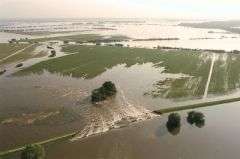
Extreme flood events in floodplain grasslands affect carabid beetles and molluscs more than plants. This is the finding of a study by biologists from the Helmholtz Centre for Environmental Research (UFZ), TU Berlin, the German Federal Institute of Hydrology (BfG), ÖKON Kallmünz and the ILN Bühl, following several years of observations before and after the Elbe floods of August 2002.
Flow variations are known to be most important drivers in structuring riverine communities. However, until now, the effects of extreme flood events on the flora and fauna of floodplains have been largely unknown, despite the fact that such events are likely to become more frequent as a result of climate change, say the researchers, writing in the latest issue of the journal Ecology. They surveyed plants, carabid beetles and molluscs in spring and autumn at 36 plots on an Elbe floodplain grassland that was flooded in 2002. Data from 1998 and 1999 were compared with data from 2003 and 2004.
The samples were taken from marked plots in riverine grassland near Dessau (UNESCO-Biosphere Reserve Riverine Landscape Elbe - Saxony-Anhalt) measuring almost one square kilometre which is flooded seasonally by the Elbe. During the 2002 flood these plots were submerged for at least two weeks, with the water height ranging from 2.4 to 5.4 metres above soil level.
"Our findings show that the mollusc and carabid beetle communities were the most severely affected by the floods," explains Christiane Ilg of the UFZ. "This disproves the hypothesis that groups with lower mobility are more severely affected by floods being less able to escape, and that they recolonise the flooded habitat only after some delay." The number of carabid beetles fell from 117 species before the flood to 88 immediately after the flood, but had recovered by 2004, quickly returning to their pre-flood level. Surprisingly, populations that are adapted to moist conditions and partly are good swimmers were the most severely affected and lost over 40 per cent of their species richness. Carabid beetles may have adapted well to floods over the course of their evolution, but these adaptations aim the survival through the typical winter and spring floods. This is why a summertime flood can have such a drastic effect on the number of carabid beetles. Because of their high mobility, however, these species also recovered the fastest. Land snails were not seriously affected by the 2002 summer flood, their abundance and species richness remaining similar to the ones observed in the pre-flood years. Merely, water mollusc species and individuals increased following the flood.
The vegetation was the least affected by the flood. The decline from 113 plant species to 107 is of hardly any significance in statistical terms. However, further analyses show that the frequency of several species drastically decreased whereas other species, on the contrary, benefited from the flood. The vegetation evidently is well adapted to flooding.
Although this research is the first to provide data about the impacts of such extreme events on flora and fauna, the researchers stress that it is difficult to infer long-term consequences from one flood: "We believe that long-term monitoring of floodplain ecosystems with standardised methods is essential to assess the consequences of an increased frequency of extreme events on floodplain biodiversity."
Reference: Christiane Ilg, Frank Dziock, Francis Foeckler, Klaus Follner, Michael Gerisch, Judith Glaeser, Anke Rink, Arno Schanowski, Mathias Scholz, Oskar Deichner, and Klaus Henle: LONG-TERM REACTIONS OF PLANTS AND MACROINVERTEBRATES TO EXTREME FLOODS IN FLOODPLAIN GRASSLANDS. Ecology: Vol. 89, No. 9, pp. 2392-2398. DOI: 10.1890/08-0528.1
www.esajournals.org/perlserv/? … abstract&doi=10.1890%2F08-0528.1
Source: Helmholtz Association of German Research Centres


