Archaeological Dig in Greece Returns Important Finds
(PhysOrg.com) -- New and interesting information is coming out of an archaeological dig at Mt. Lykaion in Greece – an interdisciplinary project University of Arizona students and faculty have worked on since 2004.
New and interesting information is coming out of an archaeological dig at Mt. Lykaion in Greece – an interdisciplinary project University of Arizona students and faculty have worked on since 2004.
That project is not only informing researchers about the rituals and beliefs of those who lived in ancient Greece but also accentuating the significance of the mountaintop site in southwestern Arcadia, which contains an ash altar, a sanctuary, a stadium, bathhouses, a fountain house, stoa, a hippodrome and other structures.
“It’s a site that is tied to so much happening, from the Classical Age to the early Bronze Age,” said George H. Davis, a Regents’ Professor in geosciences, noting that not only did the athletic games occur at Mt. Lykaion, but it is potentially the legendary birthplace of Zeus, the Greek king of gods.
The project began in 2004 and, this year, the team has worked to excavate trenches in the ash altar, the upper and lower sanctuary, the bath, the stadium and other areas.
“We started finding interesting things and continued to explore things more because of their great antiquity,” said Mary Voyatzis, head of the UA’s classics department and one of the project’s co-directors.
The other co-directors are David Romano, a senior research scientists at the Unversity of Pennsylvania, and Michaelis Petropoulos of the Greek Archaeological Service.
The team has unearthed large amounts of Final Neolithic and Early Bronze Age ceramics that date back to at least 3000 B.C, and probably earlier – which is unusual for such a location.
“Some of the material we have found is significantly older than what what was uncovered in the santuary at Olympia,” she said, adding that the site of the original Olympic Games is about 20 miles away. The earliest evidence of religious activity at Olympia is 11th century B.C., Voyatzis added.
“So we’re wondering which way the influence was in fact going," she said.
At the moment, the research team is in the process of writing a number of research papers about their results and have one more summer to excavate, though the team will request an extension to continue their work through the summer of 2010, Voyatzis said.
Greek archaeologists investigated the site about 100 years ago, but the current project is far more extensive and is more scientifically based. Also, the project includes geological, geophysical, architectural and historical surveys, stratigraphical excavation and analyses of faunal and floral remains.
So important is the project and the recent findings that the University of Athens has deemed the project is the “most important archeological excavation now underway in Greece.”
Several UA students – studying classics, geosciences, anthropology and architecture – are working on the project. Also, Teresa Moreno, an associate conservator for the Arizona State Museum, has worked on the excavations.
“What we found this year was very exciting because we got down to bedrock in a small part of the altar and found a layer of what appears to be purely Mycenaean pottery – a style of pottery that ranges from the 15th century through the 12th century,” Voyatzis said.
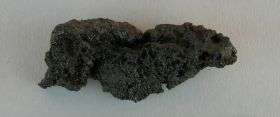
Excavators of the altar have uncovered a great deal of material, including pottery evidence ranging in date from the 14th century through the 3rd century B.C. They also have found silver coins, a bronze hand figure holding a silver lightening bolt, Hellenic fineware and – a curious find – petrified lightning.
“It kind of glistens in the sun and is porous like slag,” Voyatzis said.
“When (George) Davis saw it, he said it was exciting that we found a decent-sized piece,” she added. “It makes you wonder what the ancients understood about this natural phenomenon and why Zeus was worshipped on mountaintops.”
Though the researchers are not yet clear whether the petrified lightning, or fulgurite, was brought to the mountain or if it was created there, its presence is quite compelling. The fulgurite is created when lightening strikes and melts loose sand or soil, forming a kind of glass.
"To us, this find represents a tangible piece of evidence for the presence of Zeus at this very spot,” Voyatzis said. “That’s what it felt like to us.”
Davis, also the former UA provost, said such geological finds will become increasingly more interesting with time.
He wonders if lightning struck during a ceremony, creating the fulgurite. You just knew Zeus or Poseidon was around,” Davis said.
“It is tremendously interesting to me as a geologist but when it becomes fully grasped by the archeologists I think it will have an influence on their thinking as to why Mt. Lykaion had such an influence on peoples’ lives. Then we’ll understand the power of that site.” Davis also has recently found active fault lines near the ash altar.
“There is no doubt in my mind that at some point in the 3,000-year period when this site was active, I bet people felt earthquakes,” he said, “but I think there were people who also witnessed displacement of the land surface."
Provided by University of Arizona


