Going with the flow: Scientists solve 100-year-old engineering problem
September 25, 2008 Going with the flow: Scientists solve 100-year-old engineering problem

Enlarge

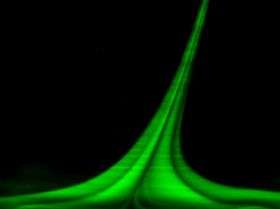
The spike in this experimental 2D image shows where a fluid is separating from the surface it is flowing past. Spikes such as these can now be reliably predicted thanks to a new MIT theory. Image courtesy / Peacock laboratory

(PhysOrg.com) -- As a car accelerates up and down a hill then slows to follow a hairpin turn, the airflow around it cannot keep up and detaches from the vehicle. This aerodynamic separation creates additional drag that slows the car and forces the engine to work harder. The same phenomenon affects airplanes, boats, submarines, and even your golf ball.

Now, in work that could lead to ways of controlling the effect with potential impacts on fuel efficiency and more, MIT scientists and colleagues have reported new mathematical and experimental work for predicting where that aerodynamic separation will occur.

The research solves "a century-old problem in the field of fluid mechanics," or the study of how fluids -- which for scientists include gases and liquids -- move, said George Haller, a visiting professor in the Department of Mechanical Engineering. Haller's group developed the new theory, while Thomas Peacock, the Atlantic Richfield Career Development Associate Professor in the same department, led the experimental effort.

Papers on the experiments and theory are being published in the Sept. 25 issue of the Journal of Fluid Mechanics and in the September issue of Physics of Fluids, respectively.

Fluid flows affect everything in our world, from blood flow to geophysical convection. As a result, engineers constantly seek ways of controlling separation in those flows to reduce losses and increase efficiency. One recent accomplishment: the sleek, full-body swimsuits used at the Beijing Olympics.

Controlling fluid flows lies at the heart of a wide range of scientific problems, including improving the performance of vehicles, Peacock said.

For example, picture air flowing around, over and past an object. "Instead of flowing smoothly past the object, the air tends to dramatically part from the surface, or separate," said Peacock. Like the wake behind a boat, the water doesn't automatically reconfigure into a single stream. Rather, the region is quite turbulent. "And that adversely affects the lift [or vertical forces] and drag [or horizontal forces] of the object."

In 1904, Ludwig Prandtl derived the exact mathematical conditions for flow separation to occur. But his work had two major restrictions: first, it applied only to steady flows, such as those around a car moving at a constant low speed. Second, it only applied to idealized two-dimensional flows.

"Most engineering systems, however, are unsteady. Conditions are constantly changing," Haller said. "For example, cars accelerate and decelerate, as do planes during maneuvers, takeoff and landing. Furthermore, fluids of technological interest really flow in our three-dimensional world," he added.

As a result, ever since 1904 there have been intense efforts to extend Prandtl's results to real-life problems, i.e., to unsteady three-dimensional flows.

A century later, Haller led a group that did just that. In 2004 Haller published his first paper in the Journal of Fluid Mechanics explaining the mathematics behind unsteady separation in two dimensions. This month, his team reports completing the theory by extending it to three dimensions. Haller's coauthors are Amit Surana, now at United Technologies; MIT student Oliver Grunberg; and Gustaaf Jacobs, now on the faculty at San Diego State University.

Equally important, this month Peacock and colleagues report important experimental work. Said Peacock, "while we fully trust George's new mathematical results, the engineering community is usually skeptical until they also see experimental results." Haller added, "while giving a beautiful validation of the 2D theory, Tom's work also gives strong experimental backing to our new 3D theory." Coauthors on the experimental work are Haller, Jacobs, Matthew Weldon, now at Penn State; and Moneer Helu, now at the University of California at Berkeley.

The research was initially supported by an internal source, the MIT Ferry Fund. Currently the work is supported by the Air Force Office of Scientific Research and the National Science Foundation.

The researchers said it's too soon to quantify the level of improvement in performance of cars and planes that might stem from the work, noting that more work must be done before it can be applied to commercial technologies. "This is the tip of the iceberg, but we've shown that this theory works," Peacock said.

Videos available:
http://techtv.mit.edu/file/1396/
http://techtv.mit.edu/file/1397

Provided by MIT


print this article email this article download pdf blog this article bookmark this article     Stumble it Digg this share on Facebook retweet share on Reddit add to delicious
Rate this story - 4.3 /5 (33 votes)

Rank Filter

Move the slider to adjust rank threshold, so that you can hide some of the comments.


Display comments: newest first

  • x646d63 - Sep 25, 2008
    • Rank: not rated yet
    Not sure what kind of golfing this author does, but my golf balls almost never slow down to make hairpin turns.
  • Valentiinro - Sep 25, 2008
    • Rank: not rated yet
    I suppose that would mean you're not very good then? Don't know about the hairpin technique? Tsk Tsk.
  • holmstar - Sep 25, 2008
    • Rank: not rated yet
    Not sure what kind of golfing this author does, but my golf balls almost never slow down to make hairpin turns.


    I assume you are just making a joke... but in case you aren't, or someone else is confused...

    The editor is really just saying that as the car is doing those things, it is moving through the air. The air cannot keep up with the motion of the car, so you get these "separations" in the air around the car.

    Golf balls, when hit, also move faster than the air and so also create separations.
  • thales - Sep 25, 2008
    • Rank: not rated yet
    That's why my golf game sucks! I've been using a hairpin.
  • superhuman - Sep 26, 2008
    • Rank: not rated yet
    As a car accelerates up and down a hill then slows to follow a hairpin turn, the airflow around it cannot keep up and detaches from the vehicle. This aerodynamic separation creates additional drag that slows the car and forces the engine to work harder.


    This is a dumb example, since you are slowing anyway to follow hairpin turn additional slowing due to aerodynamic drag is more then welcome - it saves your brakes.

September 25, 2008 all stories

Comments: 5

4.3 /5 (33 votes)
  • Stumble this up

  • Digg this

  • share this

  • hide
  • Related Stories

  • There's a speed limit to the pace of evolution, biologists say
    created Nov 02, 2009 | popularity not rated yet | comments 0
  • Laser-plasma accelerators ride on Einstein's shoulders
    created Nov 02, 2009 | popularity not rated yet | comments 0
  • Superstring theory useful for experimental physics
    created Oct 30, 2009 | popularity not rated yet | comments 0
  • Short heels make elite sprinters super speedy
    created Oct 30, 2009 | popularity not rated yet | comments 0
  • Gamma-ray photon race ends in dead heat; Einstein wins this round
    created Oct 28, 2009 | popularity not rated yet | comments 0


  • hide
  • Relevant PhysicsForums posts

  • Photoelectric effect
    created 2 hours ago
  • Ranges of coherence lengths for......
    created 5 hours ago
  • Has einsteins experient with time been proven, why hasn't it been applied or used
    created 6 hours ago
  • Drop of Water
    created 7 hours ago
  • Generalized Coordinate Systems
    created 7 hours ago
  • Electromagnet design
    created 9 hours ago
  • More from Physics Forums - General Physics

Other News

Russian physicist Ginzburg dead at 93: academy

Physics / General Physics

created 21 minutes ago | popularity not rated yet | comments 0

Nobel Physics prize winner Vitaly Ginzburg, who helped develop the Soviet hydrogen bomb, has died at the age of 93, the Russian Academy of Sciences said Monday.


Stars Fueled by Dark Matter Could Hold Secrets to the Universe

Stars Fueled by Dark Matter Could Hold Secrets to the Universe

Physics / General Physics

created Nov 03, 2009 | popularity 4.5 / 5 (51) | comments 41

(PhysOrg.com) -- The first stars in the universe may have been very different from the stars we see today, yet they may hold clues to understanding some of the mysterious features of the universe. These "dark ...


Second Law of Thermodynamics May Explain Economic Evolution

Second Law of Thermodynamics May Explain Economic Evolution

Physics / General Physics

created Nov 02, 2009 | popularity 4.3 / 5 (31) | comments 28

(PhysOrg.com) -- Terms such as the "invisible hand," laissez-faire policy, and free-market principles suggest that economic growth and decline in capitalist societies seem to be somehow self-regulated. Now, ...


High-performance plasmas may make reliable, efficient fusion power a reality

High-performance plasmas may make reliable, efficient fusion power a reality

Physics / Plasma Physics

created Nov 02, 2009 | popularity 4.7 / 5 (40) | comments 34

In the quest to produce nuclear fusion energy, researchers from the DIII-D National Fusion Facility have recently confirmed long-standing theoretical predictions that performance, efficiency and reliability ...


'Teapot effect' solved

Solving Teapot Effect

Physics / General Physics

created Nov 02, 2009 | popularity 4.9 / 5 (11) | comments 10

(PhysOrg.com) -- A team of scientists from France have worked out why teapots dribble at low flow rates, and how to stop them. The effect is called the "teapot effect", and solving it could finally put an ...