Mars rover Opportunity sets out on its greatest journey yet
September 25, 2008
Mars rover Opportunity sets out on its greatest journey yet

Enlarge

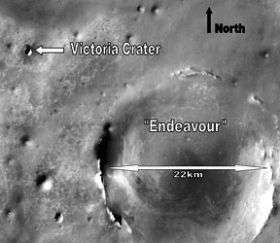
The Mars rover Opportunity, currently located near the northwestern rim of Victoria Crater, is headed next for a massive crater the rover team unofficially calls "Endeavour." The image was taken from orbit by the THEMIS instrument on NASA's Mars Odyssey spacecraft. Image: NASA/JPL/ASU

(PhysOrg.com) -- The Mars rover Opportunity, which has just crawled out of the 800-meter-wide (875 yards) Victoria Crater is setting out on the longest journey of its life. It will take the rover roughly two years of driving at its top speed -- up to 100 meters (109 yards) a day -- to reach its new target, a crater 20 times the size of Victoria that the Mars Exploration Rover team has unofficially dubbed "Endeavour."

But there's a survival problem. Opportunity is already four years past its warranty -- NASA's Sept. 22 announcement was made on day 1,658 of Opportunity's original 90-day mission. Despite its age, though, Opportunity has proved itself capable of driving and doing science on Mars. Its twin, Spirit, on the other side of the planet, is still alive as well, although one of its six wheels no longer functions.

To get to the 22 kilometer-wide crater (nearly 14 miles), Opportunity will need to drive 11 kilometers (nearly 7 miles) to the southeast -- that's equal to the total distance the rover has traveled since it landed on Mars in January 2004.

If Opportunity makes it to the crater, the view should be spectacular, said Steve Squyres, principal investigator of the Mars Exploration Rover mission and Cornell's Goldwin Smith Professor of Astronomy.

"It's the deepest window into the subsurface of Mars that we could possibly ever see," Squyres said. "I have no idea whether we'll make it, but scientifically, it's the right direction to go whether we make it or not."

Because the rock layers at Meridiani Planum (the region of Mars that Opportunity has been exploring) are older in the north and get younger toward the south, Opportunity should encounter younger and younger rock layers -- and Squyres thinks that alone could make the drive worthwhile.

No matter what Opportunity finds, the new plan is exciting the Cornell-based rover operations team.

"It's bold, it's challenging, and it's going to be fun. It's going to push the team to get better and better at what we do just to have a chance of making it," Squyres said.

Opportunity's journey to Victoria Crater was a long haul, as well; the rover traveled 6.5 kilometers (4 miles) over ripples of loose sand -- sometimes getting stuck in them -- before reaching the edge of the crater.

This time around, the rover team has some new resources that should make Opportunity's drive easier. One is a software package uploaded to both rovers in 2006 that will help them autonomously choose safe driving routes.

Another advantage is the HiRISE instrument on NASA's Mars Reconnaissance Orbiter -- a camera so powerful it can image the rovers from orbit -- that arrived at Mars in 2006. With its impressively high-resolution images, the team can identify potential hazards along Opportunity's route before the rover encounters them.

Nonetheless, Squyres believes that driving an aging Opportunity to what will probably be its final goal "will be one of the hardest things anyone's ever tried to do on Mars."

Provided by Cornell University

4.8 /5 (5 votes)  

Rank 4.8 /5 (5 votes)
Relevant PhysicsForums posts
  • Never ending outer space.....
    created15 hours ago
  • Neutron Star fragments?
    created17 hours ago
  • stationary or not?
    created21 hours ago
  • Scale of the Universe
    createdFeb 10, 2012
  • Titan's lack of impact craters
    createdFeb 09, 2012
  • Real pictures of black hole eating a star?
    createdFeb 08, 2012
  • More from Physics Forums - General Astronomy

More news stories

Salvage workers begin pumping fuel from Italian shipwreck

Salvage workers Sunday began pumping fuel from the shipwrecked Italian cruise liner Costa Concordia, a day ahead of schedule, officials said.

Space & Earth / Environment

created 2 minutes ago | popularity not rated yet | comments 0

Latin America mining boom clashes with conservation

Latin America is experiencing a mining boom as prices rise fuelled by a hike in global demand, but the region is also being hit by a wave of violent protests, strikes and rallies by environmentalists.

Space & Earth / Environment

created 8 hours ago | popularity not rated yet | comments 0

Political leaders play key role in how worried Americans are by climate change: study

More than extreme weather events and the work of scientists, it is national political leaders who influence how much Americans worry about the threat of climate change, new research finds.

Space & Earth / Environment

created Feb 06, 2012 | popularity 5 / 5 (6) | comments 73

NASA budget will axe Mars deal with Europe: scientists

US President Barack Obama's budget proposal to be submitted next week for 2013 will cut NASA's budget by 20 percent and eliminate a major partnership with Europe on Mars exploration, scientists said Thursday.

Space & Earth / Space Exploration

created Feb 10, 2012 | popularity 5 / 5 (3) | comments 55

Humans may have helped the decline of African rainforests 3000 years ago

(PhysOrg.com) -- Large areas of rainforests in Central Africa mysteriously disappeared over three thousand years ago, to be replaced by savannas. The prevailing theory has been that the cause was a change ...

Space & Earth / Environment

created Feb 10, 2012 | popularity 4.1 / 5 (14) | comments 20 | with audio podcast report


Scientists discover molecular secrets of 2,000-year-old Chinese herbal remedy

For roughly two thousand years, Chinese herbalists have treated Malaria using a root extract, commonly known as Chang Shan, from a type of hydrangea that grows in Tibet and Nepal. More recent studies suggest that halofuginone, ...

New method to examine batteries -- MRI from the inside

There is an ever-increasing need for advanced batteries for portable electronics, such as phones, cameras, and music players, but also to power electric vehicles and to facilitate the distribution and storage of energy derived ...

A mitosis mystery solved: How chromosomes align perfectly in a dividing cell

Although the process of mitotic cell division has been studied intensely for more than 50 years, Whitehead Institute researchers have only now solved the mystery of how cells correctly align their chromosomes during symmetric ...

Starve a virus, feed a cure? Findings show how some cells protect themselves against HIV

A protein that protects some of our immune cells from the most common and virulent form of HIV works by starving the virus of the molecular building blocks that it needs to replicate, according to research published online ...

Researchers find extensive RNA editing in human transcriptome

In a new study published online in Nature Biotechnology, researchers from BGI, the world's largest genomics organization, reported the evidence of extensive RNA editing in a human cell line by analysis of RNA-seq data, demons ...

The proteins ensuring genome protection

Researchers from the University of Geneva (UNIGE), Switzerland, have discovered the crucial role of two proteins in developing a cell 'anti-enzyme shield'. This protection system, which operates at the level of molecular ...