Economist's Model Forecasted Current Economic Slowdown One Year In Advance
September 25, 2008
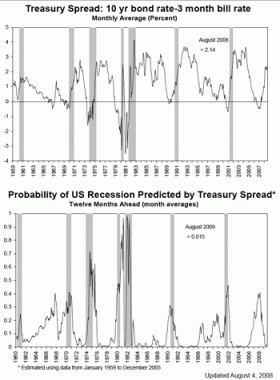
The above graphs were provided by Arturo Estrella, professor of economics and head of the economics department at Rensselaer. The graph above depicts the monthly average difference between 10-year and 3-month Treasury rates, which has turned negative (the yield curve has inverted) before every recession since the 1960s. The graph below indicates the probability of a recession, based on the yield curve twelve months earlier. When the yield curve is steep and the spread is high, the probability of a recession is close to zero. As the spread approaches zero, the probability rises more rapidly, increasing the likelihood of a recession.
(PhysOrg.com) -- An economist at Rensselaer Polytechnic Institute says that a model he developed forecasted the current economic slowdown at least one year before it became apparent to most observers. The model, which was first published in the Journal of Finance in June 1991, has successfully predicted every recession since 1955.
Arturo Estrella, professor of economics and new head of the economics department at Rensselaer Polytechnic Institute, and former senior vice president at the Federal Reserve Bank of New York, developed the model in 1988-89 in collaboration with Gikas Hardouvelis, professor in the department banking and financial management at the University of Piraeus in Athens, Greece.
“The surprisingly strong predictive power of the model stems from the term spread or yield curve slope, the difference between 10-year and 3-month Treasury interest rates,” Estrella said.
Estrella noted that he used the model to predict the 1990-91 and 2001 recessions in real time, and observed a strong signal regarding the present economic slowdown as early as October 2006.
“Historically, the model has predicted every major economic slowdown since 1955, including every recession and the ‘credit crunch’ of 1966-67, which Nobel Prize winning economist Milton Friedman regarded as an unclassified recession,” Estrella said.
The standard dating of recessions in the United States is determined by the National Bureau of Economic Research based on factors such as negative growth in real gross domestic product (GDP) and declines in real income, employment, industrial production, and wholesale-retail sales. Since several of those factors are currently observed, many economic experts say that the United States is actually in a recession now.
“Employment is one of the principal indicators of economic health. Increasing employment is a signal of growth in production, business activity, and personal income,” Estrella said. “Conversely, declining employment is associated with businesses holding off on investment and on the hiring of new employees, waiting for signs that the economy will improve. These factors can in turn further depress GDP growth and the income consumers need for new purchases.”
According to the U.S. Bureau of Statistics, the U.S. economy lost more than 80,000 jobs in August, and the national unemployment rate went from 5.7 percent to 6.1 percent, making for the most severe four-month rise in joblessness since 1981. So far in 2008, more than 600,000 jobs have been lost.
The problems go beyond the job market, according to the Mortgage Bankers Association. Mortgage foreclosures rose 1.2 percent in the second quarter, the sharpest rate of increase in the 29-year history of the group’s survey.
On another note, consumer spending, adjusted for inflation, declined in June and fell somewhat further in July. Chain store sales in August were also disappointing. The weakness in consumer spending—despite the receipt of tax rebate checks—is not surprising, noted the association. Consumer confidence is at levels not seen since the recession of 1990-91, according to the group’s economic commentary.
Are there brighter days ahead for the United States economy? “The Federal Reserve has a very difficult task still ahead as it juggles concerns about inflation, the health of the economy, and the stability of the financial system.” Estrella said. “Economic slowdowns and recessions generally help keep inflation under control, but it is a tough balancing act to slow economic growth just enough so as to prevent inflation without exacerbating economic and financial market problems.”
According to Estrella, the New York Federal Reserve continues to update the model he developed to forecast the probability of future recessions. To view a current graph in use, go to http://www.newyork … Prob_Rec.pdf .
Estrella’s research interests include empirical macroeconomic modeling, particularly forecasting associated with recessions and other trends. His research also encompasses finance, monetary policy, and bank regulation. He has published 19 papers in some of the most respected journals in his field since 2000.
Estrella has a long record of administrative leadership at the Federal Reserve Bank of New York, where he headed departments in research and bank supervision. He first joined the bank as an economist in 1983. Estrella also has experience in the academic setting, having taught previously at Columbia University, Fordham University, and the University of Puerto Rico.
He holds doctoral and master’s degrees in economics from Harvard University. He also holds master’s degrees in mathematics from the University of Michigan as well as the University of Puerto Rico. He received his bachelor’s in philosophy from Columbia University.
Provided by Rensselaer Polytechnic Institute
-
Fuel economy of new vehicles continues to rise: report
Feb 07, 2012 |
not rated yet |
2
-
Researcher says six factors can help you lead a longer, better life
Feb 03, 2012 |
4.3 / 5 (3) |
0
-
People who retire early due to back problems face long-term financial disadvantage
Jan 31, 2012 |
not rated yet |
0
-
Designing wildlife corridors in the digital age
Jan 20, 2012 |
5 / 5 (1) |
0
-
Efforts to control the 'Mighty Mississippi' result in flooded farmland and permanent damage
Jan 19, 2012 |
5 / 5 (2) |
1
-
Engineers build first sub-10-nm carbon nanotube transistor
Feb 01, 2012 |
4.9 / 5 (33) |
30
-
Something old, something new: Evolution and the structural divergence of duplicate genes
Jan 31, 2012 |
4.6 / 5 (7) |
1
-
The hidden nanoworld of ice crystals: Revealing the dynamic behavior of quasi-liquid layers
Jan 30, 2012 |
5 / 5 (5) |
1
-
Stock market network reveals investor clustering
Jan 27, 2012 |
3.9 / 5 (23) |
8
-
Of microchemistry and molecules: Electronic microfluidic device synthesizes biocompatible probes
Jan 26, 2012 |
5 / 5 (2) |
0
-
Probability Question - Chances Of Meeting Again
3 hours ago
-
Young Diagrams
10 hours ago
-
transforming from polar to parametric functions
10 hours ago
-
Validity of proof method -- error in book?
12 hours ago
-
Finding intersections
Feb 11, 2012
-
Interpreting a function based on it's equation.
Feb 11, 2012
- More from Physics Forums - General Math
More news stories
Australian women reject 'I love u' texts
Australian women may have embraced the digital era, but they prefer a face-to-face declaration of affection to an "I love u" text and find men addicted to their mobile phones a major turnoff.
Other Sciences / Social Sciences
1 hour ago |
not rated yet |
0
A frank discussion of the power law and linking correlation to causation
(PhysOrg.com) -- Michael Stumpf a mathematics professor at Imperial College in London, and Mason Porter a lecturer at Oxford have teamed together to write and publish a perspective piece in Science regarding the in ...
US workers are 'giving away the store,' costing firms billions
Nearly 70 percent of the nation's service employees give away free goods and services from hamburgers to cable TV costing companies billions of dollars a year, according to a groundbreaking study.
Other Sciences / Economics & Business
Feb 09, 2012 |
3 / 5 (5) |
11
Employers feel no love for unscrupulous practice of 'service sweethearting'
A new study led by two Florida State University marketing professors finds that some frontline service employees who are rewarded for hikes in customer loyalty and satisfaction also may engage in "service ...
Other Sciences / Economics & Business
Feb 10, 2012 |
3.3 / 5 (3) |
10
New insights into how to correct false knowledge
The abundance of false information available on the Internet, in movies and on TV has created a big challenge for educators.
Other Sciences / Social Sciences
Feb 07, 2012 |
4.9 / 5 (7) |
9
|
Rapunzel, Leonardo and the physics of the ponytail
(PhysOrg.com) -- New research provides the first mathematical understanding of the shape of a ponytail and could have implications for the textile industry, computer animation and personal care products.
Climate change causes harmful algal blooms in North Atlantic: study
Warming oceans and increases in windiness could be causing of an abundance of harmful algal blooms in the North Atlantic Ocean and North Sea, according to new research.
Hacker claims porn site users compromised
A hacker claims to have compromised the personal information of more than 350,000 users after breaking into a disused website operated by pornography provider Brazzers.
Cognitive impairment in older adults often unrecognized in the primary care setting
A new study published in the Journal of the American Geriatrics Society reveals that brief cognitive screenings combined with offering further evaluation increased new diagnoses of cognitive impairment in older veterans two to ...
AT&T customers surprised by 'unlimited data' limit
(AP) -- Mike Trang likes to use his iPhone 4 as a GPS device, helping him get around in his job. Now and then, his younger cousins get ahold of it, and play some YouTube videos and games.
Scientists discover molecular secrets of 2,000-year-old Chinese herbal remedy
For roughly two thousand years, Chinese herbalists have treated Malaria using a root extract, commonly known as Chang Shan, from a type of hydrangea that grows in Tibet and Nepal. More recent studies suggest that halofuginone, ...
Sep 25, 2008
Rank: 5 / 5 (1)
Apr 07, 2009
Rank: not rated yet
tkjtkj@gmail.com