Research underway to give sleep apnea sufferers relief and rest
September 26th, 2008 Catching Zzz's with Zzoma

Enlarge

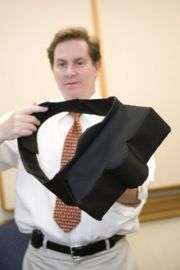
Samuel Krachman, D.O., holds Zzoma, a belt-like device worn during sleep to alleviate positional sleep apnea. Photo by Ryan S. Brandenberg/Temple University

For some, a full night's rest can be anything but restful. That's because they have sleep apnea, which causes them to struggle for breath in bouts throughout the night. Six percent of the population is affected by the condition—but many don't even know they have it.

"They don't make the connection between the fact that they snore loudly at night and they complain about being tired during the day," says Samuel Krachman, D.O. , professor of medicine and director of the Sleep Disorders Center at Temple University School of Medicine and Hospital. "They think that they're just tired, not getting enough sleep or just working too hard. But in reality, it's related to the sleep apnea."

Krachman is leading research on an experimental device to help patients who suffer from positional sleep apnea. Positional sleep apnea refers to patients who have episodes where they stop breathing when they're on their back, but when they are on their side, the abnormal breathing resolves. Fifty percent of patients with mild sleep apnea (those who experience anywhere from five to 15 events an hour) and 20 percent of people with moderate sleep apnea (15 to 30 events an hour) have positional sleep apnea. Krachman explains how wearing the device, called Zzoma, works to reduce those episodes.

"Zzoma is a device which is worn around the chest area like a belt, with a device on the back, which is a firm, foam material wrapped in canvas to keep them from moving on their backs. Over the last year, we've been studying its use in treating patients with mild to moderate positional sleep apnea."

The device was created by former Temple Fellow Joseph G. Crocetti. He and Krachman have worked together to treat positional sleep apnea. Their research has shown that the Zzoma device is less obtrusive and easier to use than the leading alternative, a continuous positive airway pressure machine or CPAP, a mask that blows air on a person's face to keep the airway open.

"Although CPAP is very effective, the best studies have shown it's only used correctly 50 percent of the time," says Krachman. "That leaves many diagnosed with sleep apnea but not treated."

Untreated sleep apnea can lead to a host of other medical problems. Just having sleep apnea is an independent risk factor for developing high blood pressure, coronary disease and heart failure. That's why Krachman hopes the FDA approves Zzoma to treat positional sleep apnea, to give sufferers an effective alternative to the burden of CPAP.

Source: Temple University


print this article email this article download pdf blog this article bookmark this article     Digg this Stumble it share on Facebook share on Reddit add to delicious save to Yahoo! bookmarks
4/5 after 2 votes


September 26th, 2008 all stories
Medicine & Health / Health

Comments: 0
Rank: 4/5 after 2 votes

  • Stumble this up

  • Digg this

  • Share it:
  • share on Facebook
  • share on MySpace
  • share on Slashdot
  • rss-newsfeed
  • share on Google
  • share on Reddit
  • add to delicious
  • save to Yahoo! bookmarks
  • share on Windows Live
  • Add to Mixx!
Rating: 4/5 after 2 votes

  • Related Stories

  • Surgery, oral devices associated with improvement in sleep breathing disorder
    created May 18, 2009 | popularity not rated yet | comments 0
  • Wearable blood pressure sensor offers 24/7 continuous monitoring
    created Apr 08, 2009 | popularity not rated yet | comments 0
  • Breathing problems during sleep associated with calories burned at rest
    created Dec 15, 2008 | popularity not rated yet | comments 0
  • Treating sleep apnea in Alzheimer's patients helps cognition
    created Dec 03, 2008 | popularity not rated yet | comments 0
  • Fat fish put obesity on the hook
    created Jun 18, 2007 | popularity not rated yet | comments 0


  • Physicists Demonstrate Quantum Memory with Matter Qubits
    Physicists Demonstrate Quantum Memory with Matter Qubits
    Physics / General Physics
    created Jul 03, 2009 | popularity 4.4 / 5 (17) | comments 1
  • 'Holey' Nanosheets for Wastewater Dye Removal
    Nanotechnology / Nanomaterials
    created Jul 01, 2009 | popularity 5 / 5 (5) | comments 1
  • Jellyfish Robot Swims Like its Biological Counterpart
    Jellyfish Robot Swims Like its Biological Counterpart
    Electronics / Robotics
    created Jun 26, 2009 | popularity 4.4 / 5 (8) | comments 1
  • Could Maxwell's Demon Exist in Nanoscale Systems?
    Could Maxwell's Demon Exist in Nanoscale Systems?
    Physics / General Physics
    created Jun 24, 2009 | popularity 4.4 / 5 (18) | comments 29
  • Living Safely with Robots, Beyond Asimov's Laws
    Living Safely with Robots, Beyond Asimov's Laws
    Electronics / Robotics
    created Jun 22, 2009 | popularity 4.6 / 5 (54) | comments 40
  • Other News

    Mice with skin condition help scientists understand tumor growth

    Medicine & Health / Cancer

    created 57 minutes ago | popularity not rated yet | comments 0

    Cancerous tumors sometimes form at the site of chronic wounds or injury, but the reason why is not entirely clear. Now researchers at Washington University School of Medicine in St. Louis have engineered mice with a persistent ...


    Dogs, humans, put heads together to find cure for brain cancer

    Medicine & Health / Genetics

    created 54 minutes ago | popularity not rated yet | comments 0

    Pinpointing the genes involved in human brain cancer can be like looking for a needle in a haystack, and sometimes the needle you find may not be the right one. By comparing human and canine genomes, researchers at North ...


    Atrial fibrillation linked to increased hospitalization in heart failure patients

    Medicine & Health / Diseases

    created 1hour ago | popularity not rated yet | comments 0

    Patients with atrial fibrillation, common in those with advanced chronic heart failure, have an increased risk of hospitalization due to heart failure, according to new research from researchers at the University of Alabama ...


    New study pinpoints difference in the way children with autism learn new behaviors

    Medicine & Health / Neuroscience

    created 3 hours ago | popularity not rated yet | comments 0

    Researchers from the Kennedy Krieger Institute and Johns Hopkins University School of Medicine have collaborated to uncover important new insights into the neurological basis of autism.


    The 2 faces of Mdmx: Why some tumors don't respond to radiation and chemotherapy

    The 2 faces of Mdmx: Why some tumors don't respond to radiation and chemotherapy

    Medicine & Health / Cancer

    created 1hour ago | popularity not rated yet | comments 0

    A tightly controlled system of checks and balances ensures that a powerful tumor suppressor called p53 keeps a tight lid on unchecked cell growth but doesn't wreak havoc in healthy cells. In their latest study, ...