Scientists unmask key HIV protein, open door for more powerful AIDS drugs
September 26, 2008
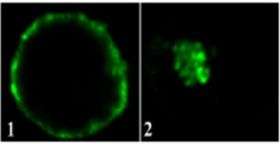
At left, a normal, uninfected cell with green-stained MHC-I protein on the cell surface. At right, an HIV infected cell -- most of the MHC-I builds up inside, keeping the cell from telling the immune system that it harbors a virus. Credit: Kathleen Collins, University of Michigan
University of Michigan scientists have provided the most detailed picture yet of a key HIV accessory protein that foils the body's normal immune response. Based on the findings, which appear online in the journal PLoS Pathogens, the team is searching for new drugs that may someday allow infected people to be cured and no longer need today's AIDS drugs for a lifetime.
"There's a big hole in current therapies, in that all of them prevent new infection, but none attack the cells that are already infected and hidden from the immune response," says Kathleen L. Collins, M.D., Ph.D., the study's senior author and a U-M associate professor in both internal medicine and microbiology and immunology.
In people infected with HIV (human immunodeficiency virus), the virus that causes AIDS, there's an unsolved problem with current anti-viral drugs. Though life-saving, they cannot root the virus out of the body. Infected cells are able to live on, undetected by the immune system, and provide the machinery for the virus to reproduce and spread.
"People have to be on the existing drugs, and when they're not, the virus rebounds. If we can develop drugs that seek out and eradicate the remaining factories for the virus, then maybe we could eradicate the disease in that person," Collins says.
The new research details the complex actions of a protein, HIV-1 Nef, that is known to keep immune system cells from doing their normal jobs of detecting and killing infected cells.
Collins and her team show how Nef disables two key immune system players inside an infected cell. These are molecules called major histocompatability complex 1 proteins (MHC-1) that present HIV antigens to the immune system, and CD4, the cell-surface receptor that normally locks onto a virus and allows it to enter the cell.
Collins likens MHC-1 to motion detectors on a house, which send the first signal to a monitoring station if an invader breaks in.
"The immune system, especially the cytotoxic T lymphocytes, are like the monitors who get the signal that there's a foreign invader inside the cell, and send out police cars," she says. "The 'police' are toxic chemicals produced by T lymphocyte cells, which kill the cell that harbors the invader."
By in effect pushing the MHC-I proteins into an infected cell's "trash bin" so they fail to alert the T lymphocytes, Nef's actions allow active virus to hide undetected and reproduce. Also, once a cell has been infected, Nef destroys CD4. The result is that this encourages new virus to spread to uninfected cells.
Nef's activities are variable and complex. But the research team's findings suggest that the many pathways involved may end in a final common step. That could make it possible to find a drug that could block several Nef functions.
Collins' lab is now screening drug candidates to find promising Nef inhibitors. Such drugs, which are at least 10 years away from use in people, would supplement, not replace, existing anti-viral drugs given to HIV-infected people. The new drugs would target the reservoirs where the virus hides.
In developing countries, the new drugs could have a huge impact, Collins says. Today, children born with HIV infection start taking the existing anti-HIV drugs at birth. It's very hard to continue costly treatments for a lifetime. But if children could be cured within a few years, global HIV treatment efforts could spread their dollars further and be much more successful, she says.
Citation: PLoS Pathogens, doi:10.1371/journal.ppat.1000131
Source: University of Michigan Health System
-
Engineers build first sub-10-nm carbon nanotube transistor
Feb 01, 2012 |
4.9 / 5 (33) |
30
-
Something old, something new: Evolution and the structural divergence of duplicate genes
Jan 31, 2012 |
4.6 / 5 (7) |
1
-
The hidden nanoworld of ice crystals: Revealing the dynamic behavior of quasi-liquid layers
Jan 30, 2012 |
5 / 5 (4) |
1
-
Stock market network reveals investor clustering
Jan 27, 2012 |
3.9 / 5 (23) |
8
-
Of microchemistry and molecules: Electronic microfluidic device synthesizes biocompatible probes
Jan 26, 2012 |
5 / 5 (2) |
0
-
Classical and Quantum Mechanics via Lie algebras
Apr 15, 2011
- More from Physics Forums - Independent Research
More news stories
Starve a virus, feed a cure? Findings show how some cells protect themselves against HIV
A protein that protects some of our immune cells from the most common and virulent form of HIV works by starving the virus of the molecular building blocks that it needs to replicate, according to research published online ...
10 hours ago |
5 / 5 (2) |
0
|
Overeating may double risk of memory loss
New research suggests that consuming between 2,100 and 6,000 calories per day may double the risk of memory loss, or mild cognitive impairment (MCI), among people age 70 and older. The study was released today and will be ...
Medicine & Health / Neuroscience
6 hours ago |
5 / 5 (2) |
0
|
Injured boomers beware: Know when to see doctor
(AP) -- It happened to nurse Jane Byron years after an in-line skating fall, business owner Haralee Weintraub while doing "men's" push-ups, and avid cyclist Gene Wilberg while lifting a heavy box.
11 hours ago |
5 / 5 (1) |
0
Declining health-care productivity in England: Who says so?
Reports that the National Health Service in England has been declining in productivity in the last decade appear to have been accepted as fact. However, a Viewpoint published Online First by The Lancet disputes this. The Vi ...
4 hours ago |
not rated yet |
0
FDA-approved drug rapidly clears amyloid from the brain, reverses Alzheimer's symptoms in mice
Neuroscientists at Case Western Reserve University School of Medicine have made a dramatic breakthrough in their efforts to find a cure for Alzheimer's disease. The researchers' findings, published in the journal Science, show t ...
Medicine & Health / Neuroscience
Feb 09, 2012 |
4.9 / 5 (58) |
17
|
Scientists discover molecular secrets of 2,000-year-old Chinese herbal remedy
For roughly two thousand years, Chinese herbalists have treated Malaria using a root extract, commonly known as Chang Shan, from a type of hydrangea that grows in Tibet and Nepal. More recent studies suggest that halofuginone, ...
New method to examine batteries -- MRI from the inside
There is an ever-increasing need for advanced batteries for portable electronics, such as phones, cameras, and music players, but also to power electric vehicles and to facilitate the distribution and storage of energy derived ...
Google might launch Drive for cloud storage soon
(PhysOrg.com) -- Google's next big move, according to the Wall Street Journal, is a cloud storage service called Drive. Hardly first to the plate, Google is simply catching up to introducing its cloud reposi ...
A mitosis mystery solved: How chromosomes align perfectly in a dividing cell
Although the process of mitotic cell division has been studied intensely for more than 50 years, Whitehead Institute researchers have only now solved the mystery of how cells correctly align their chromosomes during symmetric ...
Lab study raises questions over nano-particle impact
Tests involving chickens have raised questions about the impact on health from engineered nano-particles, the ultra-fine grains commonly used in drugs and processed foods, scientists said on Sunday.
Researchers find extensive RNA editing in human transcriptome
In a new study published online in Nature Biotechnology, researchers from BGI, the world's largest genomics organization, reported the evidence of extensive RNA editing in a human cell line by analysis of RNA-seq data, demons ...