Field of the future -- ecological experiment simulates conditions in 2100
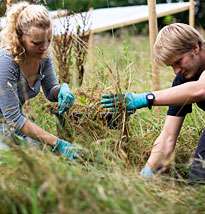
(PhysOrg.com) -- A new experiment to find out how British plant ecosystems may be affected by future changes to climate and biodiversity is underway at Imperial College London.
The experiment will simulate predicted future rainfall patterns in a semi-natural grassland at Imperial's Silwood Park campus in Berkshire, and scientists will assess how differing levels of plant diversity affect the ecosystem's response to climate stress. The study will reflect the Intergovernmental Panel on Climate Change's (IPCC) prediction that southern England will experience up to a 30% decrease in summer rainfall and a 15% increase in winter rainfall, by the year 2100.
The study is led by Dr Sally Power and Dr Pete Manning, and has been set up with funding principally from Imperial's Grantham Institute for Climate Change and the NERC Centre for Population Biology. The research is being carried out by Grantham Institute PhD student Ellen Fry and a team of researchers. It will focus on how important functions performed by ecosystems, such as water processing, nutrient cycling and carbon storage, are affected when there are significant changes to the patterns of rainfall they receive.
Importantly, however, in a novel approach to the issue, this study will also examine the extent to which climate-driven effects on these key functions are modified by changes in levels of plant biodiversity in the ecosystem. The research team have chosen to include different levels of plant diversity in their study because global biodiversity decline, associated with climate change, pollution, changing land use patterns and other human impacts on the environment is now well documented and is predicted to increase during this century.
Dr Sally Power from Imperial's Division of Biology said: "Ecosystems will be facing a multitude of challenges in the coming years. Changing rainfall patterns are likely to affect the ability of ecosystems to perform important ecological functions such as nutrient cycling; a key challenge is now to understand the implications of biodiversity loss for ecosystem functioning and the sustainability of these functions in a changing climate."
The experiment comprises 168 rain shelters, each covering 2.4 m x 2.4 m plots within a grassland ecosystem. The shelters are left on throughout the summer, enabling the scientists to accurately manipulate the amount of rainwater that reaches the plants underneath, with some groups receiving natural levels of rainfall, and others receiving the lower levels of rain predicted for 2100. In the winter the shelters are removed, and the 2100 simulation plots will be given extra water by Miss Fry and her colleagues, to reflect the anticipated rise in winter rainfall.
In addition, the researchers have manipulated the biodiversity of the plants found in each plot to reflect different levels of plant trait diversity within experimental plots. Plant traits that affect ecosystem functions, such as root length, nutrient uptake and photosynthesis rate were measured at the beginning of the experiment for all of the species found at the study site. Species were then categorised into three groups on the basis of measured attributes, with members of each group sharing similar characteristics. The experimental plots were then manipulated by the researchers so that so that either a single trait group, multiple pairs of trait groups, or all three trait groups are present in different plots, reflecting a gradient of increasing diversity.
Dr Pete Manning explains that manipulating the diversity of the plants in this way, using traits to group them together, allows the research team to relate changes in plant diversity to effects on key ecosystem processes particularly in light of changing rainfall patterns:
"We now realise that when it comes to biodiversity, it's not simply the number of different species living together in a place that's important, but what those species do in the ecosystem", he said.
"For example, losing species with bulb-like storage organs and deep roots may make the ecosystem more sensitive to climate change, as these are the species that are most likely to keep performing useful functions, like storing carbon, during periods of drought. This experiment allows us to test these sort of ideas, in a way that hasn't been possible before. Ultimately, we may be able to identify which species are the most likely to decline under future conditions and whether these declines will affect important ecosystem functions", he added.
Professor Sir Brian Hoskins, Director of the Grantham Institute for Climate Change at Imperial said: "Because this experiment tackles the issues of summer droughts and winter floods in a full ecosystem context, but one with decreasing plant trait biodiversity all at the same time, means that it promises one of the most realistic pictures to date of how ecosystems in the UK may react to the environmental changes caused by human emissions of greenhouse gases."
Source: Imperial College London


