Biophysicists create new model for protein-cholesterol interactions in brain and muscle tissue
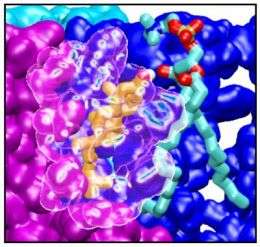
Biophysicists at the University of Pennsylvania have used 3,200 computer processors and long-established data on cholesterol's role in the function of proteins to clarify the mysterious interaction between cholesterol and neurotransmitter receptors. The results provide a new model of behavior for the nicotinic acetylcholine receptor, a well studied protein involved in inflammation, Alzheimer's disease, Parkinson's disease, schizophrenia, epilepsy, the effect of general anesthetics and addiction to alcohol, nicotine and cocaine.
Moreover, the results apply to closely related receptors that bind serotonin and GABA, which are neurotransmitters directly involved in regulation of mood and sleep.
The findings have broad implications for, among other fields, pharmacology. Drug development in this arena has to take into account the structure and chemical makeup of this receptor, both of which researchers now say were incomplete. Drugs acting on the receptor have been thought to interact with the protein as though it were isolated.
Now, researchers believe that drugs binding to the receptor not only interact with amino acids — the building blocks of the protein receptor — but also cholesterol tucked away within the protein. The shift in thinking transforms the understanding of this receptor in many ways, from shape and structure to its interaction with its environment and its response to neurotransmitters. The new model should spark a reexamination of several decades of research on the receptor's structure and function.
Researchers demonstrated that the receptor, also know as nAChR, contains internal sites capable of containing cholesterol which serve to stabilize the protein's structure. Furthermore, molecular simulations revealed that both surface sites and deeply buried sites within the protein require cholesterol, which directly supports contacts between the agonist-binding domain and the pores that are thought to be essential for activation of the receptor.
"The result was surprising because, according to most traditional biological models, cholesterol is part of the membrane, not part of the protein," Grace Brannigan, a researcher with the Center for Molecular Modeling at Penn, said. "Our model takes cholesterol out of a background role in the protein's structure and function and puts it on center stage."
Researchers used prior data on how the receptor depends on cholesterol to function plus a computer cluster to run simulations of some 230,000 atoms and their interactions over time. From the raw data, researchers used visualization software to create a model of behavior between the protein and the cholesterol required to function properly.
The study focused on the nicotinic acetylcholine receptor, an ion channel found in both brain and muscle cells. The neurotransmitter acetylcholine, released by upstream nerve cells, binds to portions of the protein on the outside of brain and muscle cells causing the channel to open and allow ions to cross the membrane. Anesthetics, for example, close the channel, which can reduce sensations and cause the memory loss associated with being "put under."
The receptor is a cation-selective channel central to both neuronal and muscular processes and is considered the prototype for ligand-gated ion channels, leading to decades of study to determine its structure. Penn researchers sought to further understand the structure recently determined through cryo-electron microscopy by British and Japanese researchers. Measuring structural details is a difficult task for any protein embedded within a membrane, which can be easily destroyed during the extraction process. The published structure included large, mysterious holes in the protein density.
"It's like looking at the shape of a lock and realizing that you've had the key in your pocket the whole time," Jerome Henin, a researcher with the Center for Molecular Modeling, said. "We found that the holes are the perfect size and shape for cholesterol, which is significant because it has been known for 30 years that this type of protein can only do its job properly if there is cholesterol nearby."
Assuming that cholesterol-shaped holes may indicate a role for cholesterol, researchers began massive simulations on the protein with and without cholesterol present and found that only with cholesterol does the protein behave as expected from experimental data.
This result could also have important implications for understanding recent data indicating that low cholesterol in brain cells has harmful effects on memory, concentration and mood. Twenty-five percent of cholesterol within the body is found in brain cells, where it seems to perform many important roles. Most of the theories for how cholesterol improves the function of brain cells have focused on its effect on the membranes that enclose these cells, but this work suggests that cholesterol may play a much more direct role by burying itself within some of the proteins that are necessary for cells to communicate.
The study was published in the Proceedings of the National Academy of Sciences.
Source: University of Pennsylvania


