Physicists Find that Size Matters When Initiating an Object's Movement Through Grains
September 26th, 2008 Physicists Find that Size Matters When Initiating an Object's Movement Through Grains

Enlarge

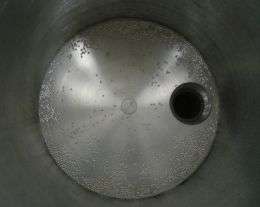
The researchers filled a cylindrical bucket with glass beads and measured the force required to lift the beads. Credit: Costantino, Penn State

A team of Penn State physicists has discovered that the size of grains, such as sand, above a buried object is important in determining the force required to begin raising the object. No one, until now, has discovered how much force is required to initiate an object's movement through grains. The result may be useful for engineering foundations for objects to be anchored in sandy soils, such as power-line towers, or for designing industrial mixer blades, such as those used in pharmaceutical processing. The team's paper is published this month in the journal Physical Review Letters.

"We found that less force is needed to lift an object that is buried beneath small grains than is needed to lift an object that is buried beneath larger grains," said Peter Schiffer, associate vice president for research and a professor of physics at Penn State. "Basically, if you are buried alive and you have to push open a coffin lid, it's better to be buried under fine-grained sand than under pebbles," he said.
Physicists Find that Size Matters When Initiating an Object's Movement Through Grains
Enlarge

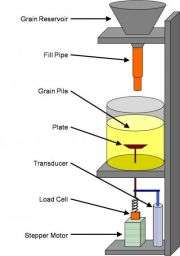
A drawing of the apparatus that the researchers used to measure the force required to lift glass beads from a stationary position. Credit: Costantino, Penn State

According to Schiffer, other researchers have examined how much force is required to maintain an object's movement through grains, but no one previously had looked at how much force is required to initiate it. "The two measurements are different," he said. "When initiating the movement of an object, the grains immediately above the object must be shifted out of the way to make space for the object to move, which requires that the surrounding grains be loosened. In contrast, an object that already is in motion requires less force to maintain that motion because the surrounding grains already are loosened. It's the loosening of grains around the object that seems to make the difference," said Schiffer.

The scientists built an apparatus that measures the force required to push a flat circular plate upward from the bottom of a cylindrical bucket that is filled with glass beads. The team measured the force using different sizes of glass beads and found that the smallest beads required the least amount of force to lift the plate. "The total weight of the grains above the plate was adjusted so that it was the same regardless of grain size," said Dan Costantino, a Penn State graduate student and one of the paper's lead authors.

In the future, the team plans to measure the force required to initiate the horizontal movement of an object through grains. The scientists also plan to substitute water or a heavy liquid for the air between the grains. "A liquid that has the same density as the grains will effectively make the grains weightless, so we can further investigate whether the strength of the grains comes from their weight or from the way they are packaged together," said Costantino.

Source: Penn State


print this article email this article download pdf blog this article bookmark this article     Digg this Stumble it share on Facebook share on Reddit add to delicious save to Yahoo! bookmarks
4.1/5 after 13 votes


September 26th, 2008 all stories
Physics / General Physics

Comments: 0
Rank: 4.1/5 after 13 votes

  • Stumble this up

  • Digg this

  • Share it:
  • share on Facebook
  • share on MySpace
  • share on Slashdot
  • rss-newsfeed
  • share on Google
  • share on Reddit
  • add to delicious
  • save to Yahoo! bookmarks
  • share on Windows Live
  • Add to Mixx!
Rating: 4.1/5 after 13 votes

  • Related Stories

  • Why anyone can make a sandcastle
    created Feb 11, 2008 | popularity not rated yet | comments 0
  • Planet Earth may have 'tilted' to keep its balance
    created Aug 25, 2006 | popularity not rated yet | comments 0
  • Mesmerized by Moondust
    created Nov 21, 2005 | popularity not rated yet | comments 0
  • Streaming sand grains help define essence of a liquid (w/ Video)
    created Jun 24, 2009 | popularity not rated yet | comments 0
  • Membrane filters are key to future of public water supply, scientists say
    created Apr 21, 2009 | popularity not rated yet | comments 0


  • Physicists Demonstrate Quantum Memory with Matter Qubits
    Physicists Demonstrate Quantum Memory with Matter Qubits
    Physics / General Physics
    created Jul 03, 2009 | popularity 4.4 / 5 (17) | comments 1
  • 'Holey' Nanosheets for Wastewater Dye Removal
    Nanotechnology / Nanomaterials
    created Jul 01, 2009 | popularity 5 / 5 (5) | comments 1
  • Jellyfish Robot Swims Like its Biological Counterpart
    Jellyfish Robot Swims Like its Biological Counterpart
    Electronics / Robotics
    created Jun 26, 2009 | popularity 4.4 / 5 (8) | comments 1
  • Could Maxwell's Demon Exist in Nanoscale Systems?
    Could Maxwell's Demon Exist in Nanoscale Systems?
    Physics / General Physics
    created Jun 24, 2009 | popularity 4.4 / 5 (18) | comments 29
  • Living Safely with Robots, Beyond Asimov's Laws
    Living Safely with Robots, Beyond Asimov's Laws
    Electronics / Robotics
    created Jun 22, 2009 | popularity 4.6 / 5 (52) | comments 40
  • Other News

    Science journals

    How to Spot an Influential Paper Based on its Citations

    Physics / General Physics

    created 23 hours ago | popularity 4 / 5 (9) | comments 5

    (PhysOrg.com) -- At first it may seem that the number of citations received by a published scientific paper is directly related to that paper's quality of content. The higher the quality, the more people read ...


    Scientists create first electronic quantum processor

    Scientists create first electronic quantum processor

    Physics / General Physics

    created Jun 28, 2009 | popularity 4.8 / 5 (52) | comments 39

    A team led by Yale University researchers has created the first rudimentary solid-state quantum processor, taking another step toward the ultimate dream of building a quantum computer.


    Fermilab's CDF observes Omega-sub-b baryon

    Fermilab's CDF observes Omega-sub-b baryon

    Physics / General Physics

    created Jun 29, 2009 | popularity 4.7 / 5 (16) | comments 7

    (PhysOrg.com) -- At a recent physics seminar at the Department of Energy’s Fermi National Accelerator Laboratory, Fermilab physicist Pat Lukens of the CDF experiment announced the observation of a new particle, ...


    New insights, and a new angle, on high-temperature superconductivity

    New insights, and a new angle, on high-temperature superconductivity

    Physics / Superconductivity

    created Jun 29, 2009 | popularity 4.8 / 5 (13) | comments 6

    (PhysOrg.com) -- A Princeton-led research team has revealed surprising information about how electron behavior influences the conduction of electricity in a class of high-temperature superconductors. An increased ...


    The art of invisibility and the perfect cat's eye

    The art of invisibility and the perfect cat's eye

    Physics / Optics & Photonics

    created Jun 30, 2009 | popularity 4 / 5 (8) | comments 6

    (PhysOrg.com) -- In recent years scientists have explored the impossible by developing invisibility or 'cloaking' devices, but can the same technology also help make things more visible?