NASA's dirty secret: Moon dust
September 26, 2008
Lunar Paver

Enlarge

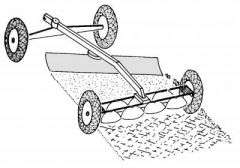
Lunar dust melts readily when exposed to microwave energy. Professor Larry Taylor of the University of Tennessee envisions a lunar paver fitted with microwave generators that could sinter, or melt, lunar soils into landing strips or roads. Credit: Larry Taylor

The Apollo Moon missions of 1969-1972 all share a dirty secret. "The major issue the Apollo astronauts pointed out was dust, dust, dust," says Professor Larry Taylor, Director of the Planetary Geosciences Institute at the University of Tennessee. Fine as flour and rough as sandpaper, Moon dust caused 'lunar hay fever,' problems with space suits, and dust storms in the crew cabin upon returning to space.

Taylor and other scientists will present their research on lunar dust at the "Living on a Dusty Moon" session on Thursday, 9 October 2008, at the Joint Meeting of the Geological Society of America (GSA), Soil Science Society of America (SSSA), American Society of Agronomy (ASA), Crop Science Society of America (CSSA), and Gulf Coast Association of Geological Societies (GCAGS) in Houston, Texas, USA. NASA will use these findings to plan a safer manned mission to the Moon in 2018. Taylor will also deliver a Pardee Keynote Session talk on Sunday, 5 October 2008 entitled "Formation and Evolution of Lunar Soil from An Apollo Perspective."

The trouble with moon dust stems from the strange properties of lunar soil. The powdery grey dirt is formed by micrometeorite impacts which pulverize local rocks into fine particles. The energy from these collisions melts the dirt into vapor that cools and condenses on soil particles, coating them in a glassy shell.

These particles can wreak havoc on space suits and other equipment. During the Apollo 17 mission, for example, crewmembers Harrison "Jack" Schmitt and Gene Cernan had trouble moving their arms during moonwalks because dust had gummed up the joints. "The dust was so abrasive that it actually wore through three layers of Kevlar-like material on Jack's boot," Taylor says.

To make matters worse, lunar dust suffers from a terrible case of static cling. UV rays drive electrons out of lunar dust by day, while the solar wind bombards it with electrons by night. Cleaning the resulting charged particles with wet-wipes only makes them cling harder to camera lenses and helmet visors. Mian Abbas of the National Space Science and Technology Center in Huntsville, Alabama, will discuss electrostatic charging on the moon and how dust circulates in lunar skies.

Luckily, lunar dust is also susceptible to magnets. Tiny specks of metallic iron (Fe0) are embedded in each dust particle's glassy shell. Taylor has designed a magnetic filter to pull dust from the air, as well as a "dust sucker" that uses magnets in place of a vacuum. He has also discovered that microwaves melt lunar soil in less time than it takes to boil a cup of tea. He envisions a vehicle that could microwave lunar surfaces into roads and landing pads as it drives, and a device to melt soil over lunar modules to provide insulation against space radiation. The heating process can also produce oxygen for breathing.

But the same specks of iron that could make moon dust manageable also pose a potential threat to human health, according to Bonnie Cooper at NASA's Johnson Space Center. "Those tiny blebs of pure iron we see on the surface of lunar grains are likely to be released from the outside edges of the particle in the lungs and enter the bloodstream," she says. Preliminary studies suggest that the inhalation of lunar dust may pose a health hazard, possibly including iron toxicity. Members of NASA's Lunar Airborne Dust Toxicity Advisory Group, Cooper, Taylor, and colleagues are studying how moon dust affects the respiratory system. They plan to set a lunar dust exposure standard by 2010, in time for NASA engineers to design a safer and cleaner trip to the Moon.

Source: Geological Society of America

4.8 /5 (28 votes)  

Filter


Move the slider to adjust rank threshold, so that you can hide some of the comments.


Display comments: newest first

earls
Sep 26, 2008

Rank: 1.7 / 5 (3)
Why can't we do this here on earth to make roads?
snivvy
Sep 26, 2008

Rank: 5 / 5 (8)
It would cost too much to transport the moon dust. ;-)
fsmith
Sep 26, 2008

Rank: 3.4 / 5 (9)
Why would you need landing strips on an airless world with no fixed-wing flight possible?
TJ_alberta
Sep 26, 2008

Rank: 5 / 5 (2)
maybe landing pads so that the reaction rockets don't kick up dust? similar to being near a helicopter takeoff or landing on bare ground.
MiniMonsterGroup
Sep 26, 2008

Rank: 2 / 5 (4)
Why would you need landing strips on an airless world with no fixed-wing flight possible?

Pwnt
bobwinners
Sep 26, 2008

Rank: 5 / 5 (1)
Suggestion: Sronger boots and a disposable lightweight dustcover that can be discarded when reentering the space capsule.
Soylent
Sep 26, 2008

Rank: 5 / 5 (2)
Why would you need landing strips on an airless world with no fixed-wing flight possible?


To avoid spraying everything with dust.
Mayday
Sep 27, 2008

Rank: 5 / 5 (2)
How deep can those microwaves penetrate? An inch? Won't this just create a thin crust of glass-like material that will shatter under the first astronaut's boot step creating thousands of shards of razor sharp moon-shrapnel?

And won't this melted-and-refrozen "dust" surface be extremely smooth and slippery with sharp uneven edges and knife-like popped bubble rims?

I think this needs just a touch more thought, don't you?

And don't all these dust problems get worse on Mars, with an atmosphere to buoy the dust and much more iron? Not to mention the recently discovered corrosive chemical make-up.

How long would I be able to breathe corrosive-ladden, iron-rich Mars dust?
deatopmg
Sep 27, 2008

Rank: 3 / 5 (2)
the microwave idea is great BUT where does all that energy come from? is it practical?
Velanarris
Sep 27, 2008

Rank: 5 / 5 (2)
The problem with moon dust as opposed to it's Earth equivalent is that it is not weathered at all, (due to no weather), so the dust is very sharp and blocky as opposed to our weathered rounded dust here. That's what gives the lunar dust the ability to stick in such great quantity and why it's so intrusive and obstructive. Now if we could find a way to repel this dust or a construct of greater efficiency than teflon to prevent obstruction, we'd have the issue solved.

The martial dust has been reported initially to be more similar to Earth dust, although the degree of weathering is an unknown quantity.
Rank 4.8 /5 (28 votes)
Related Stories
Relevant PhysicsForums posts
  • Titan's lack of impact craters
    createdFeb 09, 2012
  • Real pictures of black hole eating a star?
    createdFeb 08, 2012
  • Hypothetical way to travel faster than light, but not technically exceed lightspeed
    createdFeb 06, 2012
  • How do scientists monitor the Sun's activity?
    createdFeb 05, 2012
  • Search patterns in observational studies
    createdFeb 05, 2012
  • Derivation of Pogson's law
    createdFeb 03, 2012
  • More from Physics Forums - General Astronomy

More news stories

Humans may have helped the decline of African rainforests 3000 years ago

(PhysOrg.com) -- Large areas of rainforests in Central Africa mysteriously disappeared over three thousand years ago, to be replaced by savannas. The prevailing theory has been that the cause was a change ...

Space & Earth / Environment

created 11 hours ago | popularity 5 / 5 (4) | comments 10 | with audio podcast report

Could Venus be shifting gear?

(PhysOrg.com) -- ESA’s Venus Express spacecraft has discovered that our cloud-covered neighbour spins a little slower than previously measured. Peering through the dense atmosphere in the infrared, the ...

Space & Earth / Space Exploration

created 7 hours ago | popularity 5 / 5 (5) | comments 7 | with audio podcast

Mars Science Laboratory computer issue resolved

(PhysOrg.com) -- Engineers have found the root cause of a computer reset that occurred two months ago on NASA's Mars Science Laboratory and have determined how to correct it.

Space & Earth / Space Exploration

created 8 hours ago | popularity 5 / 5 (5) | comments 3 | with audio podcast

Clam fields found at deep, low-temperature Mariana vents

(PhysOrg.com) -- Scientists have marveled at the unusual life forms thriving at high temperature hydrothermal vents of the deep ocean.

Space & Earth / Earth Sciences

created 7 hours ago | popularity not rated yet | comments 0 | with audio podcast

Two new moons for Jupiter

Advances in technology have lead to the discovery of new planets outside of our Solar System, and now even new moons in our own backyard.

Space & Earth / Space Exploration

created 7 hours ago | popularity not rated yet | comments 5


Complex wiring of the nervous system may rely on a just a handful of genes and proteins

Researchers at the Salk Institute have discovered a startling feature of early brain development that helps to explain how complex neuron wiring patterns are programmed using just a handful of critical genes. ...

CIA website offline, Anonymous takes credit

The website of the Central Intelligence Agency was unresponsive on Friday after the hacker group Anonymous claimed to have knocked it offline.

Q&A: Obama and the birth control controversy

(AP) -- What birth control debate? A half-century after the introduction of the pill, acceptance of birth control by American women is virtually universal.

The power of estrogen -- male snakes attract other males

A new study has shown that boosting the estrogen levels of male garter snakes causes them to secrete the same pheromones that females use to attract suitors, and turned the males into just about the sexiest ...

New error-correcting codes guarantee the fastest possible rate of data transmission

Error-correcting codes are one of the triumphs of the digital age. They’re a way of encoding information so that it can be transmitted across a communication channel — such as an optical fiber o ...

Both maternal and paternal age linked to autism

Older maternal and paternal age are jointly associated with having a child with autism, according to a recently published study led by researchers at The University of Texas Health Science Center at Houston (UTHealth).