STERN rocket firing completed
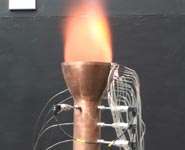
September 26, 2008 STERN rocket firing completed

(PhysOrg.com) -- The performance of unpiloted, reuseable spaceplanes could be significantly improved thanks to the completion of the Static Test Expansion/Deflection Rocket Nozzle (STERN) engine test programme.

A team of engineers from Bristol University finished the test programme last week [Friday 19 September] with 12 hot firings successfully completed. In each experiment the engine was held down on a heavily instrumented test stand providing data on pressures, temperature, flow rates and thrust.

The results will be presented by Dr Neil Taylor, Lecturer in Aerodynamics in the University’s Department of Aerospace Engineering at the International Astronautical Congress in Glasgow next week [29 September to 3 October].

The objective of the test programme was to explore the flow stability and behaviour in an unusual rocket nozzle known as an Expansion Deflection Nozzle. In theory these should allow very large expansion nozzles suitable for operating in the vacuum of space to also perform stably and efficiently within an atmosphere. If so, then the performance of single stage to orbit launch vehicles like Skylon could be significantly improved.

Dr Taylor said: “Test programmes like this usually take years and costs hundreds of thousands of pounds, but we’ve done this in 18 months and on a relative shoestring, the whole team has done a really good job but the guys from Airborne Engineering who designed, manufactured and assembled the test rig have worked near miracles. I’m looking forward to getting all the data back to the lab and seeing how it compares to my predictions.”

The STERN engine burns hydrogen and air, the same as Skylon’s Sabre engines when in air breathing mode. To maximise the engine’s life the test firings were held below the engine design values with measured thrust between 1500 and 2000 Newtons (1/5 tonne). Each firing was restricted to less than a second, as any longer and the (un-cooled) chamber walls could start to melt. This still provided sufficient time for the flow to stabilise, and all the required data to be obtained.

The initial results have confirmed that the flow within Expansion Deflection nozzles is stable across a very wide range of pressure ratios. In addition, broad agreement with computer simulations of their behaviour has also been achieved.

Although the basic principles of Expansion Deflection nozzles are now better understood, as anticipated by the research team the complex processes within the flow meant that optimum performance was not achieved by this first attempt. The ongoing analysis of the data produced by STERN will lead to a better understanding of the flow, enabling improved and optimised designs to be produced. It is expected this in turn will lead to future experimental work in a wider long-term project aimed at maximising the benefit Expansion Deflection Nozzles offer.

The STERN project is a collaboration between the University of Bristol, Reaction Engines Ltd, and Airborne Engineering Ltd. The final test firing has taken less than 18 months after a suggestion by Alan Bond, Director of Reaction Engines Ltd, over coffee at a conference.

Provided by University of Bristol


print this article email this article download pdf blog this article bookmark this article     Stumble it Digg this share on Facebook retweet share on Reddit add to delicious
Rate this story - 4.2 /5 (19 votes)

Rank Filter

Move the slider to adjust rank threshold, so that you can hide some of the comments.


Display comments: newest first


September 26, 2008 all stories

Comments: 1

4.2 /5 (19 votes)
  • Stumble this up

  • Digg this

  • share this

  • hide
  • Related Stories

  • Navy Researchers Apply Science to Fire Fighting
    created Oct 23, 2009 | popularity not rated yet | comments 0
  • New findings could help hybrid, electric cars keep their cool
    created Sep 22, 2009 | popularity not rated yet | comments 0
  • Fire Meets Ice: Superhot And Supercold Remarkably Similar In The 'Fermion' World (w/ Video)
    created Aug 04, 2009 | popularity not rated yet | comments 0
  • Equivalence principle in space test
    created May 11, 2009 | popularity not rated yet | comments 0
  • Cocoa could be a healthy treat for diabetic patients
    created May 26, 2008 | popularity not rated yet | comments 0


  • hide
  • Relevant PhysicsForums posts

  • Spectrometers
    created Dec 22, 2009
  • what accretion disk of BH?
    created Dec 22, 2009
  • Will the Moon escape Earth's orbit in billions of years?
    created Dec 21, 2009
  • How do I calculate light years to years?
    created Dec 21, 2009
  • More from Physics Forums - General Astronomy

Other News

Iran to unveil new home-built satellite: report

Space & Earth / Space Exploration

created 17 hours ago | popularity 3 / 5 (6) | comments 2

Iran will unveil a new home-built satellite in February, a newspaper reported Thursday, amid Western concerns that Tehran is using its nuclear and space industries to develop atomic and ballistic weapons.


Global warming likely to be amplified by slow changes to Earth systems

Global warming likely to be amplified by slow changes to Earth systems

Space & Earth / Earth Sciences

created Dec 20, 2009 | popularity 2.6 / 5 (38) | comments 48

Researchers studying a period of high carbon dioxide levels and warm climate several million years ago have concluded that slow changes such as melting ice sheets amplified the initial warming caused by greenhouse ...


Computer simulation strengthens link between climate change and release of subsea methane

Computer simulation strengthens link between climate change and release of subsea methane

Space & Earth / Earth Sciences

created Dec 17, 2009 | popularity 4.1 / 5 (23) | comments 48

(PhysOrg.com) -- A first-of-its-kind computer simulation that mirrors real-world observations of methane bubbling up from a seabed in the Arctic Ocean provides further evidence that warming oceans may unleash ...


Arctic ice

Study: Earth's polar ice sheets vulnerable to even moderate global warming

Space & Earth / Earth Sciences

created Dec 16, 2009 | popularity 2.8 / 5 (45) | comments 41

A new analysis of the geological record of the Earth's sea level, carried out by scientists at Princeton and Harvard universities and published in the Dec. 16 issue of Nature, employs a novel statistical approa ...


A man walks his dog in the snow in the East Village

Polluting pets: the devastating impact of man's best friend

Space & Earth / Environment

created Dec 21, 2009 | popularity 1.7 / 5 (26) | comments 26

Man's best friend could be one of the environment's worst enemies, according to a new study which says the carbon pawprint of a pet dog is more than double that of a gas-guzzling sports utility vehicle.