New underwater robot can hover in place
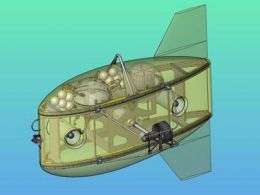
(PhysOrg.com) -- MIT researchers have designed a new robotic underwater vehicle that can hover in place like a helicopter -- an invaluable tool for deepwater oil explorers, marine archaeologists, oceanographers and others.
The new craft, called Odyssey IV, is the latest in a series of small, inexpensive artificially intelligent submarines developed over the last two decades by the MIT Sea Grant College Program's Autonomous Underwater Vehicles Laboratory. The Odyssey series revolutionized underwater research in the 1990s by introducing the thrifty and highly capable underwater robots. But the previous Odyssey vehicles still had one significant limitation: Like sharks, they could only operate while continuously moving forward.
No more. The new Odyssey IV, which has just completed sea trials off Woods Hole, Mass., can move through the deep ocean, up to 6,000 meters down, stopping anywhere in the water column and constantly correcting for currents and obstacles. Navigating to its preprogrammed destination, it can hover in place, making detailed inspections of the footings of an offshore oil platform, or photographing the flora and fauna around an undersea vent.
"Our old subs needed to swim, to go forward, in order to maintain maneuvering capability," says Chryssostomos Chryssostomidis, director of the MIT Sea Grant Program. "People wanted to be able to work in the ocean and stop and hover to do a specific task. In the past, you could only fly over a scene, take a picture, then fly over again and take another picture. Now, I can stop over a scene that's of interest, and stay and make measurements. We'll be able to observe underwater scenes in much more detail."
This summer, this latest-generation craft has been demonstrating its new abilities on its first scientific mission, a study of the George's Bank area of the Gulf of Maine, which is hugely important to the region's commercial fisheries. Odyssey is being deployed in a series of dives to map and observe an invasive species of sea squirt called Didemnum that has been infesting New England waters. MIT Sea Grant's Judy Pederson has been tracking the Didemnum invasion for several years, hoping to prevent it from smothering important native species; Odyssey IV will be her eyes on the seafloor.
And the new craft's unique capabilities go beyond just looking at objects. "Like a giant helicopter, this can pick up cargo underwater," Chryssostomidis says. "Now, we can visit an oil well, pick up a sample and bring it back to shore." With the addition of a mechanical arm, the vessel will be able to do manipulations such as twisting a valve open or closed.
Not only can the craft hover, it can move quickly, up to two meters per second going straight ahead. Both its speed and its ability to stop in place are achieved through the combined action of fins and thrusters on each side, and at the bow and stern of the two-meter-long craft.
The new vehicle may be able to stop in place, but Chryssostomidis and his colleague Franz Hover, an assistant professor in the Department of Mechanical Engineering, and their team, research engineers Jim Morash, Victor Polidoro, Justin Eskesen and graduate student Dylan Owens, certainly are not. With the initial sea trials of Odyssey IV just completed, they are focused squarely on moving ahead to their goals. They need to develop vastly improved power-storage and communications capabilities, to enable these vehicles to stay underwater longer, cover more terrain, and send back more data to scientists on shore. Ultimately, Chryssostomidis says, he hopes his team will produce an AUV that can spend a full year underwater, collecting data and transmitting it to its home base, without any need to surface at all.
"Once we prove the hovering capability foolproof, as we think it is now, the next challenge for me to worry about is the issue of recharging, so that I can be free of the surface vessel," he says. He also hopes to develop better manipulator arms that will be able to interact more flexibly with the undersea environment, to pick up objects or carry out repairs.
But for now, Chryssostomidis is reveling in the fact that Odyssey IV, after years of development, has passed its initial tests in the ocean with flying colors. No matter how good the design, that's not something you can take for granted, he explains. "The sea is very unforgiving. If there's anything that can go wrong, the sea will find it."
Provided by MIT


