Scientists identify gene that may contribute to improved rice yield
September 28, 2008
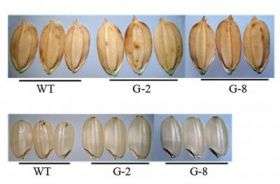
The researchers created transgenic lines of rice (G-2 and G-8) in which the GIF1 gene was overexpressed. Compared to normal strains (WT), they found that the transgenic rice had larger and heavier grains. In this figure, the grains on the top are from white rice and the grains on the bottom are from brown rice. Credit: Zuhua He, Chinese Academy of Sciences
A team of scientists, including Penn State Distinguished Professor of Biology Hong Ma, has identified a gene in rice that controls the size and weight of rice grains. The gene may prove to be useful for breeding high-yield rice and, thus, may benefit the vast number of people who rely on this staple food for survival. "Our work shows that it is possible to increase rice's yield by enhancing the expression of a particular gene," said Ma. The team's results will be published on 28 September 2008 in an early online edition of the journal Nature Genetics, and in the November print issue of the journal.
The researchers first searched for and identified mutant strains of rice that exhibited underweight grains. "We found a particular mutant that is defective in its ability to produce normal-sized grains," said Zuhua He, a biology professor at the Chinese Academy of Sciences and the leader of the team. The group then examined the mutant and found that it carried a mutation within the GIF1 gene. "The GIF1 gene is responsible for controlling the activity of the enzyme invertase, which is located in the cell wall and converts sucrose to substances that then are used to create starch," said He. "Invertase is important in the formation of starch within developing grains of rice. If invertase is not active, the rice plant cannot produce edible grains."
Next, to test the ability of the GIF1 gene to control the production of invertase, the team measured the activity of invertase within a normal strain of rice, in which the GIF1 gene lacked any mutations, and within a mutant strain of rice, in which the GIF1 gene contained a mutation that caused a defect in the invertase activity. The scientists found that invertase activity in the mutant strain was only 17 percent of the activity that was observed in the normal strain, suggesting that the GIF1 gene does, indeed, control invertase activity. The team then created transgenic lines of rice in which the GIF1 gene is overexpressed and found that, compared with normal strains, the transgenic rice had larger and heavier grains.
According to Ma, the team was surprised to find that the GIF1 gene was so specialized in controlling invertase activity in a particular part of the grain -- the vascular tissue, which transports nutrients, including sugars generated by invertase, to the developing grain. "The expression pattern was not expected, in part, because invertase is a general enzyme that is used by many cell types. In fact, the corresponding gene in wild rice is not expressed specifically."
The team also found that the GIF1 gene is one of the genes that were selected during the domestication of rice. "By selectively growing only those strains of rice with heavier grains, humans for thousands of years unknowingly have been increasing the frequency of rice populations that had modifications in the GIF1 gene," said Ma. "This process has caused GIF1 to be expressed specifically in the vascular tissue and, thus, to produce larger rice grains," said Ma.
The scientists hope that their findings will help others to create hybrid varieties of rice that produce even larger grains. In the meantime, they plan to perform additional analyses that will help them to understand how other genes might be involved in the process of improving rice yield. "The goal is to understand what controls grain weight and other factors, and to look for ways to increase yield," said Ma.
Source: Penn State
-
Something old, something new: Evolution and the structural divergence of duplicate genes
Jan 31, 2012 |
4.6 / 5 (7) |
1
-
Science to help rice growers affected by Japan's tsunami
Jan 22, 2012 |
4 / 5 (4) |
2
-
Breeding better grasses for food and fuel
Jan 17, 2012 |
5 / 5 (1) |
0
-
Maize gene could lead to bumper harvest
Jan 16, 2012 |
5 / 5 (1) |
0
-
Discovery of plant 'nourishing gene' brings hope for increased crop seed yield and food security
Jan 13, 2012 |
4 / 5 (1) |
1
-
Engineers build first sub-10-nm carbon nanotube transistor
Feb 01, 2012 |
4.9 / 5 (31) |
30
-
Something old, something new: Evolution and the structural divergence of duplicate genes
Jan 31, 2012 |
4.6 / 5 (7) |
1
-
The hidden nanoworld of ice crystals: Revealing the dynamic behavior of quasi-liquid layers
Jan 30, 2012 |
5 / 5 (3) |
1
-
Stock market network reveals investor clustering
Jan 27, 2012 |
3.9 / 5 (23) |
8
-
Of microchemistry and molecules: Electronic microfluidic device synthesizes biocompatible probes
Jan 26, 2012 |
5 / 5 (1) |
0
More news stories
Entire genome of extinct human decoded from fossil
(PhysOrg.com) -- In 2010, Svante Pääbo and his colleagues presented a draft version of the genome from a small fragment of a human finger bone discovered in Denisova Cave in southern Siberia. The ...
Feb 07, 2012 |
4.7 / 5 (58) |
44
|
Why are there so few fish in the Earth's oceans?
(PhysOrg.com) -- A Stony Brook University researcher has found that, contrary to popular belief, there are not plenty of fish in the sea.
Feb 08, 2012 |
4.3 / 5 (17) |
26
|
Miami battling invasion of giant African snails
No one knows how they got there. But an invasion of African giant snails has southern Florida in a panic over potential crop damage, disease and general yuckiness surrounding the slimy gastropods.
Feb 10, 2012 |
4.5 / 5 (2) |
5
The power of estrogen -- male snakes attract other males
A new study has shown that boosting the estrogen levels of male garter snakes causes them to secrete the same pheromones that females use to attract suitors, and turned the males into just about the sexiest ...
Feb 10, 2012 |
4.8 / 5 (6) |
2
|
Deciding to go left or right: Researchers use device to determine that lower animals can navigate too
For decades, scientists have associated binary decision making opting to go left or right with higher-ranking animals, including humans. A team of Harvard researchers, however, is rewriting that ...
Feb 09, 2012 |
4 / 5 (1) |
4
|
Walney offshore wind farm is world's biggest (for now)
(PhysOrg.com) -- The Walney wind farm on the Irish Sea--characterized by high tides, waves and windy weather--officially opened this week. The farm is treated in the press as a very big deal as the Walney ...
GPS court ruling leaves US phone tracking unclear
A US Supreme Court decision requiring a warrant to place a GPS device on the car of a criminal suspect leaves unresolved the bigger issue of police tracking using mobile phones, legal experts say.
Europeans protest controversial Internet pact
Tens of thousands of people marched in protests in more than a dozen European cities Saturday against a controversial anti-online piracy pact that critics say could curtail Internet freedom.
Europe stakes billion-dollar bet on new rocket
A pencil-slim rocket is scheduled to lift into space from South America on Monday, carrying a billion-dollar bet that Europe can grab a juicy slice of the market to place satellites in low orbit.
Study finds that anti-diabetic medication can prevent the long-term effects of maternal obesity
In a study to be presented today at the Society for Maternal-Fetal Medicine's annual meeting, The Pregnancy Meeting, in Dallas, Texas, researchers will report findings that show that short therapy with the anti-diabetic medication ...
Netflix settlement trims 14 pct off 4Q earnings
(AP) -- Netflix pressed the rewind button on its fourth-quarter earnings after settling allegations that the video subscription service violated a consumer-privacy law.