Successful re-entry marks bright future for ATV
September 29th, 2008 Successful re-entry marks bright future for ATV

Enlarge

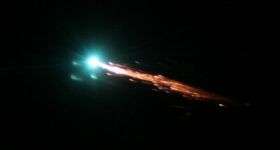
First images of Jules Verne ATV re-entry over the Pacific Ocean (ESA)

Europe’s first Automated Transfer Vehicle (ATV) Jules Verne successfully completed its six-month ISS logistics mission today with its controlled destructive re-entry over a completely uninhabited area of the South Pacific.

Following a final deorbit burn at 14:58 CEST which slowed its velocity by 70 m/s, the ATV entered the upper atmosphere at an altitude of 120 km at 15:31 CEST. It broke up at an altitude of 75 km with the remaining fragments falling into the Pacific some 12 minutes later.

The ATV has proved what a key ISS logistics vehicle it is. Following its 9 March launch on an Ariane 5 rocket from Europe’s Spaceport in French Guiana, the ATV delivered 6 tonnes of cargo to the International Space Station, to which it remained docked for five months. This included ISS reboost and refuelling propellants, water, oxygen and 1.3 tonnes of dry cargo including food, clothing, spares and other items. During its mission, the ATV displayed the full range of its capabilities, including automatic rendezvous & docking, four ISS reboosts to a higher orbital altitude to offset atmospheric drag, ISS attitude control, performing a collision-avoidance manoeuvre when fragments of an old satellite came within the Station’s vicinity, and on its final journey offloading 2½ tonnes of waste.

“This mission is a fantastic accomplishment which caps a great year of human spaceflight for the European Space Agency”, said Simonetta Di Pippo, ESA’s Director of Human Spaceflight. “Together with the Columbus laboratory, the ATV has really shown how far European capabilities have developed in building, launching and controlling space infrastructure. Europe has now taken a further step towards its capability of being able to transport and return cargo and astronauts to and from space and helping to define the global picture for human spaceflight from the ISS to future exploration activities.”

Following its undocking on 5 September, the ATV had spent 23 days carrying out “rephasing” manoeuvres to bring it to the correct position behind and underneath the ISS. This predefined position allowed the re-entry to be viewed and recorded from the Station itself, as well as from two specially-equipped observation planes located in the vicinity of the ATV’s flight path in the skies above the South Pacific. This observation campaign will serve to determine whether the vehicle’s break-up matched the computer modelling.

“Credit has to go to everyone involved in such a flawless mission.” said John Ellwood, ESA’s ATV Project Manager. “Not only to the ESA and industrial teams that brought the project to fruition, but also to the teams at the ATV Control Centre and around the world who have done a superb job while the spacecraft has been in orbit. This is truly a wonderful spacecraft, and vital to the continued service of the ISS following Shuttle retirement in 2010. I look forward to the launch of the next ATV, which is currently under production at EADS Astrium in Bremen, Germany.”

Source: ESA


print this article email this article download pdf blog this article bookmark this article     Digg this Stumble it share on Facebook share on Reddit add to delicious save to Yahoo! bookmarks
4/5 after 5 votes


September 29th, 2008 all stories
Space & Earth / Space Exploration

Comments: 0
Rank: 4/5 after 5 votes

  • Stumble this up

  • Digg this

  • Share it:
  • share on Facebook
  • share on MySpace
  • share on Slashdot
  • rss-newsfeed
  • share on Google
  • share on Reddit
  • add to delicious
  • save to Yahoo! bookmarks
  • share on Windows Live
  • Add to Mixx!
Rating: 4/5 after 5 votes

  • Related Stories

  • European-built Node 3 starts its journey to the ISS
    created May 04, 2009 | popularity not rated yet | comments 0
  • Columbus, one year on orbit
    created Feb 11, 2009 | popularity not rated yet | comments 0
  • Jules Verne prepares for ISS departure
    created Sep 02, 2008 | popularity not rated yet | comments 0
  • The International Space Station, a test-bed for future space exploration
    created Jul 18, 2008 | popularity not rated yet | comments 0
  • Record boost for ATV to raise ISS orbit
    created Jun 20, 2008 | popularity not rated yet | comments 0


  • Physicists Demonstrate Quantum Memory with Matter Qubits
    Physicists Demonstrate Quantum Memory with Matter Qubits
    Physics / General Physics
    created Jul 03, 2009 | popularity 4.4 / 5 (17) | comments 1
  • 'Holey' Nanosheets for Wastewater Dye Removal
    Nanotechnology / Nanomaterials
    created Jul 01, 2009 | popularity 5 / 5 (5) | comments 1
  • Jellyfish Robot Swims Like its Biological Counterpart
    Jellyfish Robot Swims Like its Biological Counterpart
    Electronics / Robotics
    created Jun 26, 2009 | popularity 4.4 / 5 (8) | comments 1
  • Could Maxwell's Demon Exist in Nanoscale Systems?
    Could Maxwell's Demon Exist in Nanoscale Systems?
    Physics / General Physics
    created Jun 24, 2009 | popularity 4.4 / 5 (18) | comments 29
  • Living Safely with Robots, Beyond Asimov's Laws
    Living Safely with Robots, Beyond Asimov's Laws
    Electronics / Robotics
    created Jun 22, 2009 | popularity 4.6 / 5 (52) | comments 40
  • Other News

    Steam billows from the cooling towers at a nuclear power generating station in Byron

    Tropical zone expanding due to climate change: study

    Space & Earth / Earth Sciences

    created 1hour ago | popularity 5 / 5 (2) | comments 0

    Climate change is rapidly expanding the size of the world's tropical zone, threatening to bring disease and drought to heavily populated areas, an Australian study has found.


    US ambitions to send astronauts back to the moon as a prelude to missions to Mars have been put in doubt

    Forty years ago man first walked on the moon

    Space & Earth / Space Exploration

    created 22 hours ago | popularity 4.3 / 5 (4) | comments 2

    Forty years ago on July 20, 1969, American astronaut Neil Armstrong realized the oldest dream of human civilizations when he became the first man to walk on the moon.


    The least sea ice in 800 years

    The least sea ice in 800 years

    Space & Earth / Earth Sciences

    created Jul 01, 2009 | popularity 4.1 / 5 (64) | comments 60

    New research, which reconstructs the extent of ice in the sea between Greenland and Svalbard from the 13th century to the present indicates that there has never been so little sea ice as there is now. The ...


    Gas around young galaxy

    Intense heat killed the Universe's would-be galaxies, researchers say

    Space & Earth / Astronomy

    created Jul 01, 2009 | popularity 3.4 / 5 (21) | comments 27

    (PhysOrg.com) -- Our Milky Way galaxy only survived because it was already immersed in a large clump of dark matter which trapped gases inside it, scientists led by Durham University's Institute for Computational ...


    Scientists' Drill Hits Magma: Only Third Time on Record

    Scientists' Drill Hits Magma: Only Third Time on Record

    Space & Earth / Earth Sciences

    created Jun 29, 2009 | popularity 4.7 / 5 (22) | comments 21

    (PhysOrg.com) -- Scientists drilling a borehole deep into Iceland’s rocky crust to explore new methods of using geothermal energy hit a major roadblock on Thursday: Their drill ran into molten rock at a depth ...