Smoot reflects on his measurement feat as 50th anniversary nears
September 29th, 2008 Smoot reflects on his measurement feat as 50th anniversary nears

Enlarge

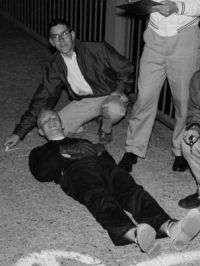
Alumnus Oliver Smoot is used to measure the Mass. Ave. bridge in 1958.

(PhysOrg.com) -- As his fraternity brothers laid his 5-foot, 7-inch frame end-to-end to measure the Massachusetts Avenue bridge one night in October 1958, there was one distinct thought running through Oliver Smoot's mind.

"It was pretty cold," he said.

Smoot '62 evoked memories recently about the night his name became a unit of measurement as MIT prepares to celebrate the 50th anniversary of the quirky hack. A series of events has been planned for the weekend of Oct. 4.

"Looking at the pictures, I think I had one sweater and I did have on gloves … but basically we all had on windbreakers and you get out in the middle of a bridge and it's windy," he said. "Even if the temperature isn't that low, it's cold out there."

In 1958, as a freshman at MIT and Lambda Chi Alpha pledge, the fraternity pledgemaster hatched the idea to use the shortest -- and most scientifically named pledge -- to measure the bridge from Boston to Cambridge. Little did they know, however, that their activity would make its way into MIT, Boston and even Google lore.

They also underestimated how difficult getting up and down 364.4 times (plus or minus an ear) would be.

"I don't think any of us had the slightest idea how much work was involved with lying down, getting up," he said. "They had to help me a great way across the bridge. I started by doing a push-up, and then I couldn't even do that. It deteriorated from there."

As they neared the end of their task, a police van drove by, and made a U-turn back toward the students. Luckily, it was a false alarm -- but Smoot notes that today their activity probably would garner more scrutiny.

"How would something like this be looked at today? Would the cops in the car stop and make a U-turn and check things out," he said. "Or would they see five or six male adults on the bridge with something that looked like canisters."

After the job was done, Smoot said he and his compatriots didn't give much thought to what would happen to the "Smoot marks." He graduated in 1962, started law school at Georgetown University shortly thereafter, and got married in 1964.

"There was a lot going on, so I basically didn't give it a thought," he said. "I don't recall actually thinking about it, or getting a note or having a conversation with my brothers."

That was until he gave an interview to a reporter at the now-defunct "Holiday magazine" who was investigating the strange marks on the bridge that were repainted each year by incoming Lambda Chi Alpha students. Then, he said, it seemed to take off.

And if he had to do it all over again, today? Well, Smoot admits he's not as strong as he used to be, but otherwise the results should be the same.

"Well as far as I can tell, and I think the meter stick we're going to give to the MIT Museum will confirm, I haven't really shrunk yet," he laughed. "I'm surprised."

And Smoot enjoys the distinction of being both a decorated professional in the standards industry (serving as a vice president Information Technology Industry Council and chairman of the American National Standards Institute's Board of Directors) and a standardized unit of measurement himself.

A Smoot is recognized enough that it's even possible to use Google's calculator function to change any measurement into Smoots.

"It's interesting to see how far apart things are," Smoot noted. "Say it's 400 miles from Washington to Boston -- it's much more than that [in Smoots]."

378,268 Smoots to be exact -- plus or minus an ear.

Provided by MIT


print this article email this article download pdf blog this article bookmark this article     Digg this Stumble it share on Facebook share on Reddit add to delicious save to Yahoo! bookmarks
5/5 after 3 votes


September 29th, 2008 all stories
Other Sciences / Other

Comments: 0
Rank: 5/5 after 3 votes

  • Stumble this up

  • Digg this

  • Share it:
  • share on Facebook
  • share on MySpace
  • share on Slashdot
  • rss-newsfeed
  • share on Google
  • share on Reddit
  • add to delicious
  • save to Yahoo! bookmarks
  • share on Windows Live
  • Add to Mixx!
Rating: 5/5 after 3 votes


Tags

bridge

  • Physicists Demonstrate Quantum Memory with Matter Qubits
    Physicists Demonstrate Quantum Memory with Matter Qubits
    Physics / General Physics
    created Jul 03, 2009 | popularity 4.4 / 5 (17) | comments 1
  • 'Holey' Nanosheets for Wastewater Dye Removal
    Nanotechnology / Nanomaterials
    created Jul 01, 2009 | popularity 5 / 5 (5) | comments 1
  • Jellyfish Robot Swims Like its Biological Counterpart
    Jellyfish Robot Swims Like its Biological Counterpart
    Electronics / Robotics
    created Jun 26, 2009 | popularity 4.4 / 5 (8) | comments 1
  • Could Maxwell's Demon Exist in Nanoscale Systems?
    Could Maxwell's Demon Exist in Nanoscale Systems?
    Physics / General Physics
    created Jun 24, 2009 | popularity 4.4 / 5 (18) | comments 29
  • Living Safely with Robots, Beyond Asimov's Laws
    Living Safely with Robots, Beyond Asimov's Laws
    Electronics / Robotics
    created Jun 22, 2009 | popularity 4.6 / 5 (52) | comments 40
  • Other News

    Creation Museum president Ken A. Ham

    Paleontologists brought to tears, laughter by Creation Museum

    Other Sciences / Other

    created Jun 30, 2009 | popularity 4.2 / 5 (43) | comments 124

    For a group of paleontologists, a tour of the Creation Museum seemed like a great tongue-in-cheek way to cap off a serious conference.


    Mummified dinosaur skin yields up new secrets

    Mummified dinosaur skin yields up new secrets

    Other Sciences / Archaeology & Fossils

    created Jul 01, 2009 | popularity 4.7 / 5 (15) | comments 10

    (PhysOrg.com) -- Scientists from The University of Manchester have identified preserved organic molecules in the skin of a dinosaur that died around 66-million years ago.


    Liberal? Conservative? Stanford study says mental nudge can make voters flip-flop

    Liberal? Conservative? Stanford study says mental nudge can make voters flip-flop

    Other Sciences / Social Sciences

    created Jul 02, 2009 | popularity 3.8 / 5 (5) | comments 4

    (PhysOrg.com) -- No doubt you’ve worked hard for your success. But chances are you’ve also had some help and lucky breaks along the way.


    Probing Question: How do Ponzi Schemes work?

    Other Sciences / Economics

    created Jul 02, 2009 | popularity 5 / 5 (2) | comments 2

    Imagine the shock, the horror, and the sheer panic that would come with learning that the financial plan you’d sunk your life savings into was a sham, the financial experts you trusted were crooks, and all your money was ...


    Tourists enjoy a "Pineapple Tour" in Costa Rica

    Costa Rica tops happiness, 'green living' poll

    Other Sciences / Social Sciences

    created Jul 04, 2009 | popularity 3 / 5 (3) | comments 0

    Costa Rica is the happiest place on earth, and one of the most environmentally friendly, according to a new survey by a British non-governmental group.