Light throws a curve ball
September 29th, 2008 Light throws a curve ball

Enlarge

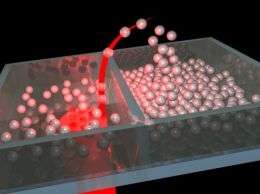
The image shows an animation of the Airy beam working as a snowblower conveying particles from one compartment to another.

(PhysOrg.com) -- Researchers at the University of St Andrews have made a surprise discovery using light beams that can travel around corners.

The academics have developed the concept of moving particles within light beams that follow curves rather than go along straight lines building on their work in the area of optical manipulation.

Professor Kishan Dholakia of the School of Physics and Astronomy commented, "Physics holds many surprises; our understanding of how light moves and behaves is challenged by such beams and it is exciting to see them move into the interdisciplinary arena - light has thrown us a curve ball.

"A standard beam of light spreads as it travels due to the wave effect known as diffraction. Take a laser pointer - even that would be 100km wide if this light beam were to reach the moon.

"Our research has shown that certain light beams do not diffract or spread - they can travel around corners and propel particles round corners. This is a new discovery in the phenomenon of light moving particles."

Thirty years ago scientists found that the Airy beam, named after the famous British astronomer Sir George Airy, had a mathematical parallel in optics. Recently, it was discovered that the beam actually 'bends' or curves as the beam moves through space unlike a laser pointer, for example.

The St Andrews team have now taken things much further by utilising this unusual curving property of Airy beams to send particles literally around curves and corners, sweeping aside or 'clearing' particles within a sample chamber.

Team member Joerg Baumgartl said, "The Airy beam allows us to clear a sample chamber without any moving light fields: in essence it acts like a small snow-blower for microscopic glass particles and even cells. It could have major applications in microfluidic engineering and cell biology."

The findings of Joerg Baumgartl, Michael Mazilu and Kishan Dholakia in the School of Physics and Astronomy are published in the latest edition of the journal Nature Photonics.

The team are now exploring a number of new avenues with these light fields including intriguing new particle sorting as well as possible methods for separating chosen cells from a given population.

"This beam shows a wonderful example of how an elegant but perhaps obscure mathematical discovery in quantum mechanics has powerful analogies to laser beams and in turn leads to important new applications for science," said Michael Mazilu.

Provided by University of St Andrews


print this article email this article download pdf blog this article bookmark this article     Digg this Stumble it share on Facebook share on Reddit add to delicious save to Yahoo! bookmarks
4.7/5 after 113 votes

Rank Filter

Move the slider to adjust rank threshold, so that you can hide some of the comments.


Display comments: newest first

  • Bazz - Sep 29, 2008
    • Rank: 3.4 / 5 (10)
    But the important question they dont answer, how long before i get my light saber?
  • Roach - Sep 29, 2008
    • Rank: 3.7 / 5 (6)
    More importantly, how long till I can get a laser gun that can shoot around corners?

    Or... a laser microphone that doesn't require line of sight?

    Or a Narrow bean radio like microwave, radar or lidar that doesn't require line of sight. Whole new level in stealth vehicles. Casting shadows from impossible directions. "Sir, we have the enemy F22 on our radar, he's coming at us from under ground."
  • sleidia - Sep 29, 2008
    • Rank: 2.2 / 5 (18)
    You guys are americans, right?
    Nothing else than weapons matters to you?
  • jeffsaunders - Sep 29, 2008
    • Rank: 5 / 5 (4)
    ok this is definitely weird.

    or so it seemed until I looked it up.

    I remember reading about this type of light a while back. The light doesn't actually travel around corners at all that is an over simplification of what is going on.
  • zevkirsh - Sep 30, 2008
    • Rank: 3.7 / 5 (3)
    if light travelled around corners i could kick you in the nuts but actually i would just be kicking what looks like an image of your nuts to me, but you would actually be around the corner. this opens many possibilities.
  • phystic - Sep 30, 2008
    • Rank: 1 / 5 (1)
    hmmm interesting
  • PraedSt - Sep 30, 2008
    • Rank: 4 / 5 (4)
    You guys are americans, right?
    Nothing else than weapons matters to you?


    Give it a rest.
  • Doug_Huffman - Sep 30, 2008
    • Rank: 5 / 5 (1)
    Weapons are the bleeding edge of the difference between First World nations and the also ran cultures. Technology is the cutting edge and manufacturing is the 'back' of the blade. All is sharpened by finance and education. See where the weaknesses lie?
  • Bazz - Sep 30, 2008
    • Rank: 4 / 5 (4)
    No i am dutch.Dikes matter a lot here.
  • gmurphy - Sep 30, 2008
    • Rank: not rated yet
    jeff, could you post up the links to the material explaining Airy beams?, I can't find anything very clear on the web, thanks.
  • earls - Sep 30, 2008
    • Rank: not rated yet
    this kinda helped me.

    http://focus.aps....v20/st19
  • skerns - Sep 30, 2008
    • Rank: not rated yet
    Why is it that the example pics in this article and the ones linked here http://focus.aps....v20/st19 are all animations or computer simulations? Is this just theory or is it real?
  • bmerc - Sep 30, 2008
    • Rank: 5 / 5 (2)
    You guys are americans, right?
    Nothing else than weapons matters to you?


    I think you are selling Americans short. Other things that matter to us are sausage, cold beer, fast cars, loose women, and lets not forget guns, oh wait that is what started the whole thing.

    So tell us what nationality you are so we can comment on what must matter to you.

  • superhuman - Oct 01, 2008
    • Rank: not rated yet
    This is a poorly written article (as usual), but google has plenty of info (also as usual).
    Theres also an earlier better article about it on physorg: http://www.physor...629.html

    The light still travels as usual but complex interference between various parts of the beam (which has a specially prepared shape) leads to a bent trajectory of the beam as a whole.
  • QubitTamer - Oct 03, 2008
    • Rank: not rated yet
    Can it just push particles around? what about being used as a carrier for an injected stream of densely ionized gas... See where i am going with this? once you can transmit a focused beam of ionized gas you can then send a huge charge of electricity down said beam and zap the daylights out of whatever the beam is touching...

    Or you could use the bendable property to loop the tube of ionized gas back into the transmission device and have yourself... you guessed it... Light Sabre. W00t.


September 29th, 2008 all stories
Physics / General Physics

Comments: 15
Rank: 4.7/5 after 113 votes

  • Stumble this up

  • Digg this

  • Share it:
  • share on Facebook
  • share on MySpace
  • share on Slashdot
  • rss-newsfeed
  • share on Google
  • share on Reddit
  • add to delicious
  • save to Yahoo! bookmarks
  • share on Windows Live
  • Add to Mixx!
Rating: 4.7/5 after 113 votes

  • Related Stories

  • Fermi Telescope reveals a population of radio-quiet gamma-ray pulsars
    created Jul 02, 2009 | popularity not rated yet | comments 0
  • Panasonic Develops High Efficiency CRT Recycling Technology Using Laser
    created Jul 02, 2009 | popularity not rated yet | comments 0
  • Integrated optical trap holds particles for on-chip analysis
    created Jun 30, 2009 | popularity not rated yet | comments 0
  • X-Rays for Early Alzheimer's Disease Detection
    created Jun 15, 2009 | popularity not rated yet | comments 0
  • Atom Pinhole Camera Acts as a Shrinking Copy Machine
    created Jun 01, 2009 | popularity not rated yet | comments 0


  • Physicists Demonstrate Quantum Memory with Matter Qubits
    Physicists Demonstrate Quantum Memory with Matter Qubits
    Physics / General Physics
    created Jul 03, 2009 | popularity 4.4 / 5 (17) | comments 1
  • 'Holey' Nanosheets for Wastewater Dye Removal
    Nanotechnology / Nanomaterials
    created Jul 01, 2009 | popularity 5 / 5 (5) | comments 1
  • Jellyfish Robot Swims Like its Biological Counterpart
    Jellyfish Robot Swims Like its Biological Counterpart
    Electronics / Robotics
    created Jun 26, 2009 | popularity 4.4 / 5 (8) | comments 1
  • Could Maxwell's Demon Exist in Nanoscale Systems?
    Could Maxwell's Demon Exist in Nanoscale Systems?
    Physics / General Physics
    created Jun 24, 2009 | popularity 4.4 / 5 (18) | comments 29
  • Living Safely with Robots, Beyond Asimov's Laws
    Living Safely with Robots, Beyond Asimov's Laws
    Electronics / Robotics
    created Jun 22, 2009 | popularity 4.6 / 5 (52) | comments 40
  • Other News

    Scientists create first electronic quantum processor

    Scientists create first electronic quantum processor

    Physics / General Physics

    created Jun 28, 2009 | popularity 4.8 / 5 (53) | comments 40

    A team led by Yale University researchers has created the first rudimentary solid-state quantum processor, taking another step toward the ultimate dream of building a quantum computer.


    Science journals

    How to Spot an Influential Paper Based on its Citations

    Physics / General Physics

    created Jul 04, 2009 | popularity 4 / 5 (9) | comments 5

    (PhysOrg.com) -- At first it may seem that the number of citations received by a published scientific paper is directly related to that paper's quality of content. The higher the quality, the more people read ...


    Fermilab's CDF observes Omega-sub-b baryon

    Fermilab's CDF observes Omega-sub-b baryon

    Physics / General Physics

    created Jun 29, 2009 | popularity 4.7 / 5 (17) | comments 7

    (PhysOrg.com) -- At a recent physics seminar at the Department of Energy’s Fermi National Accelerator Laboratory, Fermilab physicist Pat Lukens of the CDF experiment announced the observation of a new particle, ...


    New insights, and a new angle, on high-temperature superconductivity

    New insights, and a new angle, on high-temperature superconductivity

    Physics / Superconductivity

    created Jun 29, 2009 | popularity 4.8 / 5 (13) | comments 6

    (PhysOrg.com) -- A Princeton-led research team has revealed surprising information about how electron behavior influences the conduction of electricity in a class of high-temperature superconductors. An increased ...


    The art of invisibility and the perfect cat's eye

    The art of invisibility and the perfect cat's eye

    Physics / Optics & Photonics

    created Jun 30, 2009 | popularity 4 / 5 (8) | comments 6

    (PhysOrg.com) -- In recent years scientists have explored the impossible by developing invisibility or 'cloaking' devices, but can the same technology also help make things more visible?