Meat-eating dinosaur from Argentina had bird-like breathing system
September 29, 2008
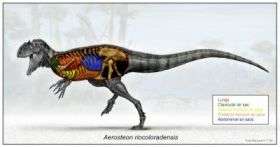
Flesh rendering of the predator Aerosteon with the body wall removed to show a reconstruction of the lungs (red) and air sacs (other colors) as they might have been in life. Drawing: Todd Marshall c 2008, courtesy of Project Exploration.
The remains of a 30-foot-long predatory dinosaur discovered along the banks of Argentina's Rio Colorado is helping to unravel how birds evolved their unusual breathing system.
University of Michigan paleontologist Jeffrey Wilson was part of the team that made the discovery, to be published Sept. 29 in the online journal Public Library of Science ONE and announced at a news conference in Mendoza, Argentina.
The discovery of this dinosaur builds on decades of paleontological research indicating that birds evolved from dinosaurs.
Birds have a breathing system that is unique among land animals. Instead of lungs that expand, birds have a system of bellows, or air sacs, which help pump air through the lungs. This novel feature is the reason birds can fly higher and faster than bats, which, like all mammals, expand their lungs in a less efficient breathing process.
Wilson was a University of Chicago graduate student working with noted dinosaur authority Paul Sereno on the 1996 expedition during which the dinosaur, named Aerosteon riocoloradensis ("air bones from the Rio Colorado") was found. Although the researchers were excited to find such a complete skeleton, it took on even more importance as they began to understand that its bones preserved hallmark features of a bird-like respiratory system.
Arriving at that understanding took some time. Laboratory technicians spent years cleaning and CT-scanning the bones, which were embedded in hard rock, to finally reveal the evidence of air sacs within Aerosteon's body cavity. Previously, paleontologists had found only tantalizing evidence in the backbone, outside the cavity with the lungs.
Wilson worked with Sereno and the rest of the team to scientifically describe and interpret the find. The vertebrae, clavicles, and hip bones bear small openings that lead into large, hollow spaces that would have been lined with a thin layer of soft tissue and filled with air in life. These chambers result from a process called pneumatization, in which outpocketings of the lungs (air sacs) invade the bones. Air-filled bones are the hallmark of the bellows system of breathing in birds and also are found in sauropods, the long-necked, long-tailed, plant-eating dinosaurs that Wilson studies.
"In sauropods, pneumaticity was key to the evolution of large body size and long necks; in birds it was key to the evolution of a light skeleton and flight," Wilson said. "The ancient history and evolutionary path of this feature is full of surprising turns, the explanations for which must account for their presence in a huge predator like Aerosteon and herbivores like Diplodocus, as well as in a chicken."
In the PLoS ONE paper, the team proposes three possible explanations for the evolution of air sacs in dinosaurs: development of a more efficient lung; reduction of upper body mass in tipsy two-legged runners; and release of excess body heat.
Sereno, a National Geographic Explorer-in-Residence, said he is especially intrigued by heat loss, given that Aerosteon was likely a high-energy predator with feathers but without the sweat glands that birds possess. At approximately 30 feet in length and weighing as much as an elephant, Aerosteon might well have used an air system under the skin to rid itself of unwanted heat.
Source: University of Michigan
-
Across the Atlantic on flotsam: New fossil findings shed light on the origins of the mysterious bird Hoatzin
Oct 04, 2011 |
4.5 / 5 (2) |
2
-
Hummingbirds catch flying bugs with the help of fast-closing beaks (w/ video)
Jul 19, 2011 |
4.7 / 5 (3) |
0
-
Body temperatures of dinosaurs measured for the first time
Jun 23, 2011 |
5 / 5 (14) |
8
-
Chilly times for Chinese dinosaurs
Mar 11, 2011 |
5 / 5 (3) |
1
-
Team first to directly measure body temperatures of extinct vertebrates
May 24, 2010 |
4.9 / 5 (15) |
5
-
Engineers build first sub-10-nm carbon nanotube transistor
Feb 01, 2012 |
4.9 / 5 (31) |
30
-
Something old, something new: Evolution and the structural divergence of duplicate genes
Jan 31, 2012 |
4.6 / 5 (7) |
1
-
The hidden nanoworld of ice crystals: Revealing the dynamic behavior of quasi-liquid layers
Jan 30, 2012 |
5 / 5 (3) |
1
-
Stock market network reveals investor clustering
Jan 27, 2012 |
3.9 / 5 (23) |
8
-
Of microchemistry and molecules: Electronic microfluidic device synthesizes biocompatible probes
Jan 26, 2012 |
5 / 5 (1) |
0
-
Pertubance in a model
6 hours ago
-
Cancer drugs and Alzheimer's, Oh my!
14 hours ago
-
Squishing cells
15 hours ago
-
Any books/articles for evolutionary stable strategy models in humans?
Feb 09, 2012
-
Science behind the bore feeling?
Feb 09, 2012
-
Homo Sapien vs. Chimpanzee - Divergence Timeline
Feb 09, 2012
- More from Physics Forums - Biology
More news stories
Employers feel no love for unscrupulous practice of 'service sweethearting'
A new study led by two Florida State University marketing professors finds that some frontline service employees who are rewarded for hikes in customer loyalty and satisfaction also may engage in "service ...
Other Sciences / Economics & Business
52 minutes ago |
not rated yet |
0
A frank discussion of the power law and linking correlation to causation
(PhysOrg.com) -- Michael Stumpf a mathematics professor at Imperial College in London, and Mason Porter a lecturer at Oxford have teamed together to write and publish a perspective piece in Science regarding the in ...
The question of life in the ancient world
Theres a general feeling that we dont get the Greeks ancient or modern. Many, including heads of state like Angela Merkel, visibly shake their head in exasperation, rightly or wrongly, at ...
Other Sciences / Archaeology & Fossils
6 hours ago |
1 / 5 (1) |
2
Sonic Cradle lands spot in TED exhibition
A Simon Fraser University graduate student project that melds music, meditation and modern technology has landed a rare spot as an exhibit at TEDActive 2012 in Palm Springs, California this month.
2 hours ago |
not rated yet |
0
US workers are 'giving away the store,' costing firms billions
Nearly 70 percent of the nation's service employees give away free goods and services from hamburgers to cable TV costing companies billions of dollars a year, according to a groundbreaking study.
Other Sciences / Economics & Business
Feb 09, 2012 |
4.5 / 5 (2) |
10
Putting the squeeze on planets outside our solar system
(PhysOrg.com) -- Using high-powered lasers, scientists at Lawrence Livermore National Laboratory and collaborators discovered that molten magnesium silicate undergoes a phase change in the liquid state, abruptly ...
US issues guidelines to avoid heparin contamination
Four years after US drug-maker Baxter International's blood thinner heparin was contaminated in China, causing dozens of deaths, US regulators on Friday issued draft guidelines for safe production.
Expat French get Internet vote for first time
French citizens will for the first time this year be able to vote in a parliamentary election over the Internet, an experiment that could be extended to other elections if successful.
"Twisted Metal" gamers get shot at real gunplay
Fans of "Twisted Metal" will get to welcome a long-awaited sequel of the car-battle videogame with a real-world bang by blasting an ice cream truck to bits with a machine gun.
The power of estrogen -- male snakes attract other males
A new study has shown that boosting the estrogen levels of male garter snakes causes them to secrete the same pheromones that females use to attract suitors, and turned the males into just about the sexiest ...
New error-correcting codes guarantee the fastest possible rate of data transmission
Error-correcting codes are one of the triumphs of the digital age. Theyre a way of encoding information so that it can be transmitted across a communication channel such as an optical fiber o ...
Sep 29, 2008
Rank: 5 / 5 (1)
Evolution in action in multiple scenarios too. Just shows that there is more than one road to Rome and maybe the anti-evolution pro creationists will finally have to admit that the world was not actually created 6,000 years ago.
Then again maybe this will just prove that if you believe that (the creationist theory) you will believe whatever the hell you want.
Sep 30, 2008
Rank: not rated yet
You make a small joke, yes?