Like an arrow: Jumping insects use archery techniques
September 30, 2008
Froghopper

Enlarge

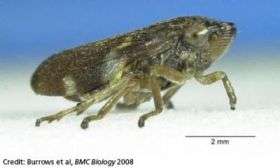
An adult froghopper. Credit: Burrows et al, BMC Biology 2008

Froghoppers, also known as spittlebugs, are the champion insect jumpers, capable of reaching heights of 700 mm - more than 100 times their own body length. Research published today in the open access journal BMC Biology reveals that they achieve their prowess by flexing bow-like structures between their hind legs and wings and releasing the energy in one giant leap in a catapult-like action.

Froghoppers are well distributed around the world. Images of the insects flexing and jumping are described in the research carried out by Malcolm Burrows from the University of Cambridge and his colleagues. Burrows' research focused on determining how the energy generated by the insects' muscles is stored before powering a jump.

He said, "A froghopper stores energy by bending a paired bow-shaped part of its internal skeleton called a 'pleural arch' which is a composite structure made of layers of hard cuticle and a rubbery protein called resilin. When the froghopper contracts its muscles to jump, these arches flex like a composite archery bow, and then on recoil catapult it forwards with a force that can be over 400 times its body mass".

There are further parallels with the jumping mechanisms of froghoppers and the design of composite bows used in archery. The composite of a hard and an elastic material means that the skeleton of a froghopper, or an archery bow, can resist damage even if they are bent for a long time. Froghoppers are observed to hold the pleural arch in a bent 'ready position', ready to jump at a moment's notice, and to be able to jump repeatedly without damaging the body.

Still more advantages of using composite structures when storing large amounts of energy are seen when considering the development of these storage structures. Froghopper nymphs live in a protective white foam, the familiar cuckoo spit that appears on plants in spring. These nymphs have no resilin in their pleural arches and don't jump until they complete the lifecycle and develop into adult Froghoppers.

The article is available at journal website: http://www.biomedc … com/bmcbiol/

Source: BioMed Central

4.2 /5 (6 votes)  

Filter


Move the slider to adjust rank threshold, so that you can hide some of the comments.


Display comments: newest first

Dinotron
Sep 30, 2008

Rank: 5 / 5 (1)
Very cool! These little bugs were in the grass around our house when I was a kid. I've always marveled at how far bugs like these can propel themselves.
Doug_Huffman
Sep 30, 2008

Rank: not rated yet
IIRC dipterans use a similar mechanism in flight.
Rank 4.2 /5 (6 votes)
Tags

Relevant PhysicsForums posts

More news stories

The power of estrogen -- male snakes attract other males

A new study has shown that boosting the estrogen levels of male garter snakes causes them to secrete the same pheromones that females use to attract suitors, and turned the males into just about the sexiest ...

Biology / Plants & Animals

created 9 hours ago | popularity 5 / 5 (3) | comments 0 | with audio podcast

Grass to gas: Researchers' genome map speeds biofuel development

Researchers at the University of Georgia have taken a major step in the ongoing effort to find sources of cleaner, renewable energy by mapping the genomes of two originator cells of Miscanthus x giganteus, a large perenn ...

Biology / Biotechnology

created 6 hours ago | popularity 3.7 / 5 (3) | comments 0 | with audio podcast

Experts reveal how plants don't get sunburn

(PhysOrg.com) -- Experts at the University of Glasgow have discovered how plants survive the harmful rays of the sun.

Biology / Cell & Microbiology

created 9 hours ago | popularity 5 / 5 (2) | comments 0 | with audio podcast

Protein libraries in a snap

(PhysOrg.com) -- A Rice University undergraduate will depart with not only a degree but also a possible patent for his invention of an efficient way to create protein libraries, an important component of biomolecular ...

Biology / Cell & Microbiology

created 12 hours ago | popularity 5 / 5 (2) | comments 0 | with audio podcast

Miami battling invasion of giant African snails

No one knows how they got there. But an invasion of African giant snails has southern Florida in a panic over potential crop damage, disease and general yuckiness surrounding the slimy gastropods.

Biology / Ecology

created 13 hours ago | popularity 4 / 5 (1) | comments 4


Google users warned of threat to smartphone wallets

Users of Google smartphone wallets were being warned on Friday that there is a way to crack pass codes intended to thwart thieves from going on illicit shopping sprees.

Anonymous knocks CIA website offline (Update)

The website of the Central Intelligence Agency was inaccessible on Friday after the hacker group Anonymous claimed to have knocked it offline.

Complex wiring of the nervous system may rely on a just a handful of genes and proteins

Researchers at the Salk Institute have discovered a startling feature of early brain development that helps to explain how complex neuron wiring patterns are programmed using just a handful of critical genes. ...

NASA sees wide-eyed cyclone Jasmine

Cyclone Jasmine's eye has opened wider on NASA satellite imagery, as it moves through the Southern Pacific Ocean.

NASA sees Giovanna reach cyclone strength, threaten Madagascar

Tropical Storm 12S built up steam and became a cyclone on February 10, 2012 as NASA's Terra satellite passed overhead. Residents of east-central Madagascar should prepare for this cyclone to make landfall ...

Putting the squeeze on planets outside our solar system

(PhysOrg.com) -- Using high-powered lasers, scientists at Lawrence Livermore National Laboratory and collaborators discovered that molten magnesium silicate undergoes a phase change in the liquid state, abruptly ...