Glanceable dashboard takes a measure of physician communication
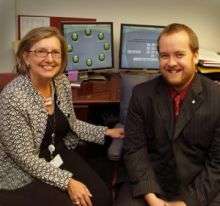
Much like a dashboard gives a good read on how your car is doing, researchers hope they'll soon give physicians a better idea of how they are doing with patients.
Glanceable data is available for stock market reports, the weather and a growing array of data consumers want in rapid, succinct fashion. "We are moving fast and we want data fed to us in a way we can process without thinking about it," says Dr. Peggy Wagner, research director for the Department of Family Medicine in the Medical College of Georgia School of Medicine. But it made her think: Why not have a globe on every doctor's desk that says how they are doing from the patient's perspective?
It's not quite a globe, but MCG researchers have developed a touch screen kiosk that lets patients quickly answer questions about their physician encounter. Their input instantly becomes a colorful measure displayed on a 24-inch monitor at the back of the clinic: red abstract orbs for below average, yellow for average and green for above-average. "This changes real time as patients put in more data," says Dr. Wagner. To help protect patient anonymity, the glanceable dashboard only updates with every fifth patient. Patient feedback about an individual physician is included in private e-mails to that physician at the end of each week.
The kiosks are collecting data for eight weeks in primary care practice sites in Tifton, Jesup, Blackshear and Moultrie, Georgia. Only two sites have the glanceable dashboard. "Our assumption is physicians will change their behavior to get more green lights," says Dr. Wagner, and having the dashboards in only two locations will help her determine if that is true.
Patients are asked six communication-related questions such as "Did the doctor you saw today explain things in a way that was easy to understand? Did the doctor listen carefully to you? Did the doctor you saw today show respect for what you had to say?" Questions were drawn from the 2007 Consumer Assessment of Healthcare Provider and Services' Clinician and Group Survey developed by the Agency for Healthcare Research and Quality, which is funding the study.
"We want to help health care providers maximize the relatively short time they have with patients but there has to be a way to measure that first," says Dr. Wagner. This feasibility study will look at whether patients will take a survey while the visit is fresh on their minds - many mailed surveys end up in a recycling bin - and how physicians respond.
Study sites, which include practices with two to seven physicians, will be able to keep the systems after the study is complete to gather pretty much any type of useful data such as whether patients were offered flu shots or whether a subpopulation, such as diabetics, are getting the extra care needed. "You could use the dashboard idea to ask questions about anything. It has a lot of application for the future," Dr. Wagner says. Hardware and software, developed for the project at MCG, is exceedingly adaptable, usable on a laptop or even a palmtop computer, says Stan Sulkowski, educational program specialist in the Department of Family Medicine.
The initial focus on physician-patient communication cuts to the heart of an increasing number of anecdotal and documented reports of patient dissatisfaction. There is no good result from bad communication, she says. "Patients vote with their feet." If they stay but don't really understand or believe what their doctor is telling them to do, they don't do well.
The number one predictor of malpractice is poor communication, not that something bad has happened," says Dr. Wagner who teaches good patient communication to first-year medical students. "These are the kind of things that would enable a lot of green lights: talking to patients in ways they can understand, never talking down to them, making sure their questions are answered. Everybody is trying to teach this it's just hard to teach."
The innate desire to do well may help physicians modify their habits when they see vivid evidence that they are not, says Dr. Wagner. "I think physicians are caring - and competitive - people." Still, little is known about how to effectively change physician behavior. She hopes the pilot study will lead to a larger study of the issue. "To me, it's the most exciting thing I have ever done," says Dr. Wagner. "Maybe it comes from being a patient myself. I want good care and I want some input."
For physicians who are not doing well, the study offers faculty development. "If they get a lot of red lights in communication, they can request that we come in and do communication training," says Dr. Wagner, the study's principal investigator. Patients also will be periodically quizzed on whether the kiosk was patient friendly and researchers will conduct focus groups with doctors and staff to get their reactions.
Source: Medical College of Georgia


