When It Comes to Galaxies, Diversity Is Everywhere
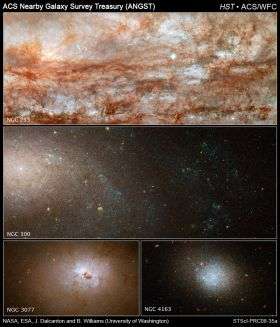
September 30, 2008 Hubble Snaps Close-up Views of Diverse Galaxies

Enlarge

Credit: NASA, ESA, J. Dalcanton and B. Williams (University of Washington)

(PhysOrg.com) -- There's an old saying in astronomy: "Galaxies are like people. They're only normal until you get to know them." That view is supported by a group of astronomers after using NASA's Hubble Space Telescope to study a large number of galaxies in our cosmic backyard.

The detailed survey, called the ACS Nearby Galaxy Survey Treasury (ANGST) program, observed roughly 14 million stars in 69 galaxies. The survey explored a region called the "Local Volume," and the galaxy distances ranged from 6.5 million light-years to 13 million light-years from Earth. The Local Volume resides beyond the Local Group of galaxies, an even nearer collection of a few dozen galaxies within about 3 million light-years of our Milky Way Galaxy.

A typical galaxy contains billions of stars but looks "smooth" when viewed through a telescope, because the stars are blurred together. In contrast, the galaxies in the new survey are close enough to Earth that the sharp "eyes" of Hubble's Advanced Camera for Surveys and Wide Field Planetary Camera 2 can resolve their brightest individual stars. By measuring the brightness and colors of these stars, scientists can derive the local history of star formation within a galaxy and can tease out subtle features in a galaxy's shape.

"Past Hubble observations of the local neighborhood have provided dramatic insights into the star-formation histories of individual galaxies, but the number of galaxies studied in detail has been rather small," said Julianne Dalcanton of the University of Washington in Seattle and leader of the ANGST survey. The survey's results were submitted to The Astrophysical Journal Supplement Series. Another paper that details the star-formation history in galaxy M81 has been submitted to The Astronomical Journal.

"Instead of picking and choosing particular galaxies to study, our survey will be complete by virtue of looking at 'all' the galaxies in the region. This gives us a multi-color picture of when and where all the stars in the local universe formed."

Many stars in nearby galaxies are the fossil equivalents of the active star formation seen in galaxies in the distant universe. "When we look back in time at distant, young galaxies, we see lots of vigorous star formation. However, we can only guess as to what those galaxies might eventually turn into," Dalcanton explained. "Using the galaxies in the nearby universe as a 'fossil record,' we can compare them with young galaxies far away. This comparison gives us a history of star formation and provides a better understanding of the masses, structures, and environments of the galaxies."

Early results of the ANGST survey show the rich diversity of galaxies. Some galaxies are made up entirely of ancient stars, while others have been forming stars nearly continuously during their whole lives. There are even a few examples of galaxies that have only started forming stars in the recent past.

"With these images, we can see what makes each galaxy unique," said team member Benjamin Williams of the University of Washington. "When we look at the distribution and development of stars in each survey galaxy, we can learn how differences in the galaxies' histories have produced the diversity of galaxy shapes and colors."

The ANGST survey also includes maps of many large galaxies, including M81. "With these maps, we can track when the different parts of the galaxy formed," explained Evan Skillman of the University of Minnesota, describing work by students Dan Weisz of the University of Minnesota and Stephanie Gogarten of the University of Washington.

In a separate paper describing the star-formation history in M81, astronomers confirmed that massive spiral galaxies formed most of their stars in the early universe. Analyzing M81's outer disk, the astronomers found that most of the stars formed more than 7 billion years ago, when the universe was half its present age. M81 and other mammoth galaxies also experienced rapid enrichment of heavy elements, such as carbon, through the deaths of massive stars in supernova explosions. "We were surprised by how quickly the elements formed and how the subsequent star-formation rate for the bulk of the stars in M81 changed after that," said Williams, the paper's lead author.

"This rich survey will add to Hubble's legacy, providing a foundation for future studies," Dalcanton said. "The ANGST sample offers superb targets for future multi-wavelength surveys, which will allow us to combine the star-formation maps with the properties of gas and dust in the galaxies. With this information, we will be able to trace the complete cycle of star formation in detail."

Provided by Space Telescope Science Institute


print this article email this article download pdf blog this article bookmark this article     Stumble it Digg this share on Facebook retweet share on Reddit add to delicious
Rate this story - 4.1 /5 (16 votes)

Rank Filter

Move the slider to adjust rank threshold, so that you can hide some of the comments.


Display comments: newest first

  • h1ghj3sus - Sep 30, 2008
    • Rank: 1 / 5 (1)
    Gathering data about the specific rates of growth is probably inaccurate because we cannot know how many supernovas occurred in the local galaxies unless you assume that everything in the universe was created at the same instant in time.

    Researchers would also have to assume that the galaxies respond to supernovas the same way.

    Then again, there are a log of galaxies out there.
  • yyz - Oct 01, 2008
    • Rank: not rated yet
    In a related paper posted at the arXiv preprint site for 10-1-08 ("The Recent Star Formation Histories of M 81 Group Dwarf Irregular Galaxies" by Weisz et al [arXiv:0809.5059]) nine dIGs are imaged by HST-ACS & star formation rates and SF histories are derived.These observations also shed light on the SF history of M 81 itself & its' environs. A link is included to a high-resolution version of the paper, where full-res images of these nine dwarfs can be fully enjoyed. If spiral galaxies formed by accretion of nearby dwarf galaxies, studies such as this will help astronomers tease out the details of this formation. A fascinating paper with great Hubble images to boot!
  • yyz - Oct 01, 2008
    • Rank: not rated yet
    Note that NGC 3077, which is imaged in the above Hubble release and also a member of the M 81 Group is not among the dwarf galaxies studied in the paper mentioned in my previous post.
  • yyz - Oct 03, 2008
    • Rank: not rated yet
    Detailed info on the star formation history in M81 was posted on the arXiv server on 10-3-08 as "The ACS Nearby Galaxy Survey Treasury II. Young Stars and their Relation to Halpha and UV Emission Timescales in the M81 Outer Disk" by Gogarten et al(arXiv:0810.0266). Many aspects of the star formation history of M81 are included as well as many great Hubble, GALEX & Spitzer images of the outer disk of this nearby galaxy.

September 30, 2008 all stories

Comments: 4

4.1 /5 (16 votes)
  • Stumble this up

  • Digg this

  • share this

  • hide
  • Related Stories

  • A Superbright Supernova That’s the First of Its Kind
    created Dec 02, 2009 | popularity not rated yet | comments 0
  • WISE Snug in Its Nose Cone; Launch Set for Dec. 9
    created Dec 01, 2009 | popularity not rated yet | comments 0
  • Hunting for Planets in the Dark
    created Nov 19, 2009 | popularity not rated yet | comments 0
  • NGC 4710 galaxy: Baffling boxy bulge (w/ Video)
    created Nov 18, 2009 | popularity not rated yet | comments 0
  • NASA's Wise Gets Ready to Survey the Whole Sky (w/ Video)
    created Nov 17, 2009 | popularity not rated yet | comments 0


  • hide
  • Relevant PhysicsForums posts

  • Big Bang Location...?
    created 2 hours ago
  • Our Improbable Home
    created 9 hours ago
  • Does matter exist only in space and time?
    created 23 hours ago
  • What is a spectral energy distribution (SED)?
    created Dec 02, 2009
  • Our Moon and Gravity
    created Dec 02, 2009
  • (Zeeman)-Doppler imaging of starspots
    created Dec 02, 2009
  • More from Physics Forums - General Astronomy

Other News

Sandtrapped Rover Makes a Big Discovery

Sandtrapped Rover Makes a Big Discovery

Space & Earth / Space Exploration

created 9 hours ago | popularity 4.9 / 5 (27) | comments 7

Homer's Iliad tells the story of Troy, a city besieged by the Greeks in the Trojan War. Today, a lone robot sits besieged in the sands of Troy while engineers and scientists plot its escape.


Ares I-X rocket

NASA puzzled why parachutes failed in rocket test

Space & Earth / Space Exploration

created 7 hours ago | popularity 3.5 / 5 (2) | comments 3

(AP) -- NASA still isn't sure why two parachutes failed during a test flight of its prototype moon rocket just over a month ago.


San Andreas fault

Quake prediction model developed

Space & Earth / Earth Sciences

created 7 hours ago | popularity 5 / 5 (1) | comments 0

(PhysOrg.com) -- The third in a series of papers in the journal Nature completes the case for a new method of predicting earthquakes.


Tadpoles Used to Rapidly Detect Water Pollution

Space & Earth / Environment

created 7 hours ago | popularity not rated yet | comments 0

(PhysOrg.com) -- Research conducted by University of Wyoming Professor Paul Johnson and others demonstrates that genetically modified tadpoles work well as sensitive monitors for rapidly detecting water pollution.


Team using Subaru Telescope makes major discovery

Team using Subaru Telescope makes major discovery

Space & Earth / Astronomy

created 11 hours ago | popularity 4.8 / 5 (13) | comments 2

An international team of scientists that includes an astronomer from Princeton University has made the first direct observation of a planet-like object orbiting a star similar to the sun.