Psychologists show experience may be the best teacher for infants
(PhysOrg.com) -- There's a lot of truth in the old proverb "experience is the best teacher," and apparently it even applies to 10-month-old infants.
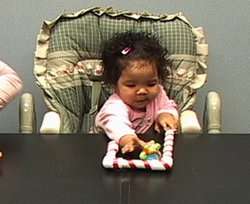
Researchers have found that infants who had an opportunity to use a plastic cane to get an out-of-reach toy were better able to understand the goal of another person's use of a similar tool than were infants who had previously only watched an adult use a cane to retrieve a toy.
"Acting on the world is one way infants learn about the world, and only recently have there been studies showing that active, hands-on experience is a more effective way of learning than watching. This study indicates that there is a benefit to actual hands-on experience early in human development," said, Jessica Sommerville, a University of Washington assistant professor of psychology and lead author of a study published in the current issue of the journal Developmental Psychology.
In earlier work, Sommerville, who is affiliated with the UW's Institute of Learning and Brain Sciences, has shown that 10-month-old infants rarely use a tool such as a cane spontaneously. To see if active, hands-on training provided greater understanding of another person's goals when using a tool, the UW researchers divided 51 infants – 26 boys and 25 girls – into three groups for the new study.
Those in one group, the training group, had an opportunity to use a red-striped and a green-striped cane to pull a rubber toy (such as a yellow duck and a purple hippopotamus) toward them on a table. Then the infants were trained in how to use the crook of a cane to retrieve a toy. Finally, they were given two trials to see if they could pull the toy to them all by themselves.
A second group of infants, the observational group, went through the same procedure with one major difference. Instead of using the tools, the infants watched an adult mimic the babies in the first group learning how to use the cane to get a toy.
Finally the infants in those two groups, as well as those in the third, or baseline, group individually watched training trials in which a researcher seated behind a table used one cane to retrieve a toy and then picked up the toy. Then, out of sight of the babies, the location of the toy was switched in four test trials. In two of the trials, the crook of the same cane she had previously used was placed around a new toy In the other two trials, crook of a new cane was placed around the same toy as in the training trials. All of the babies were filmed during the test trials to see how long they watched each trial.
Sommerville said the experiment was designed to see if the infants would play attention to a change in the experimenter's goal of getting a new toy rather than using a different tool. Infants in the observational and baseline groups spent equal amounts of time looking at the new cane and toys trials. But the trained group spent more time looking at the new toy trials, suggesting they understood that the adult was using the cane as a tool.
Even more striking was the fact that infants in the training group who were the most proficient at retrieving a toy – looking at the toy, purposefully pulling the cane to bring the toy to them and then quickly grasping the toy – were more likely to look at the new toy trials for a longer time.
"We speculate that for infants to really understand the tool use event, and, in particular, for them to anticipate upcoming actions and action outcomes while watching the event, they need to be able to perform the tool use sequence themselves," said Sommerville. "Merely watching another person perform the sequence does not appear to be enough for them to understand it.
"We think first-person experience may be particularly important for infants' understanding of an action because we need to anticipate upcoming actions and outcomes to become skillful at producing those actions. It is similar to a good tennis player, who learns to anticipate where the ball will go to on the court before it gets there. We think that once infants become skilled at performing a particular action, they apply their anticipatory skills, gained from that action, to watching similar actions performed by others."
Provided by University of Washington


