Gluttons, drunks and fools
September 30, 2008
Gluttons, drunks and fools

Enlarge

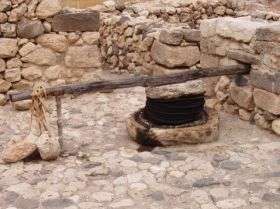
Reconstruction of an ancient olive press, Hazor, North Israel.

(PhysOrg.com) -- An academic from the University of St Andrews has delved into the Bible to provide food for thought on the subject of eating and drinking.

In the new study Dr Nathan MacDonald from the School of Divinity has examined some of the rich imagery about food and drink in the Old Testament.

The research will contribute towards a better appreciation of the lives and ideas of ancient Israelites, as well as shedding new light on many parts of the Bible.

Dr MacDonald commented, "Too often the Bible has only been read for its profound intellectual and spiritual ideas, and the apparently mundane matters relating to food and physical appetite have been overlooked. But for the ancient Israelites most of their lives were spent in growing and processing food.

"As a result different foods and the acts of eating and feasting become some of the most important symbols in the Bible. There is hardly a page in the Bible that does not mention food in some way."

In his research, Dr MacDonald highlights the important role food played in expressing national identity.

He explained, "Using food as a means of national characterization and ridicule is well known. The British label the French frogs, and are called les rosbifs in return. Such insults have a long pedigree.

"In the centuries before Jesus a number of Jewish writers wrote stories which mock the Persians for their enormous feasts. The Persian kings and nobles are presented as gluttons, obsessed by their bellies, making stupid decisions whilst drunk. In contrast Jewish heroes such as Daniel, Esther and Judith control their appetites."

In these satirical stories Dr Macdonald has shown how Jewish writers were, on the one hand, borrowing ideas from the Greek intellectuals, whilst on the other, sharply distinguishing themselves from the Greeks.

"What is fascinating is that the ideas are borrowed from earlier Greek literature," continued Dr MacDonald. "Greek writers frequently contrasted their modest diets with Persian gluttony.

"Yet these Jewish stories are being composed around the very same time that Judaism is in an epic struggle with Greek culture. Most people are familiar with the Jewish dietary laws, which have been so important to Jewish identity. These became central to Jewish practice during the time of Greek dominance when Antiochus Epiphanes desecrated the temple and sacrificed a pig on the altar.

"The oppression of the Jews included being forced to eat unclean meat according to the book of Maccabees. In response, keeping the dietary laws becomes an expression of anti-hellenism. Thus, Jewish responses to Greek influences are far more complex than they appear at first glance."

Dr MacDonald's work is part of a growing interest in food amongst academics, an interest shared more widely amongst the public.

"Everyone is interested today in food miles, what goes into our food, and whether there will be enough to go around", said Dr MacDonald. "The concerns of ancient people can be different, but they can also be strangely familiar.

"Occasionally Christians have been tempted to view food and the body as unimportant. I hope my work shows just how important food and eating are in the Bible. As churches and Christians think about modern food issues, they should not forget that the Bible may have something to say to our modern concerns."

Dr MacDonald's book 'Not Bread Alone: The Uses of Food in the Old Testament' is published by Oxford University Press.

Provided by University of St Andrews

2.9 /5 (14 votes)  

Rank 2.9 /5 (14 votes)
Tags

Related Stories
Relevant PhysicsForums posts

More news stories

Myths and shame keep many from seeking bankruptcy protection

(PhysOrg.com) -- Two interesting facts that may counter modern ideas about bankruptcy: The overwhelming majority of U.S. filings belong to individuals rather than corporations or entities, and most of these ...

Other Sciences / Economics & Business

created 8 hours ago | popularity 3.7 / 5 (3) | comments 7

What we mean when we ask for the milk

New research into the different ways that English and Polish people use language in everyday family situations can help members of each community to understand each other better and avoid cultural misunderstandings.

Other Sciences / Social Sciences

created 7 hours ago | popularity 5 / 5 (2) | comments 3

A lost world? How zooarchaeology can inform biodiversity conservation

A new study of tropical forests will provide a 50,000-year perspective on how animal biodiversity has changed, explored through an archaeological investigation of animal bones.

Other Sciences / Archaeology & Fossils

created 8 hours ago | popularity 3 / 5 (2) | comments 0

Putting the magic into maths

Queen Mary, University of London has developed a new educational resource for teachers to help students use amazing magic tricks to learn about maths.

Other Sciences / Mathematics

created 10 hours ago | popularity not rated yet | comments 0

Middle school teachers, students stay after school to work on science, engineering projects

The School of Education at Virginia Tech and the College of Education at University of Kentucky were awarded $1.3 million from the National Science Foundation to implement and evaluate an inquiry-based after-school ...

Other Sciences / Social Sciences

created 6 hours ago | popularity not rated yet | comments 0


Plants use circadian rhythms to prepare for battle with insects

In a study of the molecular underpinnings of plants' pest resistance, Rice University biologists have shown that plants both anticipate daytime raids by hungry insects and make sophisticated preparations to ...

Sensing self and non-self: New research into immune tolerance

At the most basic level, the immune system must distinguish self from non-self, that is, it must discriminate between the molecular signatures of invading pathogens (non-self antigens) and cellular constituents that usually ...

Fetal exposure to radiation increases risk of testicular cancer

Male fetuses of mothers that are exposed to radiation during early pregnancy may have an increased chance of developing testicular cancer, according to a study in mice at The University of Texas MD Anderson Cancer Center. ...

Challenges of identifying cognitive abilities in severely brain-injured patients

Only by employing complex machine-learning techniques to decipher repeated advanced brain scans were researchers at NewYork-Presbyterian/Weill Cornell able to provide evidence that a patient with a severe brain injury could, ...

Radiation treatment transforms breast cancer cells into cancer stem cells

Breast cancer stem cells are thought to be the sole source of tumor recurrence and are known to be resistant to radiation therapy and don't respond well to chemotherapy.

Cut your Valentine some slack

If the one you love usually forgets Valentine's Day, but this year makes a romantic effort, you should give him credit for trying.