MRI spots DCIS in mice
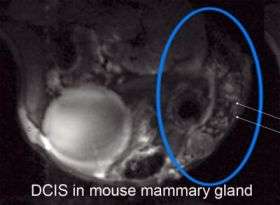
A new magnetic resonance imaging procedure can detect very early breast cancer in mice, including ductal carcinoma in situ (DCIS), a precursor to invasive cancer. Some of the tumors detected were less than 300 microns in diameter, the smallest cancers ever detected by MRI.
The technique is helping researchers study the natural history of DCIS in order to understand which tumors will become invasive cancers and require surgery, and which tumors will not. It will also be used to assess the effects of preventive therapies, such a green tea, on the development of early breast cancers. It may eventually enhance the power of MRI as a breast cancer screening tool.
"We found that MRI can reliably detect the microscopic stages of both in situ and invasive murine mammary cancers with high sensitivity," researchers from the University of Chicago Medical Center report in the September 9, 2008, issue of Physics in Medicine and Biology. "These experiments provide proof of principle that microscopic mammary tumors can indeed be detected and followed in a mouse model of breast cancer."
"These are very small tumors," said cancer specialist and study co-author Suzanne Conzen, MD, associate professor of medicine at the University of Chicago Medical Center. "They are much too small to feel or even to see without a microscope."
About 20 percent of all newly diagnosed breast cancers are DCIS, which has the best prognosis of any breast cancer with long-term survival rates of 97 to 99 percent. MRI is already used as a screening tool for many women at high risk for breast cancer, but more sensitive tests that could find cancers earlier, when they are more treatable, could increase survival.
"We decided to try to push the technology a step or two," said Greg Karczmar, PhD, professor or radiology and medical physics at the University of Chicago Medical Center, "to see if we could get good pictures of something people didn't believe could be imaged."
His colleagues, physicist Xiaobing Fan and medical physics graduate student Sunny Jansen, developed a special "birdcage" coil for MRI of the mouse mammary glands, and the team began testing a wide range of protocols for getting accurate images.
Jansen, who came to the University as an astrophysics graduate student then switched to medical physics, worked with Karczmar and Gillian Newstead, MD, director of breast imaging at the Medical Center, to find the best ways to get images that could distinguish between cancer, normal breast tissue and fat.
Using Jansen's protocol--which became her PhD thesis--the team scanned 12 transgenic mice that were genetically predisposed to developing breast cancer. Then they worked with pathologist Thomas Kraus, MD, to compare the MRI images with microscopic examination of the actual tissues.
They found that, when optimal methods were used, both DCIS and early invasive tumors "appeared clearly against a darker background." In those 12 mice, MRI was able to detect the sole relatively large tumor, 17 out of 18 small tumors that were less than 1 millimeter in size, and 13 out of 16 milk ducts that were distended with carcinoma in situ, including some tumors less than 300 microns in width, about one-third of a millimeter.
Just as important, there were no false positives. "An MR finding," the authors note, "corresponded to cancer in all glands examined."
The initial study was done with a small-bore MRI system with a 4.7 Tesla magnet, about twice the strength of a high-end clinical imaging device. Earlier this year, the team began using a new 9.4 Tesla MRI.
At that point "we began to see these tumors in exquisite detail," said Karczmar, "as small as 100 microns. We could see the ducts, and we could see tiny beads of cancer within the ducts."
Unlike previous MRI studies of tumors in mice, the UCMC team was able to detect very tiny naturally occurring cancers, and these tumors were excellent models for human breast cancer. Although the mice used were laboratory animals bred to develop breast cancer, the tumors they developed were "realistic models of the most frequently detected human cancers," the authors note. "The morphology of these early murine mammary cancers on MRI is similar to the MR presentation of early human breast cancer."
"Although still at an early stage," said Newstead, "this approach has the potential to produce significant advances in breast imaging, as well as to help us understand cancer development and study the response to therapy."
Source: University of Chicago Medical Center


