Autumn colours may be a safety mechanism for trees, say researchers
October 1, 2008
Dr Thomas Döring has a new theory on why the leaves turn red.
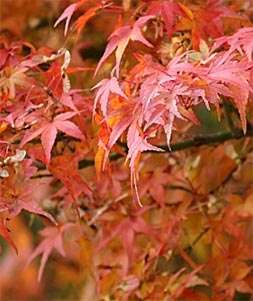
(PhysOrg.com) -- One sign of autumn is the leaves turning colour, but why do some turn red? This question has baffled biologists for decades, and many ideas have been put forward to explain leaf colour change in autumn. Now, Dr Thomas Döring, a visiting post-doc in the Division of Biology at Imperial College London, has come up with a new possible explanation.
Along with his colleagues, Professor Jim Hardie from the Division of Biology at Imperial and Dr Marco Archetti from Oxford University, Dr Döring has theorised that the production of red pigments in leaves could be concealing the yellow leaf colour that is highly attractive to tree-damaging insects such as aphids.
Yellow pigments are present in leaves in the spring and summer but only become visible in autumn when the tree breaks down and recovers green chlorophyll from leaves before they fall off. The red colour, on the other hand, is caused by pigments called anthocyanins that are produced in the autumn, just before leaf fall.
To test their theory, the scientists studied the colour preference of aphids that migrate to trees in the autumn to mate and lay their eggs. They set up a colour choice experiment with 140 water traps. They painted dishes in 70 different colours and filled them with water to see how many aphids landed on the differently coloured traps.
After two weeks, they found that traps appearing green to humans caught on average more than three times as many aphids as the red traps, but yellow traps attracted even more, around four times as many as the green ones.
To further apply the findings to leaf colours, Dr Döring then sampled the colour of hundreds of leaves from many different tree species and used the results from the trap experiment to predict how attractive the colour of each leaf would be for the insects. He found that red leaves were much less attractive than green or yellow ones for aphids.
The team speculate that some tree species may benefit from producing red leaves as a safety mechanism to fight off aphids. If these insects land on them to lay their eggs in large numbers, this could affect the growth of the trees in spring and potentially reduce their fitness.
The debate surrounding the evolution of red leaf colouration in autumn has been running for years. Some scientists have put the idea forward that the red colour warns insects about the tree’s anti-insect defenses. Another theory is that it acts as a sunscreen to reduce damage by excess sunlight.
“There is no unified theory,” explains Dr Döring. “And I’m still sceptical about the significance of our findings for explaining why red leaf colour evolved. Our results just support one part of the theory, so there is still more research to be done.”
The question of why some trees stay yellow and would not use red to conceal themselves is maybe down to the relative cost of the insect attack on the tree, explains Dr Döring: "In theory, if insect attack is generally high, causing higher costs than the costs for the production of red anthocyanins in autumn, trees would benefit from being red. If the costs entailed by the insects is lower, then you can afford to stay yellow.”
His next steps are to look closely at the effects that aphids have on the trees’ fitness and discover whether aphids that land on red leaves behave differently from those that land on yellow or green.
The findings may also have wider implications for agriculture and pest control. Dr Döring explained: “If you have got problems with insects on your crops, growing a red leaved variety could help fight off the attack.”
Provided by Imperial College London
-
Arctic summer ice anomaly shocks scientists
Sep 19, 2006 |
4.5 / 5 (43) |
0
-
Engineers build first sub-10-nm carbon nanotube transistor
Feb 01, 2012 |
4.9 / 5 (33) |
30
-
Something old, something new: Evolution and the structural divergence of duplicate genes
Jan 31, 2012 |
4.6 / 5 (7) |
1
-
The hidden nanoworld of ice crystals: Revealing the dynamic behavior of quasi-liquid layers
Jan 30, 2012 |
5 / 5 (4) |
1
-
Stock market network reveals investor clustering
Jan 27, 2012 |
3.9 / 5 (23) |
8
-
Of microchemistry and molecules: Electronic microfluidic device synthesizes biocompatible probes
Jan 26, 2012 |
5 / 5 (2) |
0
More news stories
A mitosis mystery solved: How chromosomes align perfectly in a dividing cell
Although the process of mitotic cell division has been studied intensely for more than 50 years, Whitehead Institute researchers have only now solved the mystery of how cells correctly align their chromosomes during symmetric ...
10 hours ago |
4.3 / 5 (16) |
0
|
Researchers find extensive RNA editing in human transcriptome
In a new study published online in Nature Biotechnology, researchers from BGI, the world's largest genomics organization, reported the evidence of extensive RNA editing in a human cell line by analysis of RNA-seq data, demons ...
9 hours ago |
5 / 5 (4) |
0
|
The proteins ensuring genome protection
Researchers from the University of Geneva (UNIGE), Switzerland, have discovered the crucial role of two proteins in developing a cell 'anti-enzyme shield'. This protection system, which operates at the level of molecular ...
10 hours ago |
5 / 5 (3) |
0
|
Entire genome of extinct human decoded from fossil
(PhysOrg.com) -- In 2010, Svante Pääbo and his colleagues presented a draft version of the genome from a small fragment of a human finger bone discovered in Denisova Cave in southern Siberia. The ...
Feb 07, 2012 |
4.7 / 5 (60) |
51
|
Why are there so few fish in the Earth's oceans?
(PhysOrg.com) -- A Stony Brook University researcher has found that, contrary to popular belief, there are not plenty of fish in the sea.
Feb 08, 2012 |
4.2 / 5 (18) |
27
|
Scientists discover molecular secrets of 2,000-year-old Chinese herbal remedy
For roughly two thousand years, Chinese herbalists have treated Malaria using a root extract, commonly known as Chang Shan, from a type of hydrangea that grows in Tibet and Nepal. More recent studies suggest that halofuginone, ...
New method to examine batteries -- MRI from the inside
There is an ever-increasing need for advanced batteries for portable electronics, such as phones, cameras, and music players, but also to power electric vehicles and to facilitate the distribution and storage of energy derived ...
Google might launch Drive for cloud storage soon
(PhysOrg.com) -- Google's next big move, according to the Wall Street Journal, is a cloud storage service called Drive. Hardly first to the plate, Google is simply catching up to introducing its cloud reposi ...
Lab study raises questions over nano-particle impact
Tests involving chickens have raised questions about the impact on health from engineered nano-particles, the ultra-fine grains commonly used in drugs and processed foods, scientists said on Sunday.
Starve a virus, feed a cure? Findings show how some cells protect themselves against HIV
A protein that protects some of our immune cells from the most common and virulent form of HIV works by starving the virus of the molecular building blocks that it needs to replicate, according to research published online ...
Overeating may double risk of memory loss
New research suggests that consuming between 2,100 and 6,000 calories per day may double the risk of memory loss, or mild cognitive impairment (MCI), among people age 70 and older. The study was released today and will be ...