Spotless Sun: Blankest Year of the Space Age
October 1, 2008 Spotless Sun: Blankest Year of the Space Age

Enlarge

Image: NASA

Astronomers who count sunspots have announced that 2008 is now the "blankest year" of the Space Age.

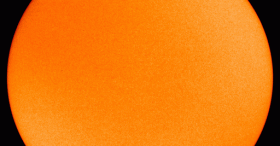
As of Sept. 27, 2008, the sun had been blank, i.e., had no visible sunspots, on 200 days of the year. To find a year with more blank suns, you have to go back to 1954, three years before the launch of Sputnik, when the sun was blank 241 times.

"Sunspot counts are at a 50-year low," says solar physicist David Hathaway of the NASA Marshall Space Flight Center. "We're experiencing a deep minimum of the solar cycle."

A spotless day looks like this (see image above).
Spotless Sun: Blankest Year of the Space Age
Enlarge


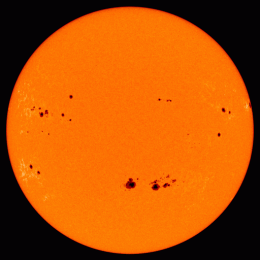
The image, taken by the Solar and Heliospheric Observatory (SOHO) on Sept. 27, 2008, shows a solar disk completely unmarked by sunspots. For comparison, a SOHO image taken seven years earlier on Sept. 27, 2001, is peppered with colossal sunspots, all crackling with solar flares (right). The difference is the phase of the 11-year solar cycle. 2001 was a year of solar maximum, with lots of sunspots, solar flares and geomagnetic storms. 2008 is at the cycle's opposite extreme, solar minimum, a quiet time on the sun.

And it is a very quiet time. If solar activity continues as low as it has been, 2008 could rack up a whopping 290 spotless days by the end of December, making it a century-level year in terms of spotlessness.

Hathaway cautions that this development may sound more exciting than it actually is: "While the solar minimum of 2008 is shaping up to be the deepest of the Space Age, it is still unremarkable compared to the long and deep solar minima of the late 19th and early 20th centuries." Those earlier minima routinely racked up 200 to 300 spotless days per year.

Some solar physicists are welcoming the lull.

"This gives us a chance to study the sun without the complications of sunspots," says Dean Pesnell of the Goddard Space Flight Center. "Right now we have the best instrumentation in history looking at the sun. There is a whole fleet of spacecraft devoted to solar physics--SOHO, Hinode, ACE, STEREO and others. We're bound to learn new things during this long solar minimum."

As an example he offers helioseismology: "By monitoring the sun's vibrating surface, helioseismologists can probe the stellar interior in much the same way geologists use earthquakes to probe inside Earth. With sunspots out of the way, we gain a better view of the sun's subsurface winds and inner magnetic dynamo."

"There is also the matter of solar irradiance," adds Pesnell. "Researchers are now seeing the dimmest sun in their records. The change is small, just a fraction of a percent, but significant. Questions about effects on climate are natural if the sun continues to dim."

Pesnell is NASA's project scientist for the Solar Dynamics Observatory (SDO), a new spacecraft equipped to study both solar irradiance and helioseismic waves. Construction of SDO is complete, he says, and it has passed pre-launch vibration and thermal testing. "We are ready to launch! Solar minimum is a great time to go."

Coinciding with the string of blank suns is a 50-year record low in solar wind pressure, a recent discovery of the Ulysses spacecraft. The pressure drop began years before the current minimum, so it is unclear how the two phenomena are connected, if at all. This is another mystery for SDO and the others.

Who knew the blank sun could be so interesting? More to come...

Source: Science@NASA, by Dr. Tony Phillips


print this article email this article download pdf blog this article bookmark this article     Stumble it Digg this share on Facebook retweet share on Reddit add to delicious
Rate this story - 4.5 /5 (23 votes)

Rank Filter

Move the slider to adjust rank threshold, so that you can hide some of the comments.


Display comments: newest first


October 1, 2008 all stories

Comments: 2

4.5 /5 (23 votes)
  • Stumble this up

  • Digg this

  • share this

  • hide
  • Related Stories

  • The Sun's Sneaky Variability
    created Oct 28, 2009 | popularity not rated yet | comments 0
  • EVE: Measuring the Sun's hidden variability
    created Sep 22, 2009 | popularity not rated yet | comments 0
  • Solar Cycle Driven by More than Sunspots
    created Sep 17, 2009 | popularity not rated yet | comments 0
  • First Solid Evidence for a Rocky Exoplanet (w/ Video)
    created Sep 16, 2009 | popularity not rated yet | comments 0
  • Are Sunspots Disappearing?
    created Sep 03, 2009 | popularity not rated yet | comments 0


  • hide
  • Relevant PhysicsForums posts

  • The shape of our solar system's orbits.
    created Nov 07, 2009
  • Above or Below the Line of Nodes
    created Nov 07, 2009
  • Supernova vs. Nova?
    created Nov 07, 2009
  • Supernova's Gamma Rays and Comets
    created Nov 06, 2009
  • Our Moon
    created Nov 06, 2009
  • Question about a Carl Zeiss lens
    created Nov 05, 2009
  • More from Physics Forums - General Astronomy

Other News

Deep creep means milder, more frequent earthquakes along Southern California's San Jacinto fault

Deep creep means milder, more frequent earthquakes along Southern California's San Jacinto fault

Space & Earth / Earth Sciences

created 15 hours ago | popularity 4.5 / 5 (4) | comments 0

With an average of four mini-earthquakes per day, Southern California's San Jacinto fault constantly adjusts to make it a less likely candidate for a major earthquake than its quiet neighbor to the east, the ...


Success in 'space elevator' competition (AP)

Success in 'space elevator' competition (Update 3)

Space & Earth / Space Exploration

created Nov 05, 2009 | popularity 4.3 / 5 (33) | comments 50

(AP) -- A robot powered by a ground-based laser beam climbed a long cable dangling from a helicopter on Wednesday to qualify for prize money in a $2 million competition to test the potential reality of the ...


In a Galaxy Far, Far Away...

In a Galaxy Far, Far Away...

Space & Earth / Astronomy

created Nov 06, 2009 | popularity 4.8 / 5 (5) | comments 17

(PhysOrg.com) -- Astronomers have published the discovery of the farthest known object in the cosmos: a star that exploded when the universe was only 630 million years old -- only 4.6% of its current age. ...


'Dropouts' pinpoint earliest galaxies

'Dropouts' pinpoint earliest galaxies

Space & Earth / Astronomy

created Nov 06, 2009 | popularity 4.2 / 5 (10) | comments 13

Astronomers, conducting the broadest survey to date of galaxies from about 800 million years after the Big Bang, have found 22 early galaxies and confirmed the age of one by its characteristic hydrogen signature ...


Space hotel taking bookings for 2012 opening

Space hotel taking bookings for 2012 opening

Space & Earth / Space Exploration

created Nov 05, 2009 | popularity 4.4 / 5 (21) | comments 11

(PhysOrg.com) -- The first orbiting space hotel is on track to open for its first customers in 2012, but hurry, as bookings are filling fast.