Water table depth tied to droughts in Great Plains
October 1, 2008 Water table depth tied to droughts in Great Plains

Enlarge

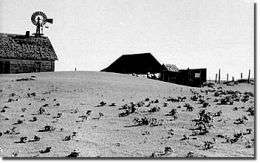
Dust Bowl farm in Coldwater District, near Dalhart, Texas. This farm is occupied. Others in this area have been abandoned. Photographed by Dorothea Lange in June 1938. Image from the Library of Congress, Farm Security Administration-Office of War Information Collection.

(PhysOrg.com) -- Will there be another “dust bowl” in the Great Plains similar to the one that swept the region in the 1930s? It depends on water storage underground. Groundwater depth has a significant effect on whether the Great Plains will have a drought or bountiful year.

Recent modeling results show that the depth of the water table, which results from lateral water flow at the surface and subsurface, determines the relative susceptibility of regions to changes in temperature and precipitation.

“Groundwater is critical to understand the processes of recharge and drought in a changing climate,” said Reed Maxwell, an atmospheric scientist at Lawrence Livermore National Laboratory, who along with a colleague at Bonn University analyzed the models that appear in the Sept. 28 edition of the journal Nature Geoscience.

Maxwell and Stefan Kollet studied the response of a watershed in the southern Great Plains in Oklahoma using a groundwater/surface-water/land-surface model.

The southern Great Plains are an important agricultural region that has experienced severe droughts during the past century including the “dust bowl” of the 1930s. This area is characterized by little winter snowpack, rolling terrain and seasonal precipitation.

While the onset of droughts in the region may depend on sea surface temperature, the length and depth of major droughts appear to depend on soil moisture conditions and land-atmosphere interactions.

That’s what the recent study takes into account. Maxwell and Kollet created three future climate simulations based on the observed meteorological conditions from 1999. All included an increase in air temperature of 2.5 degrees Celsius. One had no change in precipitation; one had an increase in precipitation by 20 percent; and one had a decrease in precipitation by 20 percent.

“These disturbances were meant to represent the variability and uncertainty in regional changes to central North America under global model simulations of future climate,” Maxwell said.

The models showed that groundwater storage acts as a moderator of watershed response and climate feedbacks. In areas with a shallow water table, changes in land conditions, such as how wet or dry the soil is and how much water is available for plant function, are related to an increase in atmospheric temperatures. In areas with deep water tables, changes at the land surface are directly related to amount of precipitation and plant type.

But in the critical zone, identified here between two and five meter’s depth, there is a very strong correlation between the water table depth and the land surface.

“These findings also have strong implications for drought and show a strong dependence on areas of convergent flow and water table depth,” Maxwell said. “The role of lateral subsurface flow should not be ignored in climate-change simulations and drought analysis.”

The simulations were performed on LLNL’s Thunder supercomputer and the work was supported by the LLNL climate change initiative.

Provided by Lawrence Livermore National Laboratory


print this article email this article download pdf blog this article bookmark this article     Stumble it Digg this share on Facebook retweet share on Reddit add to delicious
Rate this story - 4.2 /5 (15 votes)

Rank Filter

Move the slider to adjust rank threshold, so that you can hide some of the comments.


Display comments: newest first

  • Velanarris - Oct 01, 2008
    • Rank: 2.6 / 5 (5)
    This summation is very, very misdirected.

    Siegfried Schubert of NASA's Goddard Space Flight Center, Greenbelt, Md., and colleagues used a computer model developed with modern-era satellite data to look at the climate over the past 100 years. The study found cooler than normal tropical Pacific Ocean surface temperatures combined with warmer tropical Atlantic Ocean temperatures to create conditions in the atmosphere that turned America's breadbasket into a dust bowl from 1931 to 1939. The team's data is in this week's Science magazine.

    These changes in sea surface temperatures created shifts in the large-scale weather patterns and low level winds that reduced the normal supply of moisture from the Gulf of Mexico and inhibited rainfall throughout the Great Plains.


    From http://www.nasa.g...owl.html
  • axemaster - Oct 01, 2008
    • Rank: 2 / 5 (4)
    "the length and depth of major droughts appear to depend on soil moisture conditions and land-atmosphere interactions"

    Wow, I didn't know we were measuring time in meters, unless we decide to convert using the speed of light. The sounds like a square length*depth = area.

    Why is grammar so ignored these days...?
  • superhuman - Oct 02, 2008
    • Rank: 3.8 / 5 (4)
    This summation is very, very misdirected.


    Why is it misdirected? What you quote is a completely different article.
  • gmurphy - Oct 02, 2008
    • Rank: 4.5 / 5 (4)
    Velanarris, this article discusses research on the relationship of water table depth to the dust bowl. The article you reference discusses the development of the dust bowl due to changes in atmospheric conditions.
  • tkjtkj - Oct 02, 2008
    • Rank: 1 / 5 (1)
    I agree with what seems to be the
    point of the article: that low
    water-table could be associated
    with drought conditions. The fly
    in this ointment is the
    'direction' of that relationship.
  • GrayMouser - Oct 02, 2008
    • Rank: not rated yet
    I would also point out that surface soil moisture isn't directly proportional to the depth of the water table (unless the water table is very close to ground level) it is more of a function of the airborne moisture (since dry air will suck out surface moisture.)
  • Velanarris - Oct 02, 2008
    • Rank: 2 / 5 (4)
    Velanarris, this article discusses research on the relationship of water table depth to the dust bowl. The article you reference discusses the development of the dust bowl due to changes in atmospheric conditions.


    Superhuman and Gmurphy: Which aspect do you think would be of more relevance in determining the cause of a drought -

    a) the absence of precipitation and air moisture

    or

    b) how far you have to dig down to find moisture

    I'm pretty sure A would be the winner and would also directly affect B.

October 1, 2008 all stories

Comments: 7

4.2 /5 (15 votes)
  • Stumble this up

  • Digg this

  • share this

  • hide
  • Related Stories

  • Weaknesses in dikes detected by space tech spin-off
    created Sep 04, 2009 | popularity not rated yet | comments 0
  • Oceanographers examine mercury levels of pelagic fish in Hawaii
    created Sep 01, 2009 | popularity not rated yet | comments 0
  • Costs of adapting to climate change significantly underestimated
    created Aug 27, 2009 | popularity not rated yet | comments 0
  • Mars data published in Science this week
    created Jul 02, 2009 | popularity not rated yet | comments 0
  • Deep-sea rocks point to early oxygen on Earth
    created Mar 24, 2009 | popularity not rated yet | comments 0


  • hide
  • Relevant PhysicsForums posts

  • cycles
    created Nov 08, 2009
  • The Origin of the term 'fossil' fuels
    created Nov 05, 2009
  • co2
    created Nov 03, 2009
  • Early Earths Sulfidic Ocean Conditions
    created Oct 30, 2009
  • More from Physics Forums - Earth

Other News

NASA satellites see Ida spreading out before landfall

NASA satellites see Ida spreading out before landfall

Space & Earth / Earth Sciences

created 23 minutes ago | popularity not rated yet | comments 0

NASA's Aqua and Terra satellites are keeping a close eye on Tropical Storm Ida, and both have instruments aboard that show her clouds and rains are already widespread inland over the U.S. Gulf coast states. ...


L-R: Chiwetel Ejiofor, Amanda Peet and John Cusack at the premiere of "2012"

NASA on crusade to debunk 2012 apocalypse myths

Space & Earth / Space Exploration

created 4 hours ago | popularity not rated yet | comments 0

The world is not coming to an end on December 21, 2012, the US space agency insisted Monday in a rare campaign to dispel widespread rumors fueled by the Internet and a new Hollywood movie.


Making Climate Forecasts More Useful to Farmers

Making Climate Forecasts More Useful to Farmers

Space & Earth / Environment

created 2 hours ago | popularity not rated yet | comments 0

(PhysOrg.com) -- Climate forecasts are becoming more useful to farmers and ranchers, thanks to research by Agricultural Research Service (ARS) scientists and their cooperators.


Antarctica glacier retreat creates new carbon dioxide store

Antarctica glacier retreat creates new carbon dioxide store

Space & Earth / Earth Sciences

created 9 hours ago | popularity 4.3 / 5 (3) | comments 0

Large blooms of tiny marine plants called phytoplankton are flourishing in areas of open water left exposed by the recent and rapid melting of ice shelves and glaciers around the Antarctic Peninsula. This ...


NASA satellites make a movie and get rainfall, wind info on Ida

NASA satellites make a movie and get rainfall, wind info on Ida (w/ Video)

Space & Earth / Earth Sciences

created 4 hours ago | popularity not rated yet | comments 0

NASA satellites are amazing examples of technology. The TRMM satellite peers into tropical cyclones and can tell how much rain is falling per hour and where. QuikScat uses microwave technology to measure Ida's ...