A new dinosaur species, Pachyrhinosaur lakustai, unveiled from Pipestone Creek, Alberta, Canada
October 2, 2008 A new dinosaur species, Pachyrhinosaur lakustai, unveiled from Pipestone Creek, Alberta, Canada

Enlarge

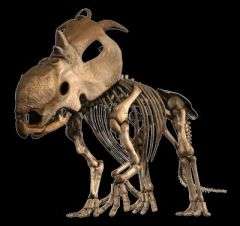
A 3-D computer rendering of the skeleton of Pachyrhinosaur lakustai. Credit: Pipestone Creek Dinosaur Project

The fossils revealed a herd of dinosaurs that perished in a catastrophic event 72.5 million years ago. The animals are characterized by a bony frill on the back of the skull ornamented with smaller horns. They also had large bony structures above their nose and eyes which lends them their name: Pachyrhinosaurus (thick-nosed lizard). These structures probably supported horns of keratin.

According to Dr. Philip Currie, renowned palaeontologist and Canada Research Chair of Dinosaur Palaeobiology from the University of Alberta who was involved in the excavation, Northwest Alberta was not previously known for dinosaur material. It wasn't until the 1970s when Al Lakusta's excavations and studies in the area led the Royal Tyrrell Museum to begin excavation of the bone bed. The naming of the new species, Pachyrhinosaur lakustai , honors Lakusta, now retired Grande Prairie science teacher.

"The density of the Pipestone Creek bonebed is exceptional and surpasses many of Alberta's other ceratopsian bonebed sites. The preservation of the material is outstanding and was easy to collect. The number of bones, from all age groups, made complex investigations possible regarding behaviour and growth patterns."

The site contains fossils from young and old individuals, allowing researchers to describe individual variations and growth patterns, investigate the possibility of sexual dimorphism, and hypothesize on a herding lifestyle.

With this new species, added Currie, researchers will now have more data to give us a better understanding of the ancient life and ecosystems in northwestern Alberta 73 million years ago.

Currie, along with Wann Langston, Jr., and Darren H. Tanke, has published a monograph entitled "A New Horned Dinosaur from an Upper Cretaceous Bone Bed in Alberta", published by NRC Press.

According to Jack O'Toole, Chair of the Pipestone Creek Dinosaur Project, Currie's research and publication puts the region on centre stage in the scientific community.

"Ongoing cooperation between Grande Prairie Regional College, the Royal Tyrrell Museum and the University of Alberta has uncovered many additional sites and fossils in our region," he explains. "Thanks to continued research, we now have a better understanding of the geology of the area as well. The communities of northwestern Alberta are excited to have such a unique resource. "

The Pipestone Creek Dinosaur Project is developing these resources as the northern part of an overall provincial network of palaeontological sites, to present them as a world-class tourism, education, and research centre that benefits local communities, the Province and Canada.

Andrew Neuman, Executive Director of the Royal Tyrrell Museum of Palaeontology, explained the importance of the site. "The excavations at Pipestone Creek provide us with many rewards. Working on a previously unknown site that is abundant in dinosaur material shows how rich the entire province of Alberta is in palaeontological resources."

Source: University of Alberta


print this article email this article download pdf blog this article bookmark this article     Stumble it Digg this share on Facebook retweet share on Reddit add to delicious
Rate this story - 4.2 /5 (13 votes)


October 2, 2008 all stories

Comments: 0

4.2 /5 (13 votes)
  • Stumble this up

  • Digg this

  • share this

  • hide
  • Related Stories

  • Researcher wants to tip the scales for northern lizard
    created Nov 16, 2009 | popularity not rated yet | comments 0
  • A misplaced dinosaur tooth may have been cannibalism
    created Oct 05, 2009 | popularity not rated yet | comments 0
  • Scientists find successful way to reduce bat deaths at wind turbines
    created Sep 28, 2009 | popularity not rated yet | comments 0
  • Northern brown bears discovered feeding on whitefish runs
    created Sep 22, 2009 | popularity not rated yet | comments 0
  • Competition may have led to new dinosaur species in Grande Prairie area
    created May 12, 2009 | popularity not rated yet | comments 0


  • hide
  • Relevant PhysicsForums posts

  • Questions about diffusion
    created 5 hours ago
  • Human Leukocyte Antigen (HLA) typing
    created 12 hours ago
  • Breeding program
    created Nov 20, 2009
  • How does a concentration gradient provide energy?
    created Nov 20, 2009
  • More from Physics Forums - Biology

Other News

Museum: Galileo's fingers, tooth are found (AP)

Museum: Galileo's fingers, tooth are found

Other Sciences / Archaeology & Fossils

created 23 hours ago | popularity 4 / 5 (1) | comments 6

(AP) -- Two fingers and a tooth removed from Galileo Galilei's corpse in a Florentine basilica in the 18th century and given up for lost have been found again and will soon be put on display, an Italian museum ...


Measure to change U. of Neb. stem-cell rule fails (AP)

Measure to change U. of Neb. stem-cell rule fails (Update 2)

Other Sciences / Other

created 23 hours ago | popularity 5 / 5 (1) | comments 0

(AP) -- The University of Nebraska's governing board on Friday voted not to place tighter restrictions on embryonic stem cell research than those outlined under federal guidelines, which were expanded after ...


Researcher: Faint writing seen on Shroud of Turin (AP)

Researcher: Faint writing seen on Shroud of Turin (Update)

Other Sciences / Archaeology & Fossils

created Nov 20, 2009 | popularity 2 / 5 (24) | comments 23

(AP) -- A Vatican researcher has rekindled the age-old debate over the Shroud of Turin, saying that faint writing on the linen proves it was the burial cloth of Jesus. Experts say the historian may be reading ...


Three of a kind

Three of a kind: Revealing language’s universal essence

Other Sciences / Social Sciences

created Nov 20, 2009 | popularity 3.9 / 5 (11) | comments 6

(PhysOrg.com) -- On the surface, English, Japanese, and Kinande, a member of the Bantu family of languages spoken in the Democratic Republic of Congo, have little in common. It is not just that the vocabularies ...


Maya

New insights into the life of the Maya

Other Sciences / Archaeology & Fossils

created Nov 16, 2009 | popularity 4.6 / 5 (15) | comments 7

(PhysOrg.com) -- Ancient artifacts are almost always concerned with rich and powerful religious and political leaders, but new excavations of an ancient Maya site have unearthed a pyramid decorated with murals ...