First atomic–scale compositional images of fuel-cell nanoparticles
October 2nd, 2008 By Elizabeth Thomson First atomic–scale compositional images of fuel-cell nanoparticles

Enlarge

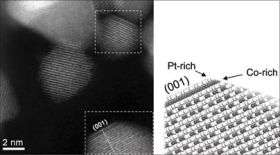
Left image highlights two platinum-cobalt catalyst nanoparticles (inside the dashed boxes) with a 'sandwich' structure of platinum and cobalt atoms near the surface. At right is a cross-sectional model corresponding to the lower particle, showing platinum atoms enriched in the outermost layer, cobalt enriched in the second, and additional layers containing a mixture of the two. (Image at left taken at Oak Ridge National Laboratory.) Image courtesy / Electrochemical Energy Laboratory at MIT

(PhysOrg.com) -- In a step toward developing better fuel cells for electric cars and more, engineers at MIT and two other institutions have taken the first images of individual atoms on and near the surface of nanoparticles key to the eco-friendly energy storage devices.

Nanoparticles made of platinum and cobalt are known to catalyze some of the chemical reactions behind fuel cells, making those reactions run up to four times faster than if platinum alone is used as the catalyst.

No one, however, understands exactly why. That’s because “little is known about the nanoparticles’ surface atomic structure and chemistry,” which are key to the particles’ activity, said Yang Shao-Horn, an associate professor in the Department of Mechanical Engineering and Department of Materials Science and Engineering and director of the Electrochemical Energy Laboratory at MIT.

Using a new technique known as aberration-corrected Scanning Transmission Electron Microscopy, Shao-Horn’s team, in collaboration with Professor Paulo Ferreira of the University of Texas at Austin and Dr. Larry Allard of Oak Ridge National Laboratory, identified specific atomic structures near the surface of such a catalyst. That information in hand, the researchers propose a theory for why the material is so active. Perhaps most importantly, “knowing the surface composition will help us design even better catalysts,” Shao-Horn said.

The work was reported in the Sept. 24 online issue of the Journal of the American Chemical Society.

The researchers analyzed platinum and cobalt nanoparticles that were either treated with acid, or treated with acid then subjected to high heat. Nanoparticles produced both ways are known to be more active than platinum alone. Shao-Horn and colleagues found that each, in turn, also had slightly different surface structures.

For example, in the nanoparticles subjected to heat treatments, the platinum and cobalt atoms formed a “sandwich-like” structure. Platinum atoms covered most of the surface, while the next layer down was composed primarily of cobalt. Successive layers contained mixtures of the two.

The team proposes that these particular nanoparticles are up to four times more active than platinum alone because the platinum atoms on the surface are constrained by the cobalt atoms underneath. “This modifies the interatomic distances between the platinum atoms on the nanoparticle surface,” making them more effective in chemical reactions key to fuel cells, Shao-Horn said.

She further noted that “this work bridges the gap between our understanding of electrocatalysis in bulk materials and at the nano-scale.”

In addition to Shao-Horn, Allard, and Ferreira, who is also an MIT research affiliate, other members of the research team are Shuo Chen, first author of the paper and a postdoctoral associate in mechanical engineering; Wenchao Sheng, a graduate student in chemistry; and Naoaki Yabuuchi, a research affiliate in mechanical engineering.

The Department of Energy and the National Science Foundation, through its Materials Research Science and Engineering Center program, funded the work.

Provided by MIT


print this article email this article download pdf blog this article bookmark this article     Digg this Stumble it share on Facebook share on Reddit add to delicious save to Yahoo! bookmarks
4.6/5 after 12 votes


October 2nd, 2008 all stories
Nanotechnology / Nanomaterials

Comments: 0
Rank: 4.6/5 after 12 votes

  • Stumble this up

  • Digg this

  • Share it:
  • share on Facebook
  • share on MySpace
  • share on Slashdot
  • rss-newsfeed
  • share on Google
  • share on Reddit
  • add to delicious
  • save to Yahoo! bookmarks
  • share on Windows Live
  • Add to Mixx!
Rating: 4.6/5 after 12 votes

  • Related Stories

  • One Sponge-Like Material, Three Different Applications
    created May 26, 2009 | popularity not rated yet | comments 0
  • One sponge-like material, three different applications
    created May 17, 2009 | popularity not rated yet | comments 0
  • Going platinum: New catalyst could boost cleaner fuel use
    created May 14, 2009 | popularity not rated yet | comments 0
  • World's smallest periscopes
    created Feb 25, 2009 | popularity not rated yet | comments 0
  • Natural Oils Can Be Hydrogenated Without Making Unhealthy Trans Fats
    created Jan 23, 2009 | popularity not rated yet | comments 0


  • Transform a ball into a rock -- or make it invisible -- using transformation optics
    Transform a ball into a rock -- or make it invisible -- using transformation optics
    Physics / General Physics
    created 9 hours ago | popularity 3 / 5 (2) | comments 0
  • Could a quantum motor do work?
    Physics / General Physics
    created Jul 07, 2009 | popularity 4 / 5 (12) | comments 0
  • Physicists Demonstrate Quantum Memory with Matter Qubits
    Physicists Demonstrate Quantum Memory with Matter Qubits
    Physics / General Physics
    created Jul 03, 2009 | popularity 4.5 / 5 (20) | comments 1
  • 'Holey' Nanosheets for Wastewater Dye Removal
    Nanotechnology / Nanomaterials
    created Jul 01, 2009 | popularity 5 / 5 (5) | comments 1
  • Jellyfish Robot Swims Like its Biological Counterpart
    Jellyfish Robot Swims Like its Biological Counterpart
    Electronics / Robotics
    created Jun 26, 2009 | popularity 4.4 / 5 (9) | comments 1
  • Other News

    Nanopillars promise cheap, efficient, flexible solar cells

    Nanopillars Promise Cheap, Efficient, Flexible Solar Cells

    Nanotechnology / Nanomaterials

    created 2 hours ago | popularity 4.3 / 5 (3) | comments 1

    (PhysOrg.com) -- Researchers at the U.S. Department of Energy's Lawrence Berkeley National Laboratory and the University of California at Berkeley have demonstrated a way to fabricate efficient solar cells ...


    Material world: Graphene's versatility promises new applications

    Graphene's versatility promises new applications

    Nanotechnology / Nanomaterials

    created 7 hours ago | popularity 5 / 5 (2) | comments 1

    Since its discovery just a few years ago, graphene has climbed to the top of the heap of new super-materials poised to transform the electronics and nanotechnology landscape. As N.J. Tao, a researcher at the ...


    Light-absorbing nanowires may make better solar panels

    Light-absorbing nanowires may make better solar panels

    Nanotechnology / Nanomaterials

    created Jul 07, 2009 | popularity 4.1 / 5 (9) | comments 5

    (PhysOrg.com) -- A century after German physicist Gustav Mie derived the math to explain why the colors in some stained glass windows look especially resplendent in the sunlight, a team of Stanford engineers ...


    Researchers enlist DNA to bring carbon nanotubes' promise closer to reality

    Nanotechnology / Bio & Medicine

    created Jul 08, 2009 | popularity 5 / 5 (1) | comments 1

    A team of researchers from DuPont and Lehigh University has reported a breakthrough in the quest to produce carbon nanotubes (CNTs) that are suitable for use in electronics, medicine and other applications.


    'Flexible camera' replaces lens with fiber web

    'Flexible camera' replaces lens with fiber web

    Nanotechnology / Nanomaterials

    created Jul 07, 2009 | popularity 4.6 / 5 (10) | comments 0

    (PhysOrg.com) -- Imagine a soldier's uniform made of a special fabric that allows him to look in all directions and identify threats that are to his side or even behind him. In work that could turn such science ...