Sharpening up Jupiter
October 2, 2008 Sharpening up Jupiter

Enlarge

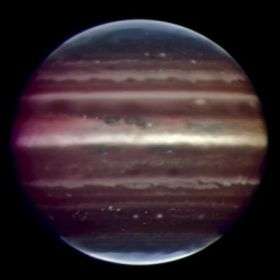
Amazing image of Jupiter taken in infrared light on the night of Aug. 17, 2008, with the Multi-Conjugate Adaptive Optics Demonstrator prototype instrument mounted on ESO's Very Large Telescope. This false colour photo is the combination of a series of images taken over a time span of about 20 minutes, through three different filters (2, 2.14, and 2.16 microns). The image sharpening obtained is about 90 milli-arcseconds across the whole planetary disc, a real record on similar images taken from the ground. This corresponds to seeing details about 300 km wide on the surface of the giant planet. The great red spot is not visible in this image as it was on the other side of the planet during the observations. The observations were done at infrared wavelengths where absorption due to hydrogen and methane is strong. This explains why the colours are different from how we usually see Jupiter in visible-light. This absorption means that light can be reflected back only from high-altitude hazes, and not from deeper clouds. These hazes lie in the very stable upper part of Jupiter's troposphere, where pressures are between 0.15 and 0.3 bar. Mixing is weak within this stable region, so tiny haze particles can survive for days to years, depending on their size and fall speed. Additionally, near the planet's poles, a higher stratospheric haze (light blue regions) is generated by interactions with particles trapped in Jupiter's intense magnetic field. Credit: ESO/F. Marchis, M. Wong, E. Marchetti, P. Amico, S. Tordo

A record two-hour observation of Jupiter using a superior technique to remove atmospheric blur has produced the sharpest whole-planet picture ever taken from the ground. The series of 265 snapshots obtained with the Multi-Conjugate Adaptive Optics Demonstrator (MAD) prototype instrument mounted on ESO's Very Large Telescope (VLT) reveal changes in Jupiter's smog-like haze, probably in response to a planet-wide upheaval more than a year ago.

Being able to correct wide field images for atmospheric distortions has been the dream of scientists and engineers for decades. The new images of Jupiter prove the value of the advanced technology used by MAD, which uses two or more guide stars instead of one as references to remove the blur caused by atmospheric turbulence over a field of view thirty times larger than existing techniques.

"This type of adaptive optics has a big advantage for looking at large objects, such as planets, star clusters or nebulae," says lead researcher Franck Marchis, from UC Berkeley and the SETI Institute in Mountain View, California, USA. "While regular adaptive optics provides excellent correction in a small field of view, MAD provides good correction over a larger area of sky. And in fact, were it not for MAD, we would not have been able to perform these amazing observations."

MAD allowed the researchers to observe Jupiter for almost two hours on 16 and 17 August 2008, a record duration, according to the observing team. Conventional adaptive optics systems using a single Jupiter moon as reference cannot monitor Jupiter for so long because the moon moves too far from the planet. The Hubble Space Telescope cannot observe Jupiter continuously for more than about 50 minutes, because its view is regularly blocked by the Earth during Hubble's 96-minute orbit.

Using MAD, ESO astronomer Paola Amico, MAD project manager Enrico Marchetti and Sébastien Tordo from the MAD team tracked two of Jupiter's largest moons, Europa and Io – one on each side of the planet – to provide a good correction across the full disc of the planet. "It was the most challenging observation we performed with MAD, because we had to track with high accuracy two moons moving at different speeds, while simultaneously chasing Jupiter," says Marchetti.

With this unique series of images, the team found a major alteration in the brightness of the equatorial haze, which lies in a 16 000-kilometre wide belt over Jupiter's equator. More sunlight reflecting off upper atmospheric haze means that the amount of haze has increased, or that it has moved up to higher altitudes. "The brightest portion had shifted south by more than 6000 kilometres," explains team member Mike Wong.

This conclusion came after comparison with images taken in 2005 by Wong and colleague Imke de Pater using the Hubble Space Telescope. The Hubble images, taken at infrared wavelengths very close to those used for the VLT study, show more haze in the northern half of the bright Equatorial Zone, while the 2008 VLT images show a clear shift to the south.

"The change we see in the haze could be related to big changes in cloud patterns associated with last year's planet-wide upheaval, but we need to look at more data to narrow down precisely when the changes occurred," declares Wong.

Source: ESO


print this article email this article download pdf blog this article bookmark this article     Stumble it Digg this share on Facebook retweet share on Reddit add to delicious
Rate this story - 5 /5 (9 votes)


October 2, 2008 all stories

Comments: 0

5 /5 (9 votes)
  • Stumble this up

  • Digg this

  • share this

  • hide
  • Related Stories

  • Cosmic 'Dig' Reveals Vestiges of the Milky Way's Building Blocks
    created Nov 25, 2009 | popularity not rated yet | comments 0
  • Atomic-level Snapshot Catches Protein Motor in Action (w/ Video)
    created Nov 20, 2009 | popularity not rated yet | comments 0
  • Researchers find new piece of BSE puzzle
    created Nov 20, 2009 | popularity not rated yet | comments 0
  • The protein Srebp2 drives cholesterol formation in prion-infected neuronal cells
    created Nov 18, 2009 | popularity not rated yet | comments 0
  • Kan., Okla. conduct joint livestock disease drill
    created Oct 23, 2009 | popularity not rated yet | comments 0


  • hide
  • Relevant PhysicsForums posts

  • Some help with a X-Ray astronomy question please!
    created 18 hours ago
  • Help with Images and Optical Instrument Question..
    created Nov 26, 2009
  • Redshift as a distance indicator
    created Nov 26, 2009
  • Question about 2-body gravity
    created Nov 24, 2009
  • More from Physics Forums - General Astronomy

Other News

Fermi Telescope Peers Deep into Microquasar

Fermi Telescope Peers Deep into Microquasar (w/ Video)

Space & Earth / Astronomy

created 12 hours ago | popularity 4.5 / 5 (6) | comments 0

(PhysOrg.com) -- NASA's Fermi Gamma-ray Space Telescope has made the first unambiguous detection of high-energy gamma-rays from an enigmatic binary system known as Cygnus X-3. The system pairs a hot, massive ...


The Energy Sources of Ultraluminous Galaxies

The Energy Sources of Ultraluminous Galaxies

Space & Earth / Astronomy

created 12 hours ago | popularity 4.4 / 5 (10) | comments 1

(PhysOrg.com) -- Ultraluminous infrared galaxies ((ULIRGs) are galaxies whose luminosity exceeds that of a trillion suns; for comparison, the Milky Way galaxy has a typical (and much more modest) luminosity ...


Space shuttle Atlantis, 7 astronauts back on Earth (AP)

Space shuttle Atlantis, 7 astronauts back on Earth

Space & Earth / Space Exploration

created 13 hours ago | popularity not rated yet | comments 0

(AP) -- Space shuttle Atlantis and its seven astronauts returned to Earth with a smooth touchdown Friday to end an 11-day flight that resupplied the International Space Station.


New climate targets may not change daily life much (AP)

New climate targets may not change daily life much

Space & Earth / Environment

created 16 hours ago | popularity 3.8 / 5 (10) | comments 3

(AP) -- Americans' day-to-day lives won't change noticeably if President Barack Obama achieves his newly announced goal of slashing carbon dioxide pollution by one-sixth in the next decade, experts say.


China is set to launch its second moon orbiter next October, state media have reported

China to launch second lunar probe: state media

Space & Earth / Space Exploration

created 17 hours ago | popularity 5 / 5 (4) | comments 0

China will launch its second moon orbiter next October, state media reported Friday, as it powers ahead with a space programme that has sparked concerns abroad.