Biochemists devise method for bypassing aluminum toxicity effects in plants
October 2, 2008
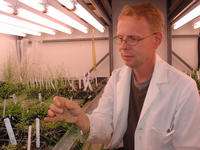
Paul Larsen, an associate professor of biochemistry at UC Riverside, examines an Arabidopsis plant. Photo: UCR Strategic Communications
(PhysOrg.com) -- Aluminum toxicity, a global agricultural problem, halts root growth in plants, severely limiting agricultural productivity for more than half of the world's arable land.
For many years, scientists have puzzled over how toxic levels of aluminum damage the growing root. The popular understanding is that aluminum binds to several targets in the root system, blocking cell division, damaging DNA, and ultimately interrupting plant growth.
Now, working on the model plant Arabidopsis, a team of UC Riverside biochemists has determined that it is not aluminum toxicity that is directly responsible for inhibiting plant growth. The researchers identified a factor in plant cells, called AtATR, that functions as a built-in DNA surveillance system for alerting the plant of damage from excess aluminum and shutting down growth.
The researchers' experiments showed that AtATR can be manipulated to greatly enhance aluminum tolerance, resulting in plants whose roots can grow normally in soils that contain toxic levels of aluminum.
Study results appear in the Oct. 14 issue of Current Biology.
"Plants actively monitor aluminum-dependent damage through AtATR," said Paul Larsen, an associate professor of biochemistry and the lead author of the study. "But by breaking this assessment mechanism in a plant growing in soil with high aluminum content, we were able to stimulate plant growth again because the plant was no longer able to sense the damage aluminum caused. In other words, by bypassing this growth checkpoint, plants are not able to sense the effects of aluminum; they continue to grow even in an aluminum-toxic environment that is highly inhibitory to a normal Arabidopsis plant."
The research, which gives scientists new insights into how aluminum tolerance works in plants, offers a new strategy for engineering crop plants that can tolerate growth in aluminum-toxic environments, increasing crop production in areas that otherwise could not sustain agriculture.
"Dr. Larsen's work is a significant breakthrough in our understanding of how aluminum toxicity inhibits root growth," said Leon Kochian, a professor of plant biology at Cornell University, who was not involved in the research. "What he has shown, using an elegant combination of genetics, molecular biology and physiology, is that aluminum causes DNA damage in the growing root tip. The cells of this region have a mechanism to monitor this damage and shut down cell division and thus, root growth."
Larsen explained that a root tip has a "quiescent center" that houses stem cells – master cells, maintained throughout the life of the root, that develop into cell types and tissues. Aluminum toxicity results in the loss of these stem cells, and consequently cell division, bringing growth to a halt.
"Knocking off AtATR's functioning maintains the quiescent center," said Larsen, who joined UCR's Department of Biochemistry in 2000. "In our study, we broke AtATR throughout the plant. But if we can break this factor only in the root tip, the plant will not sense aluminum's damage to the root. The root then continues to grow and we regain productivity."
The researchers' experiments involved introducing random mutations throughout the genome of Arabidopsis and screening for those roots that can grow in the presence of high levels of aluminum.
A silvery-white metal, aluminum is the most abundant metallic element in the Earth's crust. Never found in the metallic form in nature, it occurs instead in compounds.
Next, Larsen's lab will work on identifying other factors in plants that detect DNA damage. His lab also plans to induce the AtATR mutation into crop plants such as tomato and corn to increase their aluminum tolerance.
Provided by University of California - Riverside
-
Planet Earth's playhouse
Dec 13, 2010 |
4 / 5 (5) |
1
-
Tannins' surprising benefits for soils, forests and farms
Nov 18, 2010 |
not rated yet |
0
-
Cloned sorghum is aluminum tolerant
Feb 23, 2010 |
3.7 / 5 (3) |
0
-
Controlling cucumber beetles organically
Feb 17, 2009 |
5 / 5 (1) |
0
-
Nanoparticle impact on plants
Dec 08, 2005 |
4.2 / 5 (10) |
0
-
Engineers build first sub-10-nm carbon nanotube transistor
Feb 01, 2012 |
4.9 / 5 (32) |
30
-
Something old, something new: Evolution and the structural divergence of duplicate genes
Jan 31, 2012 |
4.6 / 5 (7) |
1
-
The hidden nanoworld of ice crystals: Revealing the dynamic behavior of quasi-liquid layers
Jan 30, 2012 |
5 / 5 (4) |
1
-
Stock market network reveals investor clustering
Jan 27, 2012 |
3.9 / 5 (23) |
8
-
Of microchemistry and molecules: Electronic microfluidic device synthesizes biocompatible probes
Jan 26, 2012 |
5 / 5 (2) |
0
More news stories
A mitosis mystery solved: How chromosomes align perfectly in a dividing cell
Although the process of mitotic cell division has been studied intensely for more than 50 years, Whitehead Institute researchers have only now solved the mystery of how cells correctly align their chromosomes during symmetric ...
2 hours ago |
5 / 5 (3) |
0
|
The proteins ensuring genome protection
Researchers from the University of Geneva (UNIGE), Switzerland, have discovered the crucial role of two proteins in developing a cell 'anti-enzyme shield'. This protection system, which operates at the level of molecular ...
2 hours ago |
5 / 5 (2) |
0
|
Researchers find extensive RNA editing in human transcriptome
In a new study published online in Nature Biotechnology, researchers from BGI, the world's largest genomics organization, reported the evidence of extensive RNA editing in a human cell line by analysis of RNA-seq data, demons ...
2 hours ago |
5 / 5 (3) |
0
|
Entire genome of extinct human decoded from fossil
(PhysOrg.com) -- In 2010, Svante Pääbo and his colleagues presented a draft version of the genome from a small fragment of a human finger bone discovered in Denisova Cave in southern Siberia. The ...
Feb 07, 2012 |
4.7 / 5 (58) |
48
|
Why are there so few fish in the Earth's oceans?
(PhysOrg.com) -- A Stony Brook University researcher has found that, contrary to popular belief, there are not plenty of fish in the sea.
Feb 08, 2012 |
4.3 / 5 (17) |
27
|
Scientists discover molecular secrets of 2,000-year-old Chinese herbal remedy
For roughly two thousand years, Chinese herbalists have treated Malaria using a root extract, commonly known as Chang Shan, from a type of hydrangea that grows in Tibet and Nepal. More recent studies suggest that halofuginone, ...
New method to examine batteries -- MRI from the inside
There is an ever-increasing need for advanced batteries for portable electronics, such as phones, cameras, and music players, but also to power electric vehicles and to facilitate the distribution and storage of energy derived ...
Google might launch Drive for cloud storage soon
(PhysOrg.com) -- Google's next big move, according to the Wall Street Journal, is a cloud storage service called Drive. Hardly first to the plate, Google is simply catching up to introducing its cloud reposi ...
Lab study raises questions over nano-particle impact
Tests involving chickens have raised questions about the impact on health from engineered nano-particles, the ultra-fine grains commonly used in drugs and processed foods, scientists said on Sunday.
Starve a virus, feed a cure? Findings show how some cells protect themselves against HIV
A protein that protects some of our immune cells from the most common and virulent form of HIV works by starving the virus of the molecular building blocks that it needs to replicate, according to research published online ...
Injured boomers beware: Know when to see doctor
(AP) -- It happened to nurse Jane Byron years after an in-line skating fall, business owner Haralee Weintraub while doing "men's" push-ups, and avid cyclist Gene Wilberg while lifting a heavy box.
Oct 02, 2008
Rank: not rated yet
Oct 03, 2008
Rank: not rated yet