Nanodiamond drug device could transform cancer treatment
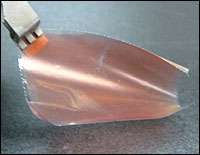
A Northwestern University research team has developed a promising nanomaterial-based biomedical device that could be used to deliver chemotherapy drugs locally to sites where cancerous tumors have been surgically removed.
The flexible microfilm device, which resembles a piece of plastic wrap and can be customized easily into different shapes, has the potential to transform conventional treatment strategies and reduce patients' unnecessary exposure to toxic drugs. The device takes advantage of nanodiamonds, an emergent technology, for sustained drug release.
The researchers demonstrated that the device releases the chemotherapy agent Doxorubicin in a sustained and consistent manner -- a requirement of any implanted device for localized chemotherapy. The results of the study are published online today (Oct. 2) by the journal ACS Nano.
"The thin device -- a sort of blanket or patch -- could be used to treat a localized region where residual cancer cells might remain after a tumor is removed," said Dean Ho, assistant professor of biomedical engineering and mechanical engineering at Northwestern's McCormick School of Engineering and Applied Science, who led the research.
If a surgical oncologist, for example, was removing a tumor from the breast or brain, the device could be implanted in the affected area as part of the same surgery. This approach, which confines drug release to a specific location, could mitigate side effects and complications from other chemotherapy treatments.
"Several surgeons at Northwestern's Feinberg School of Medicine, as well as other medical schools and hospitals, are very interested in the device because it is biocompatible and provides such stable and consistent drug release," said Ho, a member of the Robert H. Lurie Comprehensive Cancer Center of Northwestern University.
In their study, Ho and his colleagues embedded millions of tiny drug-carrying nanodiamonds in the FDA-approved polymer parylene. Currently used as a coating for implants, the biostable parylene is a flexible and versatile material resembling plastic wrap. A substantial amount of drug can be loaded onto clusters of nanodiamonds, which have a high surface area. The nanodiamonds then are put between extremely thin films of parylene, resulting in a device that is minimally invasive.
To test the device's drug release performance, the researchers used Doxorubicin, a chemotherapeutic used to treat many types of cancer. They found the drug slowly and consistently released from the embedded nanodiamond clusters for one month, with more Doxorubicin in reserve, indicating a more prolonged release (several months and longer) was possible. The device also avoided the "burst" or massive initial release of the drug, a common disadvantage with conventional therapy.
In control experiments, where the drug was present but without the nanodiamonds, virtually all of the drug was released within one day. By adding the drug-laden nanodiamonds to the device, drug release was instantly lengthened to the months-long timescale.
In addition to their large surface area, nanodiamonds have many other advantages that can be utilized in drug delivery. They can be functionalized with nearly any type of therapeutic. They can be suspended easily in water, which is important for biomedical applications. The nanodiamonds, each being four to six nanometers in diameter, are minimally invasive to cells, biocompatible and do not cause inflammation, a serious complication. And they are very scalable and can be produced in large quantities.
The architecture of the device is amenable to housing small molecule, protein, antibody or RNA- or DNA-based therapeutics. This gives the technology the potential to impact a range of treatment strategies where implanted, long-term drug release is needed.
Ho and his research group previously pioneered the application of nanodiamonds for systemic drug-carrying applications. This new work successfully transitions the nanodiamonds from basic materials to serving as a foundation for device manufacturing.
To build the biomedical device, the researchers developed a streamlined approach where a double layer of parylene was fabricated, with the nanodiamond-drug complexes sandwiched in between. The bottom layer, approximately 20 to 30 microns thick, serves as the backbone of the device, allowing it to be easily handled. For the top layer, the research team created a thinner semi-porous film that allows the drug to slowly release from the device.
"One of the most significant aspects of this work is that the fabrication procedures are highly scalable, meaning hundreds, or even thousands, of devices potentially could be manufactured in parallel and at low cost," said Ho.
"The nanodiamonds are quite economical and have already been mass-produced as lubrication components for automobiles and for use in electronics," added Robert Lam, a graduate student in Ho's research group and the article's lead author.
In the area of localized chemotherapy, the team hopes that this technology will bring new levels of treatment efficacy that can complement injected chemotherapy to reduce dosages and decrease devastating side effects.
Because of the proven biocompatibility and massively parallel deposition capabilities of parylene, the researchers are engaged with pre-clinical trials of the nanodiamond-embedded parylene.
Journal: pubs.acs.org/journals/ancac3/index.html
Source: Northwestern University


